Learning how to play Spanish 21 is easy for anyone who already knows blackjack. The goal is the same: beat the dealer with a hand as close to 21 as possible without going over. The difference is the deck. Spanish 21 is dealt from 48-card decks with all four 10-spot cards removed, and the casino makes up for the missing 10s with player-friendly rules and bonus payouts that regular blackjack does not have.
A player 21 always wins, even against a dealer 21. You can double down on any number of cards and take back part of the bet after doubling with Double Down Rescue. Five-card, six-card and seven-card 21s pay up to 3:1, and a suited 7-7-7 against a dealer 7 pays a Super Bonus of $1,000 or $5,000. With correct basic strategy the house edge is about 0.40% at tables where the dealer stands on soft 17. This guide covers the rules, payouts, side bets, house edge, strategy and table tips, followed by a short FAQ.
Spanish 21 at a Glance
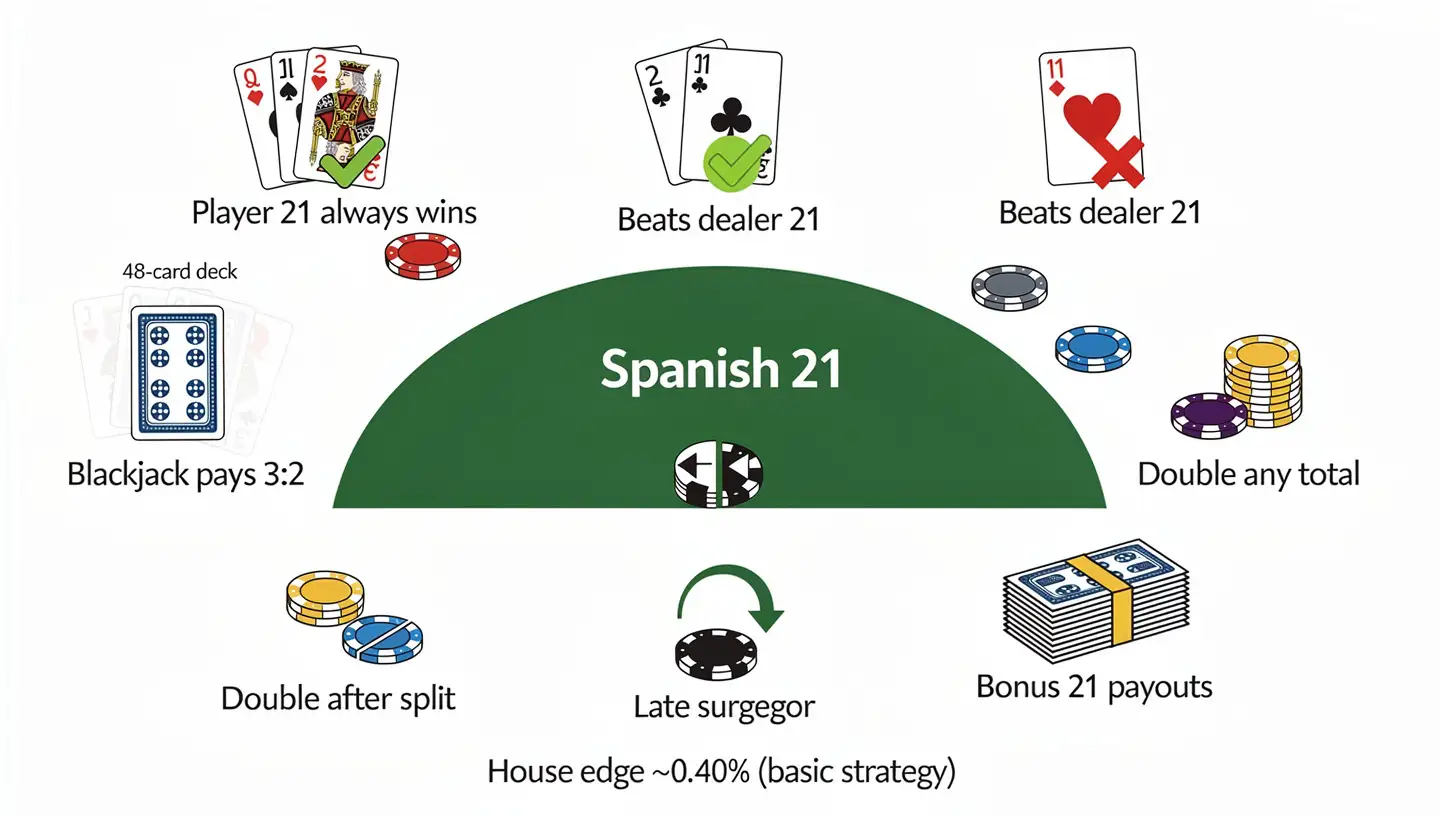
The table below sums up Spanish 21 before the details. Every row is explained in the sections that follow.
| Feature | Spanish 21 |
|---|---|
| Deck | 48 cards, four 10-spot cards removed, six or eight decks |
| Player 21 | Always wins, even against a dealer 21 |
| Player blackjack | Beats a dealer blackjack and pays 3:2 |
| Doubling | Any total, any number of cards, also after a split |
| Double Down Rescue | Yes, you take back the doubled portion |
| Late surrender | Yes, half of the bet comes back |
| Bonus payouts | Up to 3:1 on multi-card 21s, plus the Super Bonus |
| House edge | About 0.40% with basic strategy and S17 |
| Side bets to skip | Match the Dealer and Insurance |
A blackjack player can pick up the Spanish 21 rules in a few minutes. The Spanish 21 strategy chart is the part that takes practice, and it is where most of the value of the game sits.
What Is Spanish 21?
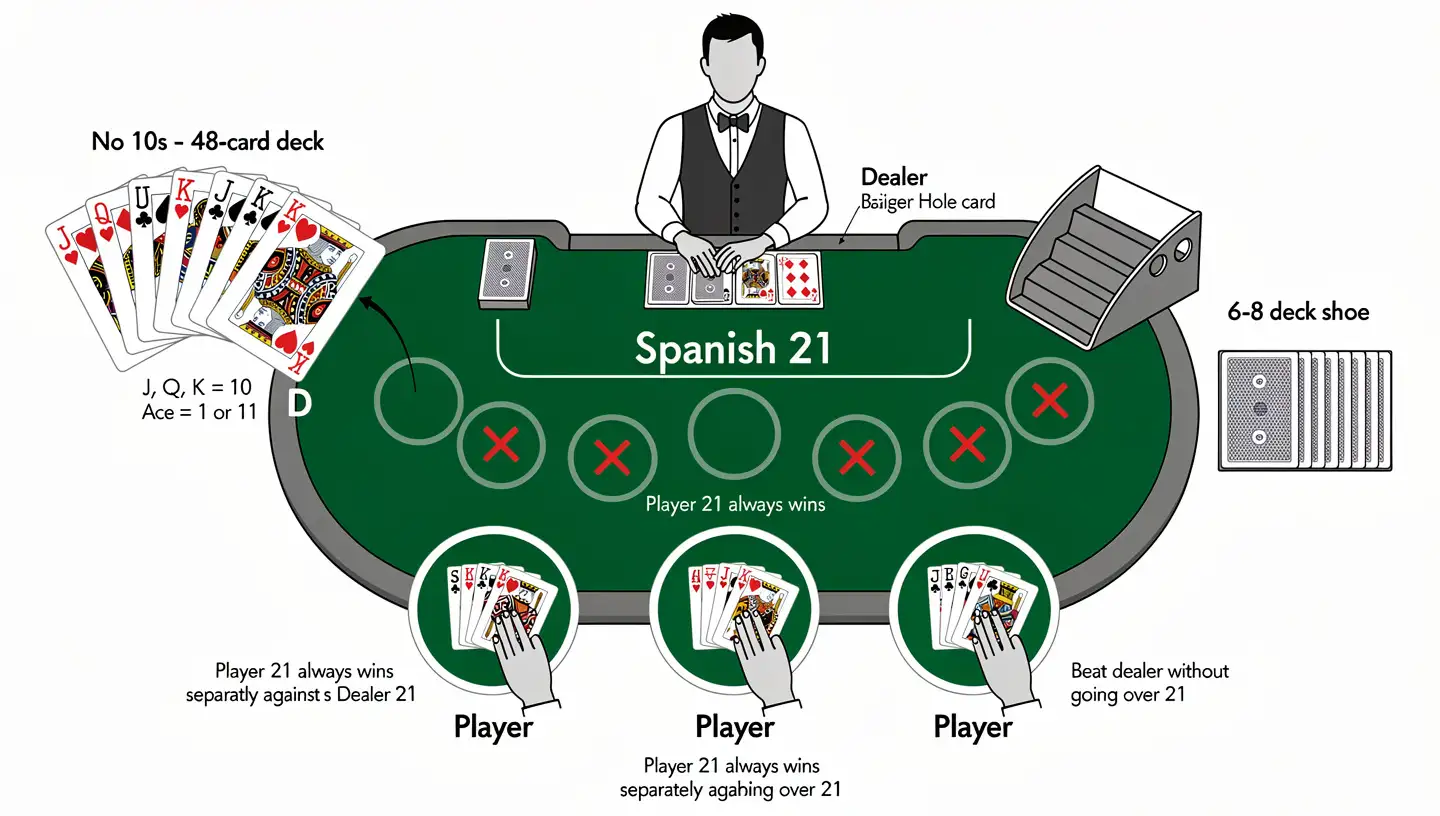
Spanish 21 is a blackjack variant played on a table with a custom layout. The dealer takes a hole card, and each player plays a separate hand against the dealer.
How Spanish 21 Started
Spanish 21 is owned by Masque Publishing, a gaming company based in Colorado, and it reached casinos in the mid-1990s. Versions that copy the rules without the license go by other names, such as Spanish blackjack, Pirate 21 and Pontoon.
The 48-Card Spanish Deck
Each Spanish deck is a standard 52-card deck with the four 10-spot cards taken out, which leaves 48 cards. Jacks, Queens and Kings stay in and still count as 10. The Ace counts as 1 or 11, and every other card counts at face value. Casinos deal the game from a shoe of six or eight decks. Removing the 10s cuts the share of 10-value cards from 4 in 13 to 3 in 12, or from about 31% to 25%. A natural blackjack becomes harder to hit, and the dealer gains an edge of about 2% before the special rules are counted.
Objective of the Game
The goal in Spanish 21 is to beat the dealer without going over 21, exactly as in the blackjack rules you may already know. You win if your total is higher than the dealer total, if the dealer busts, or if you make 21, since a player 21 wins on the spot.
Spanish 21 Rules
The Spanish 21 rules follow blackjack with a set of changes that favor the player. Each one is a rebate for the missing 10s, and learning them is the main job before you sit down.
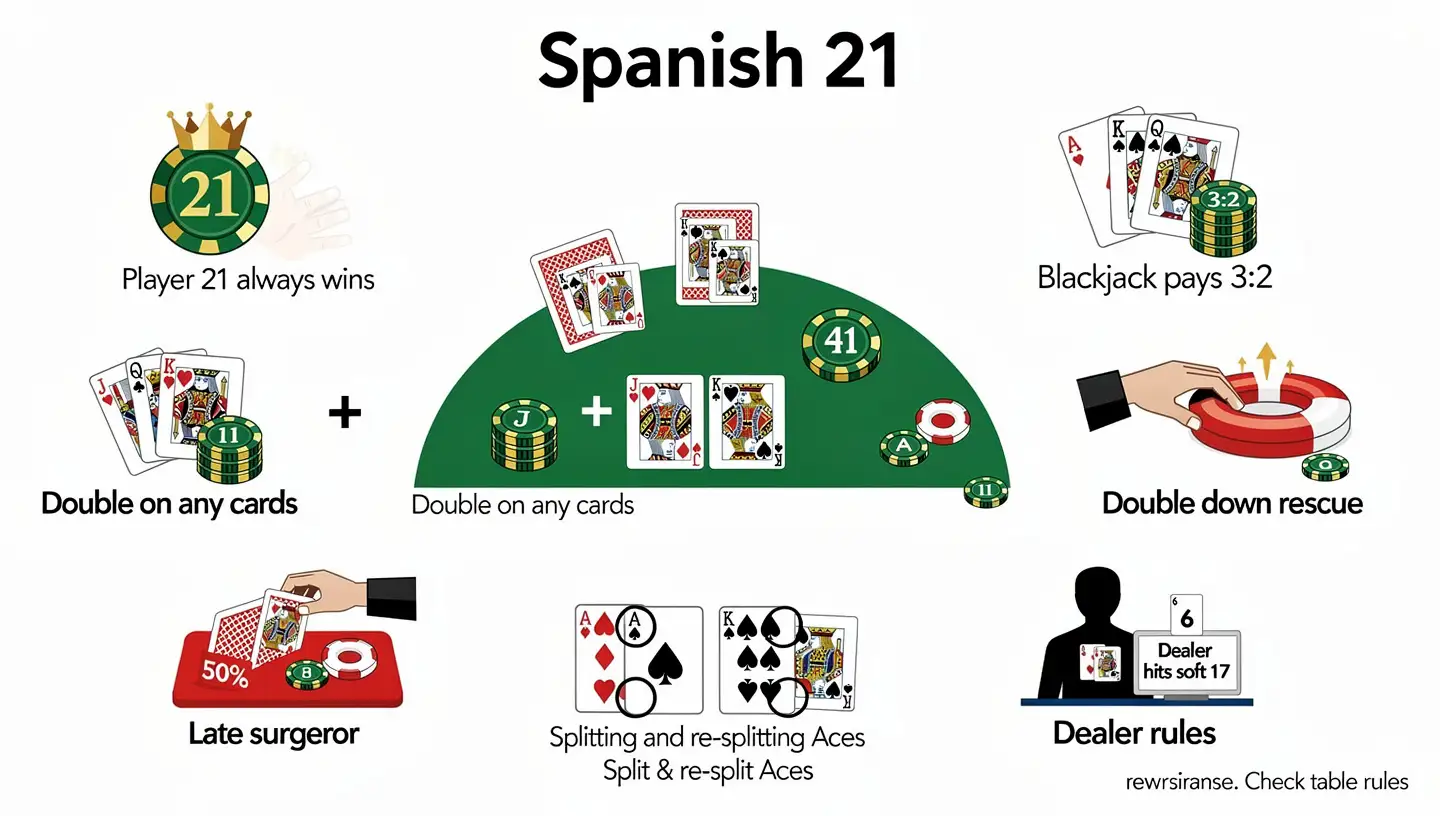
Player 21 Always Wins
Among the Spanish 21 rules, the simplest is that a total of 21 never pushes. If you make 21 and the dealer also has 21, you win. A player blackjack, meaning an Ace and a 10-value card, beats a dealer blackjack and pays 3:2. Most tables pay a 21 as soon as you make it, before the dealer draws another card.
Double Down on Any Number of Cards
Regular blackjack usually limits doubling to the first two cards. In Spanish 21 you can double down on any total and on two or more cards, including after a split. That means a three-card 11 or a four-card 10 can still be doubled. You place a second bet up to the size of the original bet and receive one more card. Some casinos allow redoubling, so read the rules card of the table.
Double Down Rescue
Double Down Rescue is the rule that sets the game apart. After you double and see the card, you may give up the hand if you do not like the total. The dealer takes the original bet and you keep the doubled portion. For example, you bet $10 on a hard 11 and double with another $10, then draw a 2 for a total of 13 against a dealer 10. You can rescue the extra $10 and lose only the original $10, instead of risking $20 on a weak hand. A busted hand cannot be rescued. The rule works as a safety net, which is why the chart tells you to double more often than in blackjack.
Late Surrender
Late surrender lets you give up a hand for half of the bet. You can use it on your first two cards, and only after the dealer has checked for blackjack, so you never surrender into a dealer blackjack. Some charts call for surrender with a hard 17 or a pair of 8s against a dealer Ace, and rarely anywhere else. New players tend to surrender too often.
Splitting and Re-Splitting Aces
You may split any pair into separate hands, up to four hands in total at most casinos, and this includes Aces. After splitting Aces you can hit, re-split when you draw another Ace and double down. The number of splits differs by casino, so read the layout of the table. At most tables a 21 made after a split counts as a 21 but not as a blackjack, so it does not pay 3:2.
Dealer Peek and Soft 17
The dealer checks the hole card for blackjack when the upcard is an Ace or a 10-value card, before any player acts. If the dealer has blackjack, the round ends and only player blackjacks survive. The dealer hits 16 and stands on hard 17. Some tables hit soft 17 (H17) and others stand (S17). The choice changes the house edge, so look for S17 tables when you can.
Rules That Change From Table to Table
Not every casino uses the same Spanish 21 rules. Before you play, ask about soft 17, redoubling, the number of splits, drawing to split Aces and whether bonuses pay after a split.
How to Play Spanish 21 Step by Step
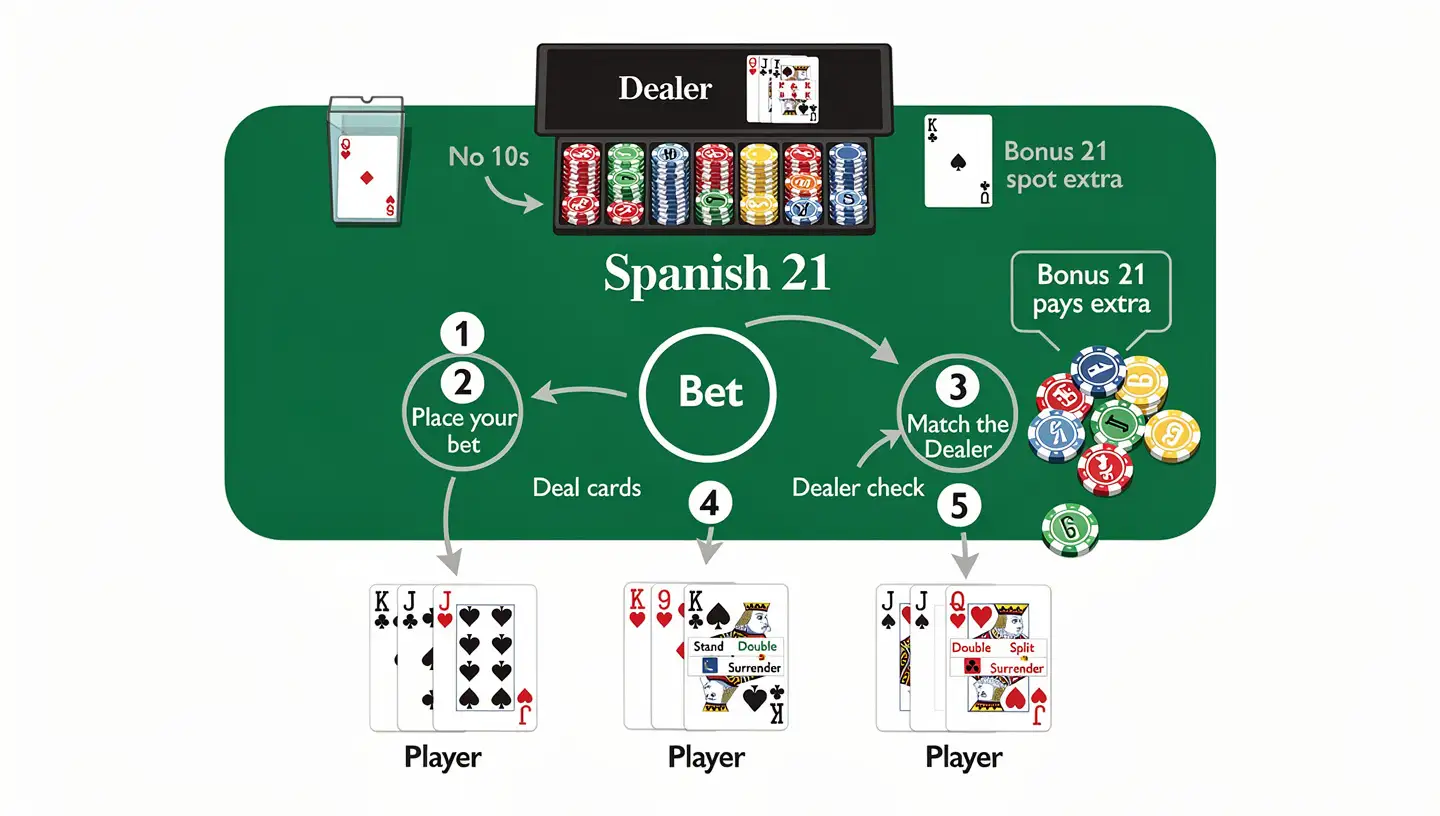
Here is how to play Spanish 21 from the first chip to the payout. The flow of Spanish 21 matches blackjack, and the extra options come after the deal.
- Place your bet. Put your chips in the betting circle. Table minimums usually run from $5 to $25. You may add a Match the Dealer side bet in its own circle.
- Get your cards. Each player receives two cards. The dealer receives one card face up and one face down, the hole card.
- Dealer check. If the dealer upcard is an Ace or a 10-value card, the dealer peeks at the hole card for blackjack.
- Make your decision. You can hit, stand, double down, split or surrender.
- Dealer plays. If you have not busted or made 21, the dealer turns the hole card and hits until reaching 17.
- Payout. A winning hand pays 1:1, a blackjack pays 3:2, and a bonus hand pays as posted on the felt.
Card Values
Cards from 2 to 9 count at face value, and Jack, Queen and King count as 10. The Ace counts as 1 or 11, whichever helps the hand. There are no 10-spot cards in a Spanish 21 shoe.
Player Options: Hit, Stand, Double, Split and Surrender
To hit is to take another card, and you may keep hitting until you reach 21 or bust. To stand is to keep your total. To double down is to double the bet for one more card, with the Rescue option afterward. To split is to turn a pair into two hands, and to surrender is to take back half of the bet. Many players stand too early. With the 10s missing, the risk of busting is lower than in blackjack, so hitting a 13 or 14 is often the correct play.
A Sample Hand From Deal to Payout
You sit down at a Spanish 21 table and bet $10. You are dealt a 2 and a 3, and the dealer shows a 6. You hit and get a 4, hit again and get a 5, for a total of 14 with four cards. On the next hit you draw a 7. That is a five-card 21, and it pays 3:2, so the win is $15 on the $10 bet, whatever the dealer holds. Doubling on any of those cards would have cancelled the bonus.
Spanish 21 Payouts and Bonus Hands
Spanish 21 pays more than blackjack on hands that reach 21 in a special way. These Spanish 21 bonus payouts need no side bet and are paid automatically.
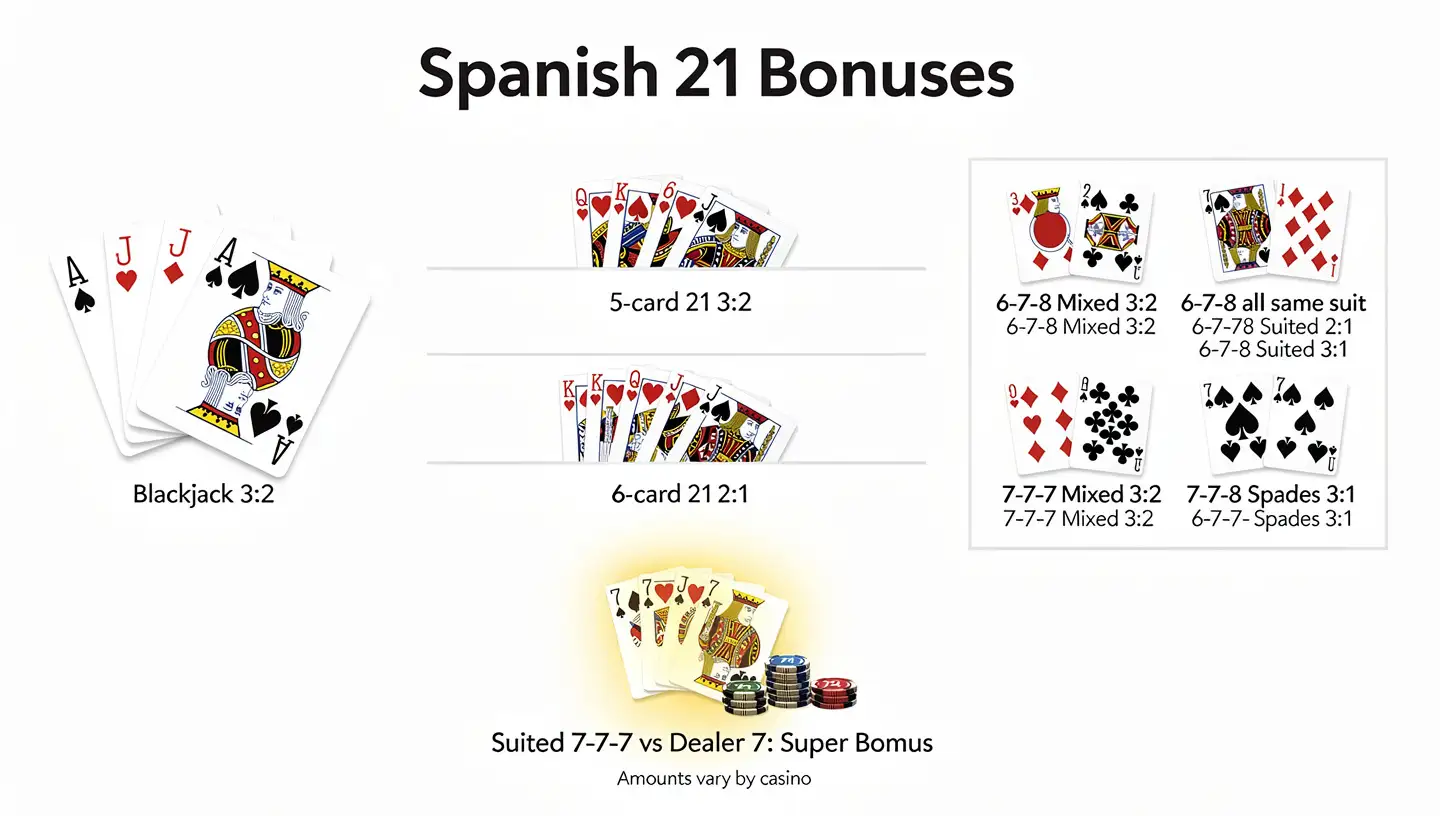
| Hand | Payout |
|---|---|
| Winning hand | 1:1 |
| Blackjack | 3:2 |
| 5-card 21 | 3:2 |
| 6-card 21 | 2:1 |
| 7-card or longer 21 | 3:1 |
| 6-7-8 or 7-7-7, mixed suits | 3:2 |
| 6-7-8 or 7-7-7, same suit | 2:1 |
| 6-7-8 or 7-7-7, spades | 3:1 |
| Suited 7-7-7 against a dealer 7 | Super Bonus |
Multi-Card 21 Bonuses
In Spanish 21 a 21 made with five cards pays 3:2, a 21 with six cards pays 2:1, and a 21 with seven or more cards pays 3:1. These bonuses are the reason the charts tell you to hit some hands that blackjack strategy would stand on, such as a four-card hard 15 against a dealer 2.
6-7-8 and 7-7-7 Bonuses
A 6-7-8 or a 7-7-7 pays 3:2 in mixed suits, 2:1 in one suit and 3:1 in spades. Both hands total 21, which is why they qualify as bonus hands.
Super Bonus and Envy Bonus
The Spanish 21 Super Bonus pays when you hold a suited 7-7-7 and the dealer shows any 7. The payout is $1,000 for a bet of $5 to $24 and $5,000 for a bet of $25 or more, and every other player at the table with a regular bet gets a $50 Envy Bonus. Amounts differ by casino. The odds of the hand are about 1 in 668,382 with six decks and 1 in 549,188 with eight decks, so it is a bonus to enjoy and not a plan.
When Bonuses Do Not Pay
Doubling down cancels the multi-card bonuses and the 6-7-8 and 7-7-7 bonuses, and doubling or splitting cancels the Super Bonus. Some casinos also refuse the other bonuses after a split. Ask the dealer before you split a hand that could turn into a bonus hand.
Spanish 21 Side Bets
Two side bets show up at most Spanish 21 tables, Match the Dealer and Insurance. Both cost more than the main game.
Match the Dealer
Match the Dealer is a separate side bet placed in its own circle. It wins if one or both of your first two cards match the rank of the dealer upcard, and a match of rank and suit pays more. The payout depends on the number of decks. The house edge is 3.06% with six decks and 2.99% with eight decks, about seven times the edge of the main game.
| Match | 6 decks | 8 decks |
|---|---|---|
| One non-suited match | 4:1 | 3:1 |
| Two non-suited matches | 8:1 | 6:1 |
| One suited match | 9:1 | 12:1 |
| One suited and one non-suited match | 13:1 | 15:1 |
| Two suited matches | 18:1 | 24:1 |
| House edge | 3.06% | 2.99% |
Insurance
Insurance is a side bet offered when the dealer shows an Ace. It costs half of the original bet and pays 2:1 if the dealer has blackjack. With four 10s gone from every deck, only 3 cards in 12 give the dealer blackjack, so the bet carries a house edge of about 24.7%. Skip it every time.
Are Side Bets Worth It?
For entertainment, a small stake on a side bet such as Match the Dealer is fine. For a lower cost per hand, stay on the base game and leave both side bets alone.
Spanish 21 House Edge
The house edge in Spanish 21 is among the lowest on the casino floor, but only with basic strategy. With the dealer standing on soft 17, it is about 0.40%.
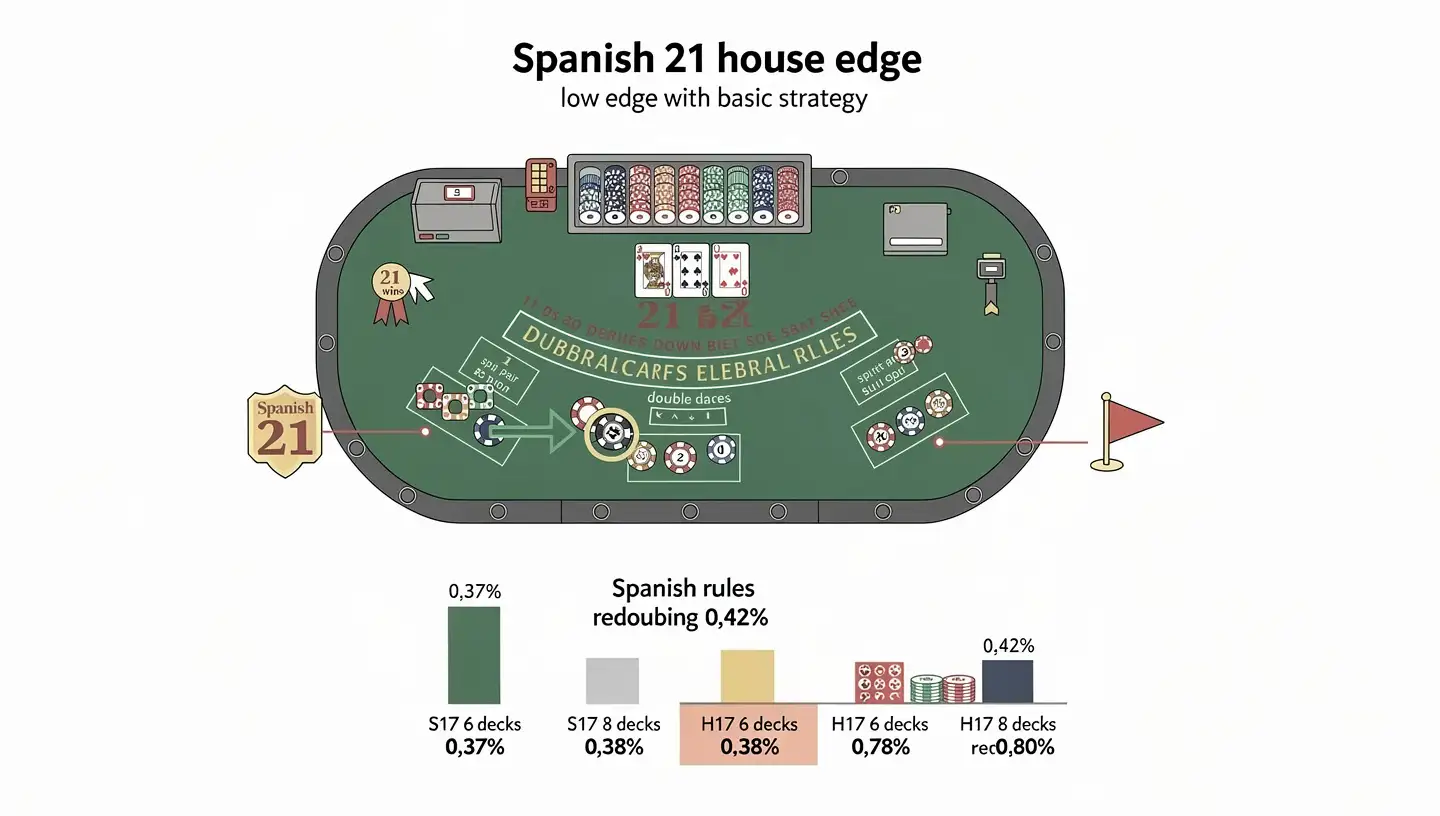
| Rule set | 6 decks | 8 decks |
|---|---|---|
| S17 | 0.37% | 0.38% |
| H17 | 0.78% | 0.80% |
| H17 with redoubling | 0.42% | 0.45% |
Why the Missing 10s Matter
Tens help the player make blackjacks and strong totals, and they also bust the dealer. Taking them out gives the dealer about 2% before any bonus rules. The liberal rules hand that back and a little more: player 21 wins, late surrender, doubling on any number of cards, Double Down Rescue and the bonus payouts. In Spanish 21 vs blackjack with the same soft 17 rule, the edge ends up lower with optimal play.
Soft 17 and Redoubling
A dealer who hits soft 17 adds about 0.4% to the edge. Redoubling, where a casino allows it, brings the H17 edge with six decks from 0.78% back to 0.42%.
Best and Worst Rule Sets
The best Spanish 21 rule set is S17 with surrender, drawing to split Aces and redoubling. Not drawing to split Aces adds 0.28% to the edge, as at Mohegan Sun. Paying 3:2 on a natural after splitting lowers the edge by 0.16%. Removing surrender adds under 0.02%. Players who look for low edge bets away from the card tables can check the craps rules, where some wagers carry a small edge.
Spanish 21 Basic Strategy
Do not use a blackjack chart at a Spanish 21 table. The missing 10s change many close plays, so use a Spanish 21 basic strategy chart made for the rules of your table. The points below give the shape of the chart, not the full chart, and the exact play often depends on the number of cards in your hand.
Hard Hands
- Hard 8 or less: hit.
- Hard 9: double against a dealer 6, otherwise hit.
- Hard 10: double against a dealer 2 to 8, hit against 9, 10 and Ace.
- Hard 11: double against almost every dealer card.
- Hard 12 to 16: mostly hit, and stand against a dealer 4, 5 or 6 on some totals when the hand has few cards.
- Hard 17: stand, except against a dealer Ace, where the chart says surrender or hit.
- Hard 18 or higher: stand.
Soft Hands
Soft 13 to 16 are mostly a hit. Soft 17 is a double against a dealer 4, 5 or 6 with few cards and a hit otherwise. Soft 18 is a stand against a dealer 2, 3, 7 and 8, a double against 4, 5 and 6, and a hit against 9, 10 and Ace. Soft 19 is a stand.
Pairs
Always split Aces, and never split 4s, 5s or 10s. Split 8s against every dealer card except an Ace, where some charts say surrender. Split 2s and 3s against a dealer 2 to 8, 6s against a dealer 4 to 6, and 7s against a dealer 2 to 7. Split 9s against a dealer 3 to 6, 8 and 9, and stand against the rest.
Where Spanish 21 Strategy Differs From Blackjack
The biggest shift is hard 17 with three or more cards against a dealer Ace: hit, which Wizard of Odds says saves about 2.8% of the bet. A pair of 6s against a dealer 3 is a split in blackjack and a hit here. A four-card hard 15 against a dealer 2 is a hit because of the 5-card 21 bonus, and a two-card 15 made of 7 and 8 is a hit too, since one more card can make a 6-7-8. Spanish 21 vs blackjack strategy differs in a few more spots, and the blackjack strategy chart shows where the two part ways.
H17 and S17 Charts
Spanish 21 strategy charts exist for H17 and for S17, with extra pages for redoubling. Use the chart that matches the soft 17 rule at your table, since a few close plays change.
Practice With a Strategy Card
Online games often show the chart in the pay table, and free demo tables are a cheap way to practice. Keep at it until the plays feel automatic.
Spanish 21 vs Blackjack: Key Differences
The main difference in Spanish 21 vs blackjack is the deck, and the rest of the table is built around that change.
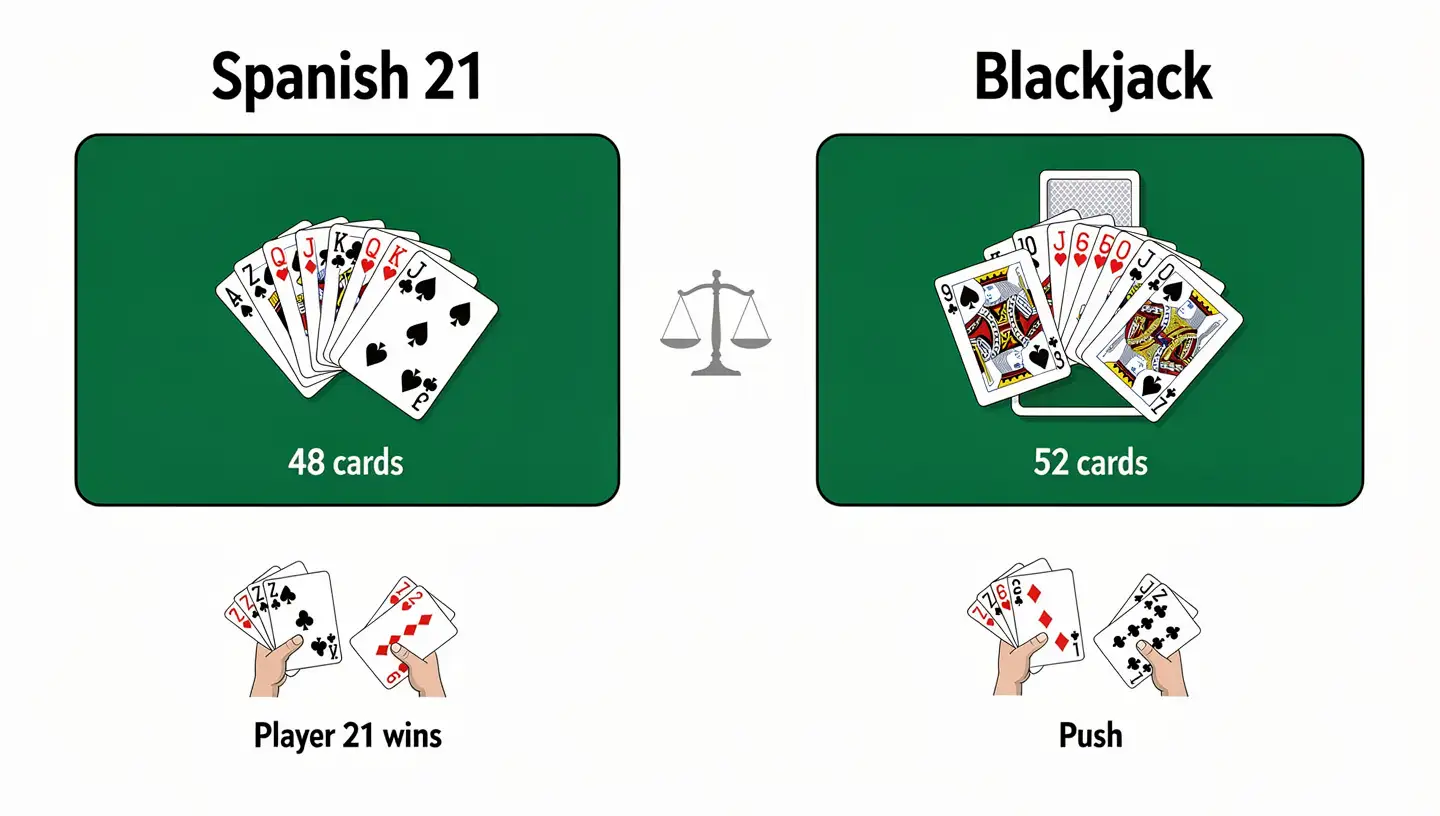
| Feature | Spanish 21 | Blackjack |
|---|---|---|
| Deck | 48 cards, no 10-spot cards | 52 cards |
| Player 21 against dealer 21 | Player wins | Push |
| Blackjack against blackjack | Player wins and is paid 3:2 | Usually a push |
| Doubling | Any number of cards | Usually the first two cards |
| Double Down Rescue | Yes | No |
| Re-splitting Aces | Yes | Rarely |
| Bonus payouts | Yes | No |
| House edge with perfect play | About 0.40% | About 0.5% at 3:2, about 2% at 6:5 |
Which Game Is Better?
In a straight Spanish 21 vs blackjack comparison with the same soft 17 rule and perfect strategy, Spanish 21 is cheaper to play, about 0.40% against about 0.5% for a good 3:2 blackjack game. Against 6:5 blackjack, which costs about 2%, Spanish 21 wins clearly. It is also more technical, and a mistake costs more, so the lower edge only shows up for players who follow the Spanish 21 strategy chart.
When Blackjack Is the Better Pick
Blackjack is the better pick if you want simpler rules, a strategy that fits on a small card, or a table with 3:2 payouts, S17, double after split and surrender all in place. Players who want a different kind of table game can read Dragon Tiger vs Baccarat, which compares a one-card game with a two-card game.
Spanish 21, Pontoon and Pirate 21
Spanish 21 is a trademark of Masque Publishing, so other names are used for similar games. Pontoon is the name in Australia and Malaysia, with its own terms: stick for stand, twist for hit and buy for double down. Pirate 21 is the Betsoft version, dealt from six decks. Casino Bregenz in Austria calls the game Blackjack Exchange, and Seven Cedars in Washington state calls it Bahama Bonus Blackjack. Spanish 21 rules and payouts differ a little between these versions, so check the pay table before using a Spanish 21 chart.
Where to Play Spanish 21
Land-Based Casinos
Reports list Spanish 21 at Atlantic City casinos such as Borgata, Caesars, Golden Nugget, Resorts and Tropicana, and at Venetian and Palazzo in Las Vegas. Most casinos run one or two tables against 20 or more blackjack tables, with minimums that usually run from $5 to $25.
Online Casinos and Licenses
Before you deposit, verify the casino license of the site. Some online casinos carry Spanish 21, while others list Pirate 21 or Pontoon in its place. Real money play is legal only in states that license online casinos, and the list of operators differs from state to state. Age limits also differ, and 21 is the usual minimum at licensed US casinos.
Free Practice and Bonuses
Many sites offer a free demo, which is the cheapest way to learn the chart. Practice hands cost nothing and show how often the bonus hands and the Rescue option come up, so the payouts stop feeling like a surprise. Before you use a welcome bonus on a table game, read the wagering requirements, because table games often count for less than slots.
Spanish 21 Tips for Beginners
Use these tips the first time you learn how to play Spanish 21 at a real table.
Learn the Spanish 21 Chart First
Study a Spanish 21 strategy chart before you sit down. Blackjack instincts cost money here, since many plays are different.
Pick a Table Where the Dealer Stands on Soft 17
S17 tables cost less than H17 tables. Ask before you buy in, and compare redoubling and surrender rules as well.
Skip Insurance and Match the Dealer
Both side bets carry a much higher edge than the base game. Keep your chips on the main bet.
Do Not Chase Bonuses With Doubled Hands
Doubling cancels the multi-card bonuses and the 6-7-8 and 7-7-7 bonuses, and doubling or splitting cancels the Super Bonus. Hit for a bonus only when the chart says so.
Know Table Etiquette and Hand Signals
Tap the table with a finger to hit and wave a hand over your cards to stand. To double, place chips next to the original bet and point with one finger. To split, place chips and show two fingers in a V. In some casinos only the dealer touches the cards.
Common Mistakes and Myths
Can You Count Cards in Spanish 21?
Yes, but the count changes because the 10s are gone. A modified Hi-Lo count works, and the number of decks and the depth of the shoe matter. Counting Match the Dealer gives such a small edge that it is not worth the effort. Our guide to blackjack card counting covers the basics.
Is Spanish 21 Profitable?
Not over the long run. No table game beats the house edge, and Spanish 21 is no exception. A low edge means your bankroll lasts longer, and the result of one shoe can still go either way.
Standing on 13 or 14 Is a Mistake
Many players stand on a 13 or 14 out of habit. With four 10s gone from each deck, the risk of busting is lower, so the chart calls for a hit against a strong dealer card.
Responsible Play
Set a budget and a time limit before you play, and stop when the budget is gone. Our page on responsible gambling limits explains deposit, loss and time limits. In the US you can reach the National Problem Gambling Helpline through the National Council on Problem Gambling, which lists the current phone and text numbers. Only play if you are of legal age.
Is Spanish 21 Worth Playing?
Yes, if you are willing to learn the chart. Now you know how to play Spanish 21, what the Spanish 21 rules are and which bets to avoid. A low house edge, bonus payouts and Double Down Rescue make it a strong choice at an S17 table, and blackjack stays the simpler pick. Players who want a quicker game with a single card per side can read the Dragon Tiger rules.
Spanish 21 FAQ
What Is Spanish 21 and How Do You Play It?
Spanish 21 is a blackjack variant dealt from 48-card decks with the 10-spot cards removed. You bet, receive two cards and try to beat the dealer without going over 21, using player-friendly rules such as late surrender and doubling on any number of cards.
How Is Spanish 21 Different From Blackjack?
In Spanish 21 the deck has no 10s, a player 21 always wins, and a player blackjack beats a dealer blackjack. You can double on any number of cards, use Double Down Rescue, and collect bonus payouts on multi-card 21s.
What Is the House Edge in Spanish 21?
Spanish 21 costs about 0.40% with basic strategy at an S17 table. An H17 table costs about 0.78% to 0.80%, and the Match the Dealer side bet carries about 3%.
What Is Double Down Rescue in Spanish 21?
After you double down in Spanish 21, you may give up a non-busted hand. The dealer keeps the original bet and you take back the doubled portion.
What Is the Super Bonus in Spanish 21?
A suited 7-7-7 against a dealer 7 pays $1,000 for bets of $5 to $24 and $5,000 for bets of $25 or more at many casinos. Other players receive a $50 Envy Bonus, and doubling or splitting cancels the payout.
Is Spanish 21 Better Than Blackjack?
With perfect strategy and the same soft 17 rule, Spanish 21 costs less. It beats 6:5 blackjack by a wide margin, but the strategy is harder to learn.
Can You Count Cards in Spanish 21?
Yes. Counting in Spanish 21 needs changes because the 10s are missing, and the game runs on six or eight decks, so the gain is small.
Is Spanish 21 Good for Beginners?
Yes, for anyone who knows blackjack. Learning how to play Spanish 21 takes a few minutes, and a strategy chart covers the rest. Beginners should skip insurance and Match the Dealer and set a budget first.