Almost every online casino displays a license somewhere on its site, usually tucked into the footer next to a small regulator logo. Most players glance at it, see something official looking, and move straight to creating an account. That single glance is not verification. A logo can be copied onto any website in minutes, regardless of whether a real license sits behind it.
Actually checking a casino’s license takes a few extra minutes, and it is the single most reliable way to confirm you are dealing with an operator that answers to someone if things go wrong. This guide walks through exactly how to do that, regulator by regulator, along with the warning signs that tell you a license claim does not hold up.
Why verifying a license actually matters
An unlicensed casino owes you nothing. There is no regulator to contact if a withdrawal never arrives, no dispute process, and no consequence for the operator if it simply decides to keep your money. A legitimate license changes that completely. Licensed operators are required to follow specific rules around fund security, fair game testing, and responsible gambling, and a real regulator has the authority to investigate complaints and penalize operators who break those rules. None of this guarantees a flawless experience every time, but it does guarantee that somewhere, someone is accountable if things go badly wrong.

That accountability is the entire point of checking, and it is worth the five minutes it takes before you ever type in a card number. The same logic applies just as directly to sports betting, and our guide on choosing a reputable bookmaker walks through the same licensing checks in that specific context, along with a few considerations unique to sportsbooks that do not come up with casino games.
Think of it the same way you would think of checking a contractor’s license before letting them work on your house. The paperwork alone does not guarantee good work, but its absence tells you a great deal about how much recourse you would have if something went wrong.
What a casino license actually is
A casino license is a formal authorization, issued by a government or regulatory body, allowing a company to legally offer gambling services within that regulator’s rules and under that regulator’s ongoing supervision. The license does not just sit there as a badge of honor. It comes attached to ongoing obligations: the operator must protect player funds, run games that have been independently tested for fairness, follow rules around advertising and bonus terms, and offer tools that support responsible gambling. A license granted once and never checked again would be close to meaningless, which is why reputable regulators require ongoing compliance rather than a one time approval that lasts forever regardless of how the operator behaves afterward.
Regulators vary enormously in how strictly they enforce these obligations, which is exactly why checking which specific regulator issued a license matters just as much as confirming that a license exists at all. Two casinos can both display the word licensed in their footer while operating under completely different levels of scrutiny, and that gap is invisible until you actually check which authority is behind each one.
Step 1: find the license information in the footer
Start at the very bottom of the casino’s homepage, since that is where this information almost always lives. A properly licensed operator will display a license number, the name of the regulator that issued it, and usually a clickable seal linking back to the regulator’s own site. Some casinos also repeat this information on a dedicated About Us or Legal page, so check there too if the footer comes up empty. Write down or copy the exact license number along with the regulator’s full name, since you will need both pieces of information for the next step.
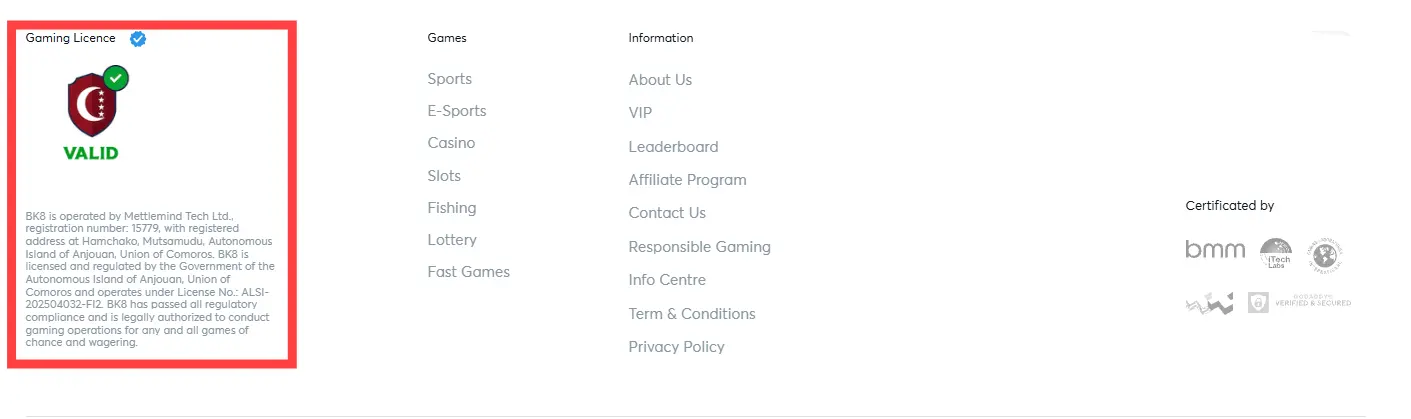
If you cannot find any license reference at all after checking both locations, treat that absence as a serious warning sign rather than an honest oversight. A few casinos genuinely do bury this information somewhere unusual, but the large majority that hide it are hiding it because there is nothing real to find.
Step 2: identify the licensing authority
Once you have a license number, the regulator’s name tells you which register to check next.
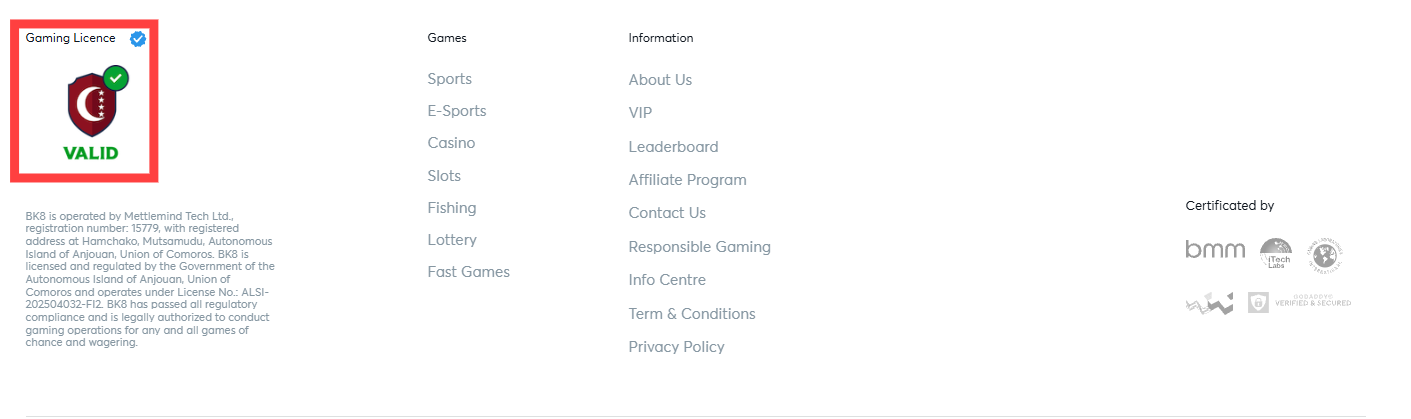
A handful of authorities cover the large majority of licensed operators you will come across, so recognising these names quickly becomes second nature.
- Malta Gaming Authority (MGA), one of the most established and respected regulators in the industry
- UK Gambling Commission (UKGC), mandatory for any operator accepting players from the United Kingdom
- Curaçao Gaming Authority, significantly reformed since late 2024, now a genuine mid-tier regulator
- Gibraltar Gambling Commissioner, a smaller jurisdiction with a solid reputation
- Kahnawake Gaming Commission, a long established authority based in Canada
You will run into these five far more often than any others, and recognising the names on sight saves time once you have checked a handful of casinos and started to notice the same regulators appearing again and again.
If the license traces back to a Curaçao operator specifically, our full breakdown of the Curaçao gambling license covers what that regulator requires and how its standards have changed in recent years, which is useful context before you decide whether the license clears your own bar for comfort.
Step 3: look up the license on the regulator’s website
This is the step most players skip, and it is the one that actually matters. Every legitimate regulator maintains a public register where anyone can confirm whether an operator holds an active license. This takes slightly longer than the previous step, usually a minute or two per regulator, but it is the part of the process that actually separates a genuine license claim from a copied logo.
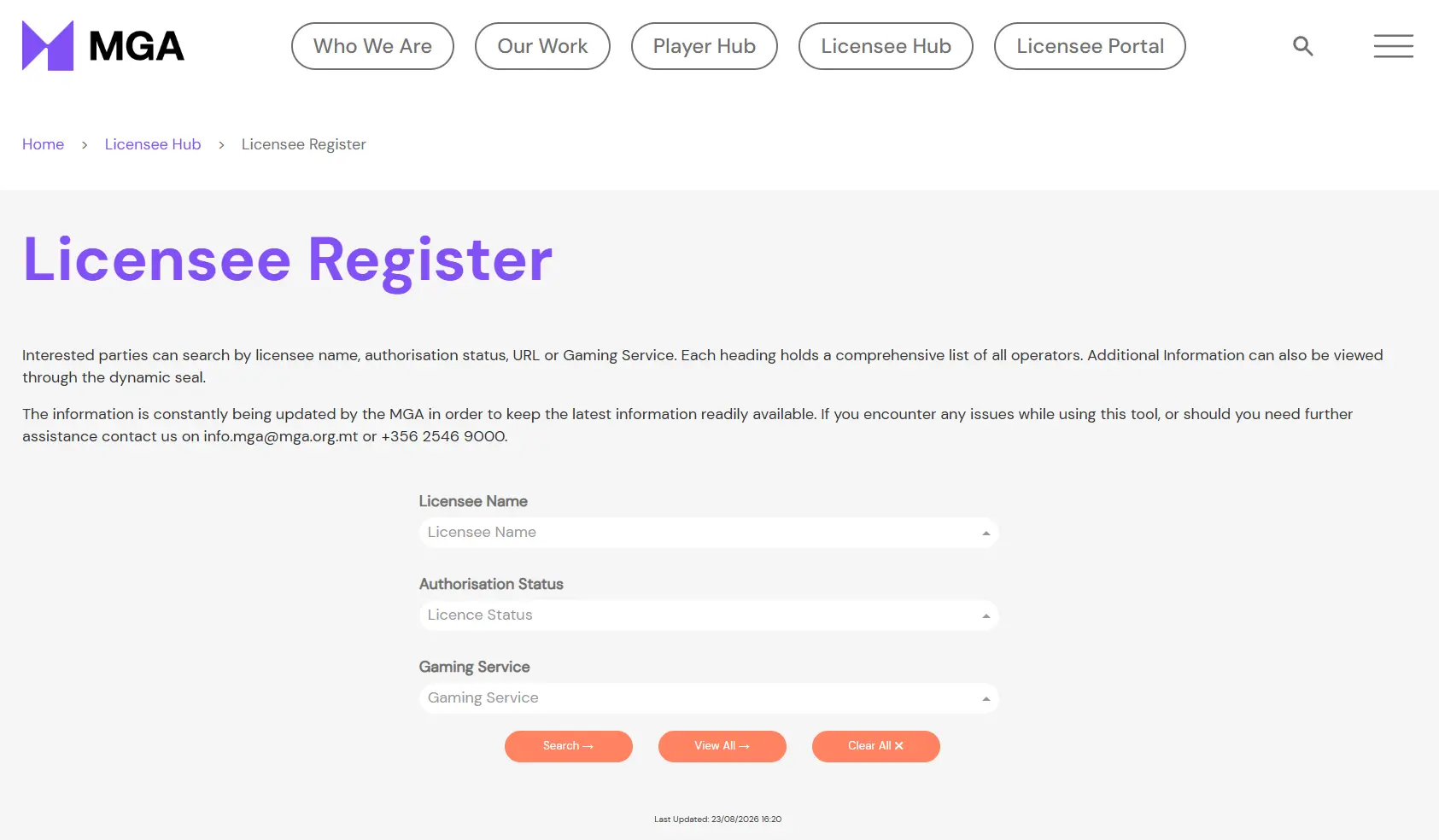
Skipping this single step is the difference between verifying a license and simply trusting a badge, which is exactly what someone faking a license is counting on you to do.
MGA licensee register
Visit the MGA’s official site and search the licensee register by company name or license number. The listing shows license status, license type, and the legal entity behind the brand, which is worth comparing against the company name listed in the casino’s own terms and conditions.
UKGC public register
The UK Gambling Commission runs a public register searchable by operator name. It confirms active status, any license conditions attached, and a record of past regulatory actions if the operator has been sanctioned before.
Curaçao Gaming Authority portal
The CGA now publishes its own licensee list directly, a meaningful change from the old sublicense system where no single public register existed. Search by operator name or license number to confirm the license is active under the current framework.
Kahnawake and Gibraltar registers
Kahnawake maintains an interactive licensee list searchable by brand name. Gibraltar’s regulator publishes a list of licensed operators as well, though it covers a smaller number of brands than the larger jurisdictions.
One detail worth knowing before you even begin searching: casinos frequently operate under a parent company name that differs entirely from the consumer facing brand shown on the homepage. Pull the exact legal entity name from the casino’s terms and conditions page rather than guessing based on the brand name alone, since searching the wrong name can make a genuinely licensed casino look unlicensed in your search results.
This trips up more players than any other part of the process, simply because the brand name on the homepage and the legal entity name buried in the terms and conditions can look nothing alike.
Step 4: check for red flags
Finding a license entry is a good sign, but a few details are worth double checking before you consider the process finished. These checks take only another minute or two, and skipping them is how players end up trusting a license that technically exists but does not actually cover the site they are about to deposit on, or one that stopped being valid months ago.
- An expired or suspended status on the regulator’s register, rather than active
- A mismatch between the company name on the regulator’s site and the one in the casino’s own terms and conditions
- A license number that appears nowhere on the casino’s site at all, only a logo with no verifiable number attached
- A regulator that does not appear on any recognised list of licensing authorities
None of these findings alone proves a casino is dishonest, but any one of them is reason enough to slow down and dig further before depositing. Two or more of these signs appearing together is a much stronger warning than any single one on its own, and that pattern is worth taking seriously regardless of how polished or professional the rest of the site looks on the surface.
If you want a broader checklist that goes beyond licensing alone, our guide on how to spot a reputable online casino covers additional signals like customer support quality and player reviews.
Types of casino licenses you might see
Not every license works the same way, and the terminology can be confusing if you have not run into it before, especially since operators rarely explain the difference on their own site.
Master license vs sub-license
A master license is issued directly by a regulator to a single holding company, which is then sometimes permitted to sublicense other operators underneath it. A sub-license is what those underlying operators actually hold, and historically this structure made accountability difficult to trace, since a sublicense holder answered to the master license holder rather than directly to the regulator. Reforms in several jurisdictions have moved away from this model in favor of direct licensing, where every operator holds its own license issued straight from the regulator.
This distinction matters because a sublicense holder that gets flagged for misconduct can sometimes reappear under a different sublicense within the same structure, which is exactly the kind of accountability gap that direct licensing was designed to close.
White label license
A white label operator runs its casino on top of an already licensed platform, using another company’s backend systems, payment processing, and player database while presenting its own separate branding to the public. This is common and not inherently a problem, but it does mean the actual license and the operational responsibility sit with the platform provider rather than the branded site you are directly interacting with.
If a dispute ever arises, you may find yourself dealing with a company you have never heard of rather than the brand name on the homepage, since that platform provider is technically the licensed entity handling the backend. Our guide to casino license types goes into more depth on how these structures compare, including how B2C and B2B licensing fits into the picture.
What each license tier means for you
Regulators are not interchangeable, and the tier a license falls into affects how much real protection actually stands behind it once something goes wrong.
| Tier | Regulators | What it means for players |
|---|---|---|
| Top-tier | UKGC, MGA | Segregated player funds, mandatory responsible gambling tools, formal dispute resolution |
| Mid-tier | Curaçao (post reform), Kahnawake, Gibraltar | Real oversight and obligations, though generally lighter enforcement than top-tier |
| Low-tier or unlicensed | Obscure or unrecognised jurisdictions, no license at all | Little to no recourse if something goes wrong |
Bodies like the UK Gambling Commission sit at the top of that table for a reason: it runs frequent compliance reviews and can impose real penalties, up to and including revoking a license entirely. Not every player needs top-tier oversight for every type of play, but knowing where a specific casino’s license actually sits helps you decide how much trust to extend and how much research to do before committing your main bankroll to any single site.
Someone playing casually with small amounts might reasonably accept a mid-tier license in exchange for a wider selection of games and payment options, while someone planning to deposit larger sums regularly may prefer the added protection a top-tier regulator provides, even if it means fewer available operators to choose from. If you would rather start from a shortlist that has already been through this process, our ranking of top online casinos covers a range of regulators so you can compare oversight levels side by side rather than researching every candidate from scratch on your own.
What a license does and does not guarantee
A valid license confirms that a casino’s games have been tested by an approved lab and that minimum fairness standards are being met on an ongoing basis, not just at launch. It does not guarantee you will personally have a perfect experience, and it does not eliminate every possible frustration around support response times or bonus terms. What it does guarantee is legal recourse. If a licensed operator fails to meet its obligations, there is a real regulator you can escalate the issue to, which simply does not exist with an unlicensed site.
Most licensed operators are also required to offer practical player protection tools such as deposit limits and self-exclusion, not just game fairness on paper. Our guide on responsible gambling limits covers how to set these up in a way that actually sticks, and it is worth doing right after you confirm a casino’s license checks out, before your first deposit rather than after a session has already gotten away from you.
Most licensed casinos also require identity verification before releasing your first withdrawal, a process commonly called KYC. This can feel like an extra hurdle right when you are trying to collect a win, but it exists specifically because regulators require operators to confirm they are paying the actual account holder and not facilitating fraud or money laundering through the platform. Our guide to the casino KYC verification process explains what documents are typically requested and why this step is standard practice under nearly every regulator’s rules rather than something specific to one operator.
Checking a license takes only a few minutes once you know where to look, and it is genuinely the single most useful habit you can build before signing up anywhere new. Skipping this step to save five minutes is exactly how players end up stuck with an operator that never had any real obligation to pay them in the first place. Bookmark the regulator registers once you have used them a couple of times, since you will likely find yourself checking new casinos and sportsbooks more than once over time, and having the links ready removes the last bit of friction from a habit that is genuinely worth keeping. Once you are set up somewhere that checks out, learning how to play blackjack is as good a place as any to start actually enjoying the site you picked, now that the research part is behind you.
Frequently asked questions
What if a casino does not show a license number?
Treat it as a strong warning sign. A legitimate operator has no real reason to hide its license details, and the absence of a visible, verifiable license number is one of the clearest indicators that a site may be unregulated. Some casinos will still display a regulator’s logo without a number, which is arguably worse than showing nothing at all, since it is a deliberate attempt to imply legitimacy without giving you anything to actually check.
Can a casino have more than one license?
Yes, and this is actually quite common among larger, more established operators. A casino might hold an MGA license to serve European players and a separate UKGC license specifically for UK based players, since different regulators cover different markets. Holding multiple recognised licenses generally signals a more established, better resourced operation, since maintaining compliance across two or more regulators takes real ongoing investment that smaller or less serious operators tend to avoid.
What happens if a casino loses its license?
The regulator typically publishes the suspension or revocation directly on its public register, and the operator is legally required to stop accepting players from that regulator’s jurisdiction going forward. If you have an active balance at a casino whose license has been pulled, withdraw your funds immediately and contact the regulator directly if the casino refuses to process the payout.
Acting quickly matters here, since an operator in the process of losing its license is exactly the kind of operator that may start delaying withdrawals across the board rather than for you specifically.
Does a license guarantee fair games?
A license confirms that games have passed independent testing and that minimum return to player standards are being actively maintained over time, which is a meaningful baseline to start from. It does not eliminate all risk entirely. Looking for additional certifications from labs such as eCOGRA or iTech Labs alongside the license adds an extra layer of confidence in game fairness specifically, since these labs run their own independent audits separate from whatever the licensing regulator itself requires.
Is a Curaçao license enough on its own?
It really depends on how much regulatory oversight you personally want standing behind the site you choose. Curaçao’s post 2024 framework is considerably stronger than the old sublicense system, and it is a real, enforceable license rather than a symbolic one. It still involves lighter ongoing supervision than a UKGC or MGA license, so treat it as a reasonable mid-tier option rather than an automatic red flag or an automatic green light either way.
Plenty of well run, honest operators hold Curaçao licenses simply because it lets them serve a broader international player base than a stricter regulator would allow, and that business reason does not automatically say anything negative about how a specific operator treats its players.