Blackjack is one of the easiest casino games to pick up in a single sitting, and one of the few where the choices you make actually change your odds. Unlike slots or roulette, where the outcome is entirely down to chance, blackjack rewards a player who knows when to take a card and when to stop. That single fact is why it has stayed popular in casinos for centuries, long after games with flashier presentation have come and gone.
The goal is simple: beat the dealer by getting your hand closer to 21 than theirs, without going over. This guide covers the rules, the payouts, the handful of decisions that make up nearly every hand you will ever play, and a few small strategy habits that separate a confident player from someone just guessing.
What is the goal of blackjack
In blackjack, you are not competing against other players at the table, even when several people are seated around it. Every hand is a straight contest between you and the dealer, decided entirely on its own.
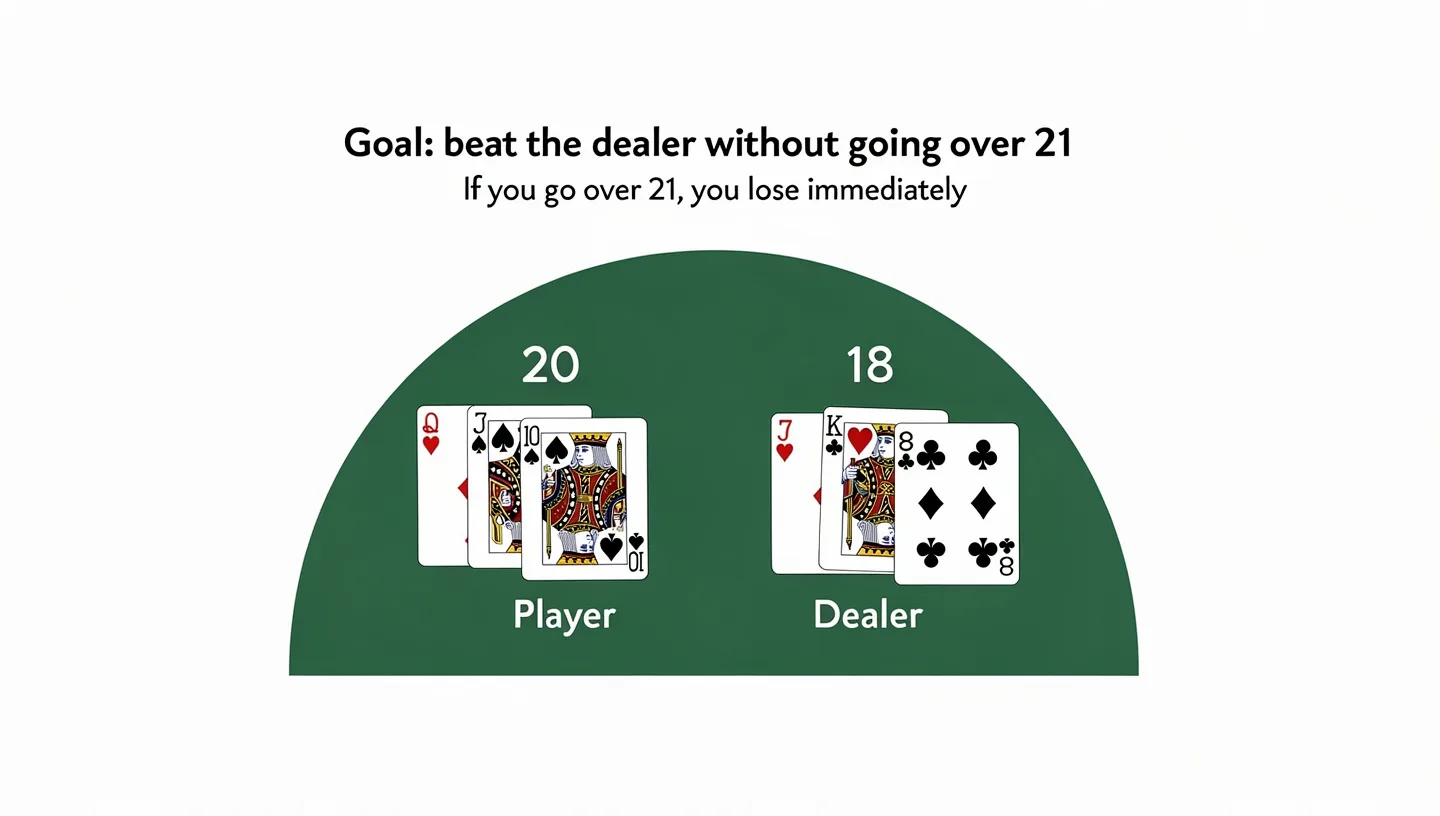
You win by getting a hand value higher than the dealer’s without going over 21, or by the dealer going over 21 themselves, which is called a bust and ends the hand immediately in your favor. If your total goes over 21 first, you lose immediately, regardless of what the dealer ends up with afterward, even if the dealer would have busted too on their own turn.
Card values in blackjack
Before anything else, it helps to know exactly what each card is worth once it lands in your hand.
| Card | Value |
|---|---|
| 2 through 10 | Face value |
| Jack, Queen, King | 10 |
| Ace | 1 or 11, whichever helps your hand more |
That flexibility on the ace is what creates what players call a soft hand, a hand where the ace can count as 11 without pushing you over 21.
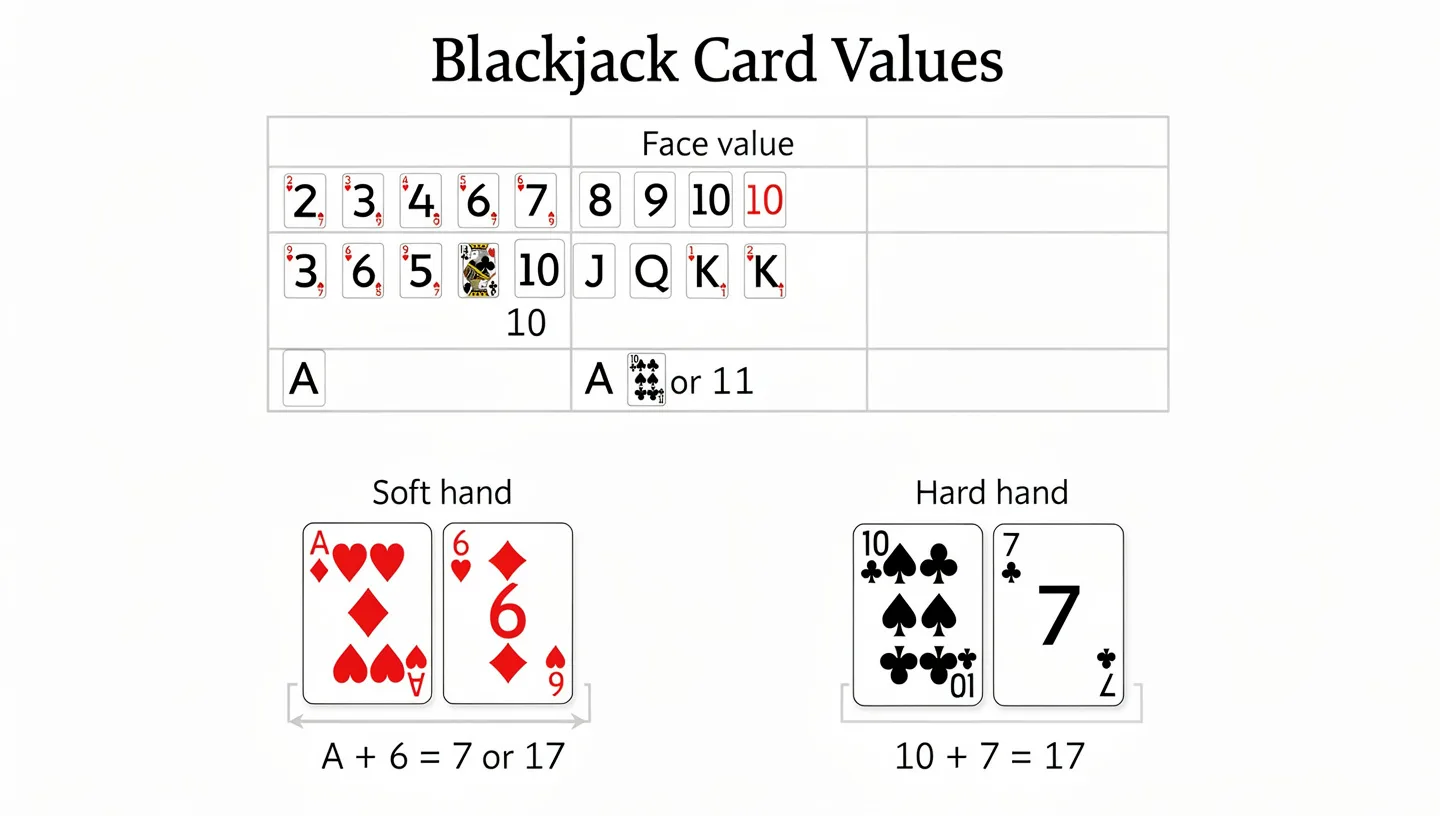
A hand of ace and 6, for example, can be treated as either 7 or 17, and that flexibility changes how you should play it. A hand without an ace, or one where the ace can only safely count as 1, is called a hard hand, and the two are played differently even when the total looks the same on paper.
How a hand of blackjack is dealt
Each player places a bet before any cards are dealt. Once bets are down, you and every other player at the table receive two cards face up, so everyone can see exactly what they have from the very start.
The dealer also takes two cards, but only one is dealt face up, visible to everyone at the table from the very start of the hand. The second stays hidden until later in the hand, which is why it is often called the hole card. That single hidden card is the reason blackjack involves genuine decision making rather than just watching numbers land, since you have to play your own hand without knowing exactly what the dealer is holding underneath.
How to play blackjack step by step
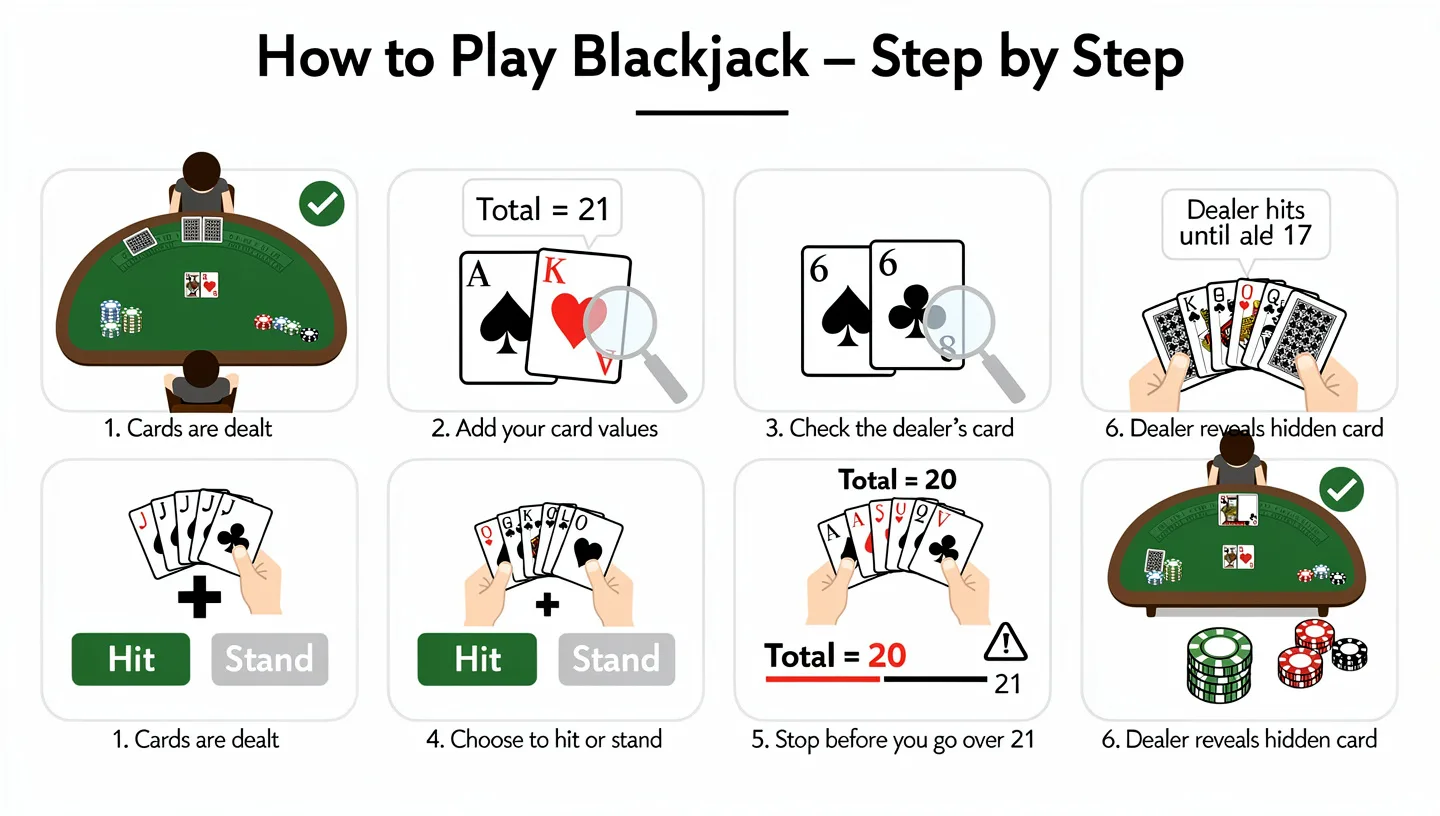
Once the cards are out, the actual gameplay follows the same short sequence every single hand, whether you are playing your first hand ever or your thousandth.
- Look at your first two cards and add up their total value
- Check the dealer’s one visible card, since it affects which move makes sense
- Choose to hit (take another card) or stand (keep your current total)
- Keep hitting if you want, but stop the moment you are happy with your total or you will bust past 21
- Once every player has finished, the dealer reveals the hidden card
- The dealer then hits or stands based on a fixed rule, not personal choice
- Whoever is closer to 21 without going over wins the hand
That fixed dealer rule is worth understanding on its own, since it is different from how you get to play. If you are still building comfort with a live casino floor before trying this at the table, our guide on how to spot a reputable online casino is worth reading first, since practicing on a trustworthy site matters just as much as knowing the rules themselves.
The dealer’s fixed rule
Unlike you, the dealer has no real decisions to make. Nearly every casino requires the dealer to hit on 16 or less and stand on 17 or higher, regardless of what any player at the table is holding or how the hand is shaping up around them.
This rule is exactly why basic strategy exists. Since the dealer’s behavior is predictable, you can plan your own moves around it instead of guessing what they might do on any given hand.
Blackjack payouts
How much you actually win depends on how the hand plays out, not just whether you win at all. The size of the payout changes based on exactly how the hand finishes, so it is worth knowing the differences before you sit down.
| Outcome | Payout |
|---|---|
| Regular win | 1:1 (win the same amount as your bet) |
| Blackjack (ace plus a 10-value card) | 3:2 in most casinos |
| Push (tie with the dealer) | Your bet is returned, no win or loss |
| Loss or bust | Dealer collects your bet |
Watch for tables that pay 6:5 on a blackjack instead of the standard 3:2. It looks like a small difference, but it meaningfully increases how much the house keeps over time, so it is worth checking the payout table before you sit down, since this single detail is often printed right on the felt itself.
Splitting and doubling down
Beyond the basic hit or stand choice, two other moves come up often enough that they are worth knowing before your first hand.
When to split
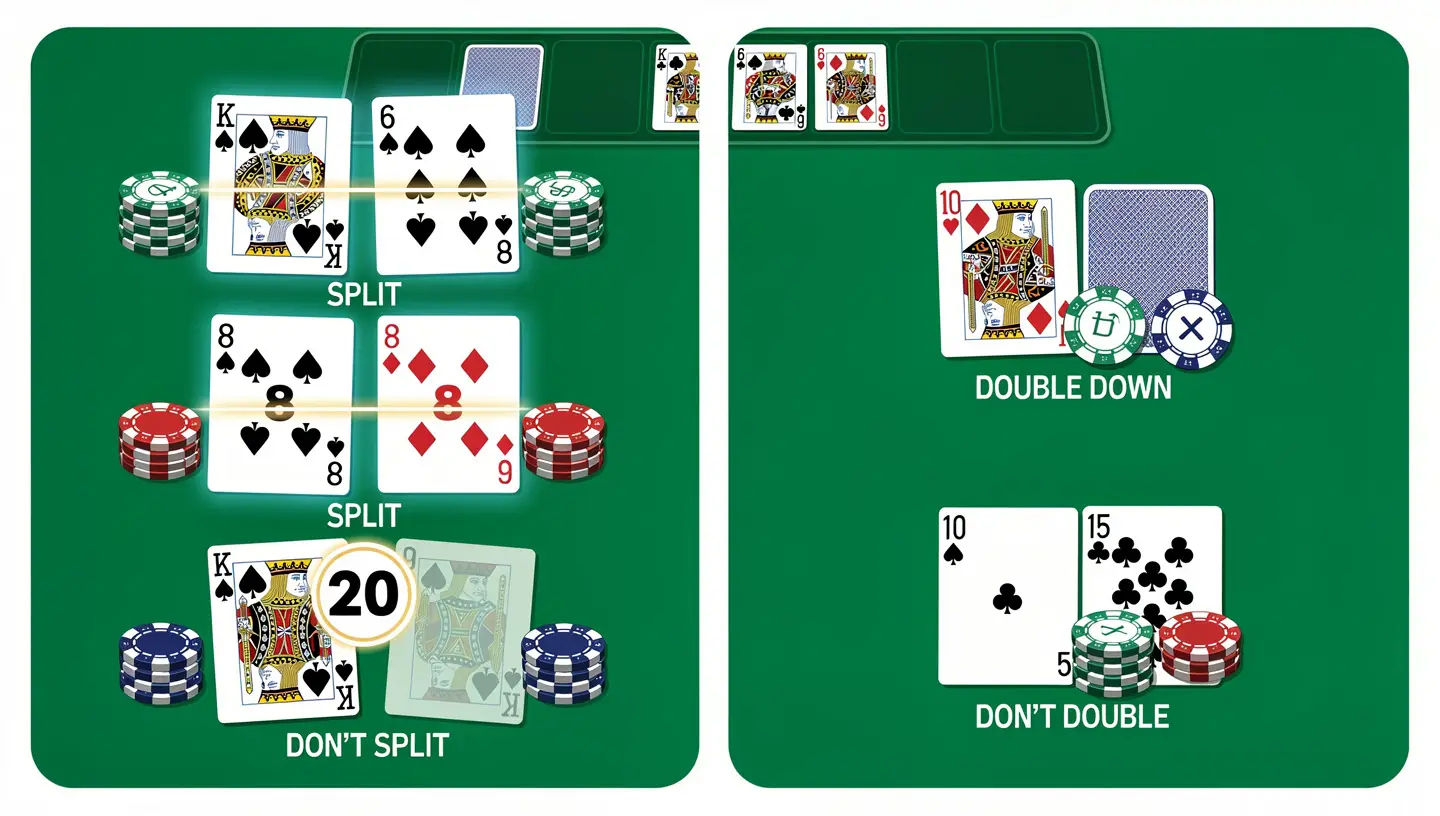
If your first two cards share the same value, you can split them into two separate hands by placing a second bet equal to your first, doubling your total action on that round of play. Each card then becomes the start of its own hand, played out independently against the dealer, as if you were suddenly playing two hands at once instead of one.
Splitting aces and 8s is almost always the right move. Two aces give you two strong starting hands instead of one awkward 12, and splitting a pair of 8s turns a weak 16 into two hands with real potential. Splitting 10-value cards, on the other hand, is rarely worth it, since a starting total of 20 is already a strong hand on its own and breaking it up usually creates two weaker hands instead of one strong one.
When to double down
Doubling down means doubling your original bet in exchange for exactly one more card, after which you must stand no matter what you draw next. It is a way to press your advantage when the odds are clearly in your favor, rather than a move to make on every strong looking hand.
A total of 10 or 11 is the classic double down spot, since there is a strong chance the next card pushes you to a total the dealer will struggle to beat. Doubling on a weak total, by contrast, just doubles your risk without the odds to back it up, which is why sticking to the right situations matters more than doubling often.
Insurance bets explained
When the dealer’s visible card is an ace, most tables offer a side bet called insurance. You can bet up to half your original wager that the dealer’s hidden card gives them a blackjack, essentially a separate bet running alongside your main hand.
If the dealer does have blackjack, insurance pays 2:1, which offsets the loss on your main hand. If they do not, you simply lose the insurance bet and play your hand as normal. The math behind this bet does not favor the player over the long run, which is why most basic strategy guides recommend skipping it entirely, no matter how strong your own hand looks or how tempting the bet feels in the moment.
Basic blackjack strategy
You do not need to memorize a full strategy chart to play well right away.
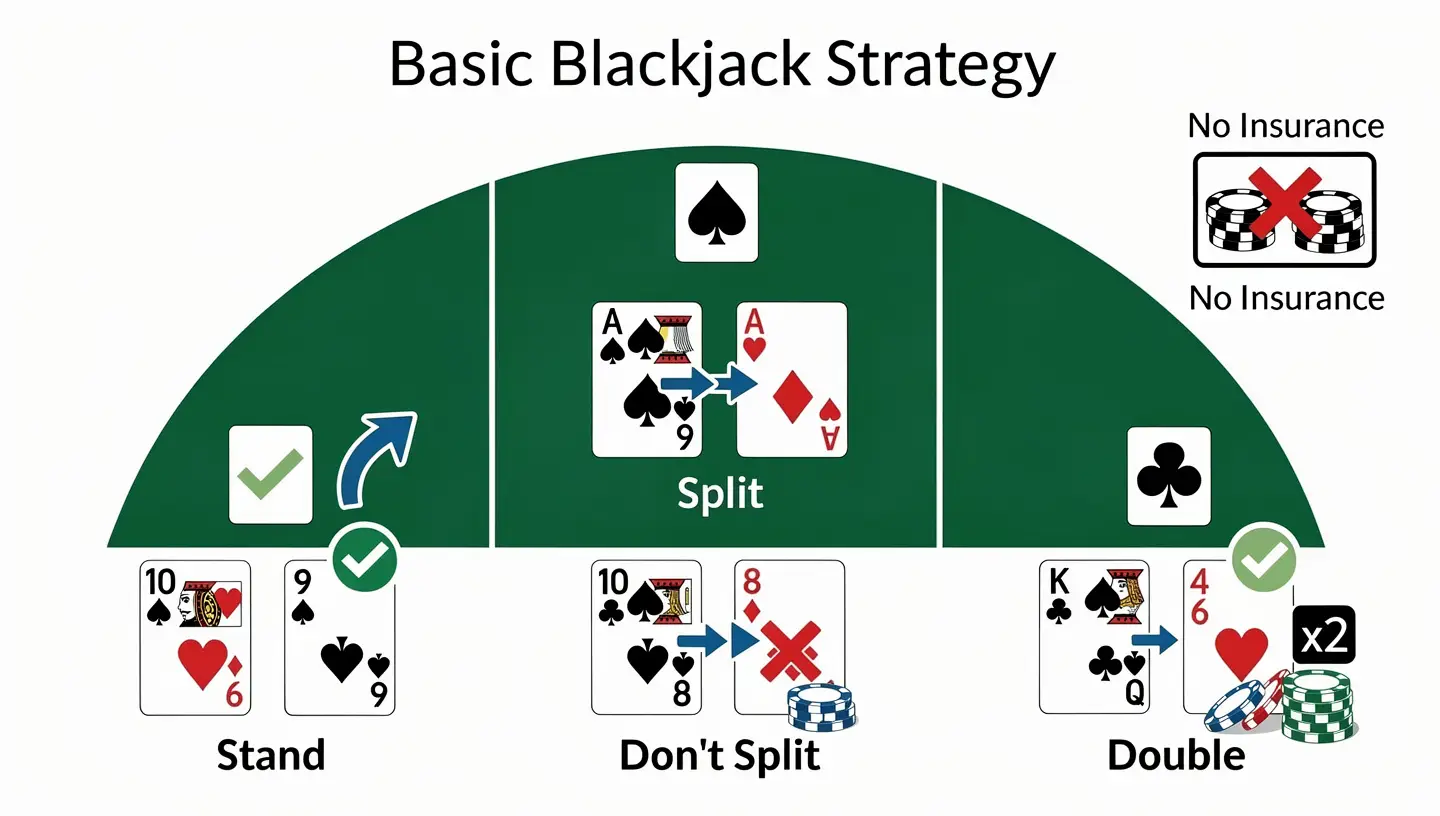
A handful of rules cover the large majority of hands you will actually see at the table, and they are simple enough to remember after just a few sessions of play, without needing to sit down and study anything formally.
- Stand on 12 through 16 when the dealer shows 2 through 6, since the dealer is more likely to bust
- Hit on 12 through 16 when the dealer shows 7 through ace, since you need to improve a hand the dealer is likely to beat
- Always split aces and 8s
- Never split a pair of 10-value cards
- Double down on a total of 10 or 11
- Skip insurance, regardless of how confident you feel
These rules will not make you unbeatable, since blackjack still carries a house edge even when played perfectly. What they do is bring that edge down to roughly half a percent on most tables, which is about as close to even as any casino game gets outside of a handful of specific bets in other games. Players who want to go beyond this and study a full chart broken down by every possible hand combination can find one in our guide to blackjack basic strategy.
Common blackjack mistakes to avoid
A few habits show up constantly at blackjack tables, and nearly all of them cost players money without them realizing it. Watching for these patterns in your own play is often more useful than memorizing extra strategy rules, since fixing a bad habit tends to matter more than perfecting an already solid one.
Taking insurance because a hand feels strong is one of the most common, since the bet has nothing to do with your own cards and everything to do with the dealer’s hidden one. Standing too early out of caution, particularly on totals of 12 through 16 against a dealer showing 7 or higher, is another, since it hands the dealer an easy win they might not have earned otherwise.
Playing by feel instead of the dealer’s visible card is probably the biggest one overall. Basic strategy exists precisely because guessing, even confident guessing, performs worse over time than following the same handful of rules on every hand.
Chasing losses by increasing bets after a bad run is another habit worth watching for, since it has nothing to do with the cards themselves and everything to do with trying to win back money already lost through bigger, riskier wagers. The cards do not know or care what happened on the previous hand, and treating each hand as a fresh decision, separate from the last one, tends to lead to steadier results over a full session at the table.
Ignoring the payout table before sitting down is a smaller mistake but an easy one to fix. A table paying 6:5 on blackjack instead of 3:2 can turn what looks like a good game into a noticeably worse one, and that difference is visible before you ever place a bet if you take a moment to check, usually printed directly on the table layout for anyone who bothers to look.
Blackjack rule variations worth knowing
Not every blackjack table plays by identical rules, and a few small differences can shift the odds more than they appear to at first glance.
Some casinos have the dealer hit on a soft 17, shown on the table as H17, while others require the dealer to stand on any 17, shown as S17. A table with S17 rules is slightly better for the player, since it gives the dealer one less chance to improve a borderline hand into something stronger.
The number of decks in play matters too. Single deck and double deck games are generally more favorable to a skilled player than the six or eight deck shoes common in larger casinos, though single deck tables often make up for this with a lower payout on blackjack itself, so it is worth checking both details together rather than focusing on just one number in isolation.
Some casinos also offer variants like Spanish 21, which removes all the 10s from the deck but adds player-friendly rules like bonus payouts for certain hands. It plays differently enough that basic blackjack strategy does not transfer over directly. Our guide on how to play Spanish 21 covers what changes and how to adjust your approach if you decide to try it.
Table minimums and maximums are worth checking too, since they vary widely even within the same casino floor. A high limit table might offer better rule variations, such as more generous doubling options or the ability to double after splitting, while a low limit table nearby runs stricter house rules to offset the smaller average bet size sitting at each seat. Reading the small placard on the table before sitting down takes only a few seconds and tells you far more than the general reputation of the casino as a whole.
Trying other casino table games
Once blackjack feels comfortable, a lot of players branch out into other table games that use similar decision making, so it is worth knowing what else is out there once you are ready for something new. Casino floors are built around variety on purpose, and there is no rule that says you have to stick with one game forever once you have found something you enjoy.
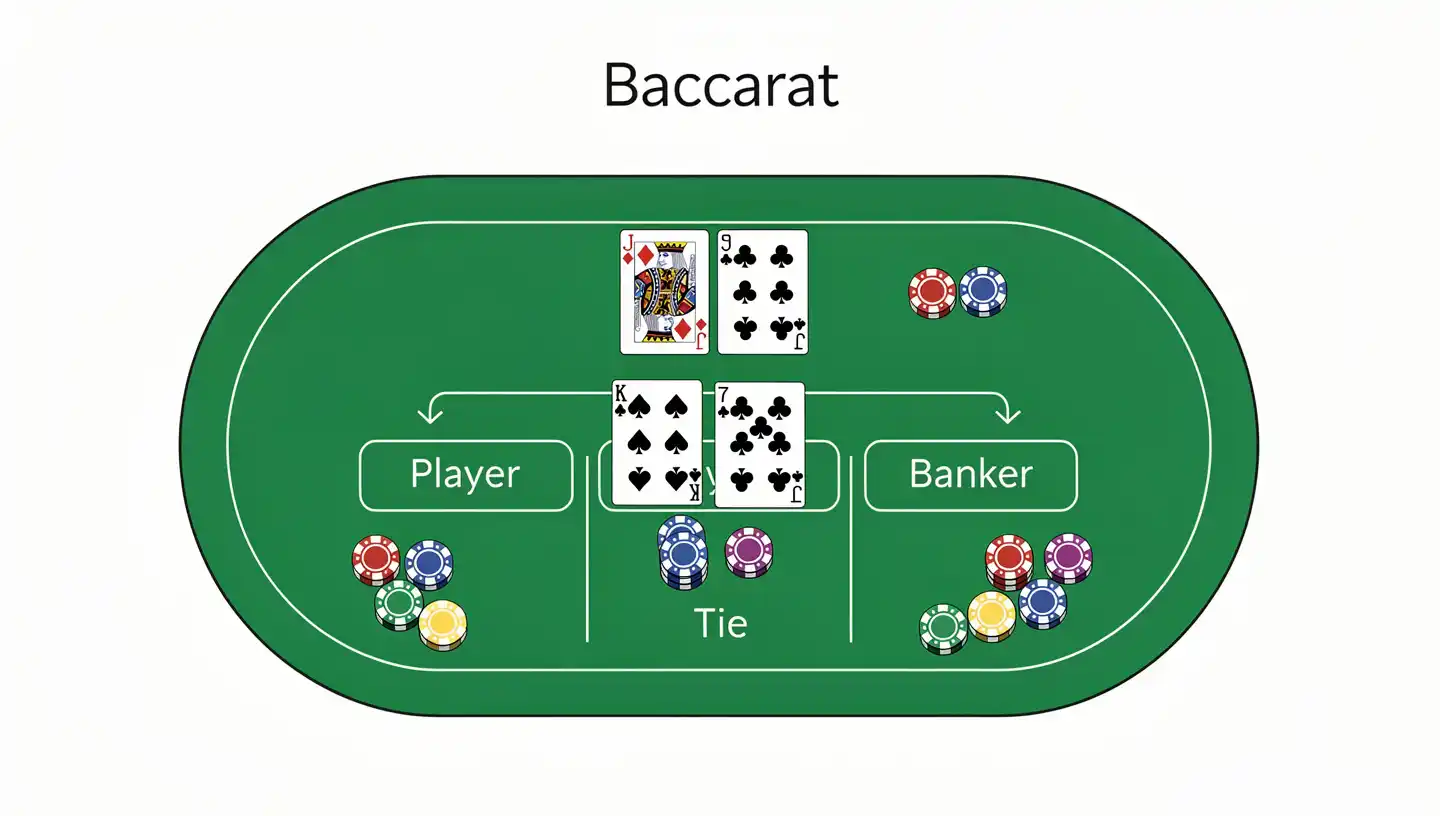
Baccarat is a good next step, since it also comes down to a small number of clear choices each hand, without the deeper strategy layer that blackjack eventually asks for once you move past the basics. It tends to appeal to players who liked the pace of blackjack but want fewer decisions per hand, and the betting itself feels familiar almost immediately.
Give it a session or two before deciding whether it replaces blackjack as your main game or simply becomes something you rotate into occasionally. Plenty of regular players end up splitting their time between two or three table games rather than settling on just one, which also helps keep a long session feeling fresh rather than repetitive.
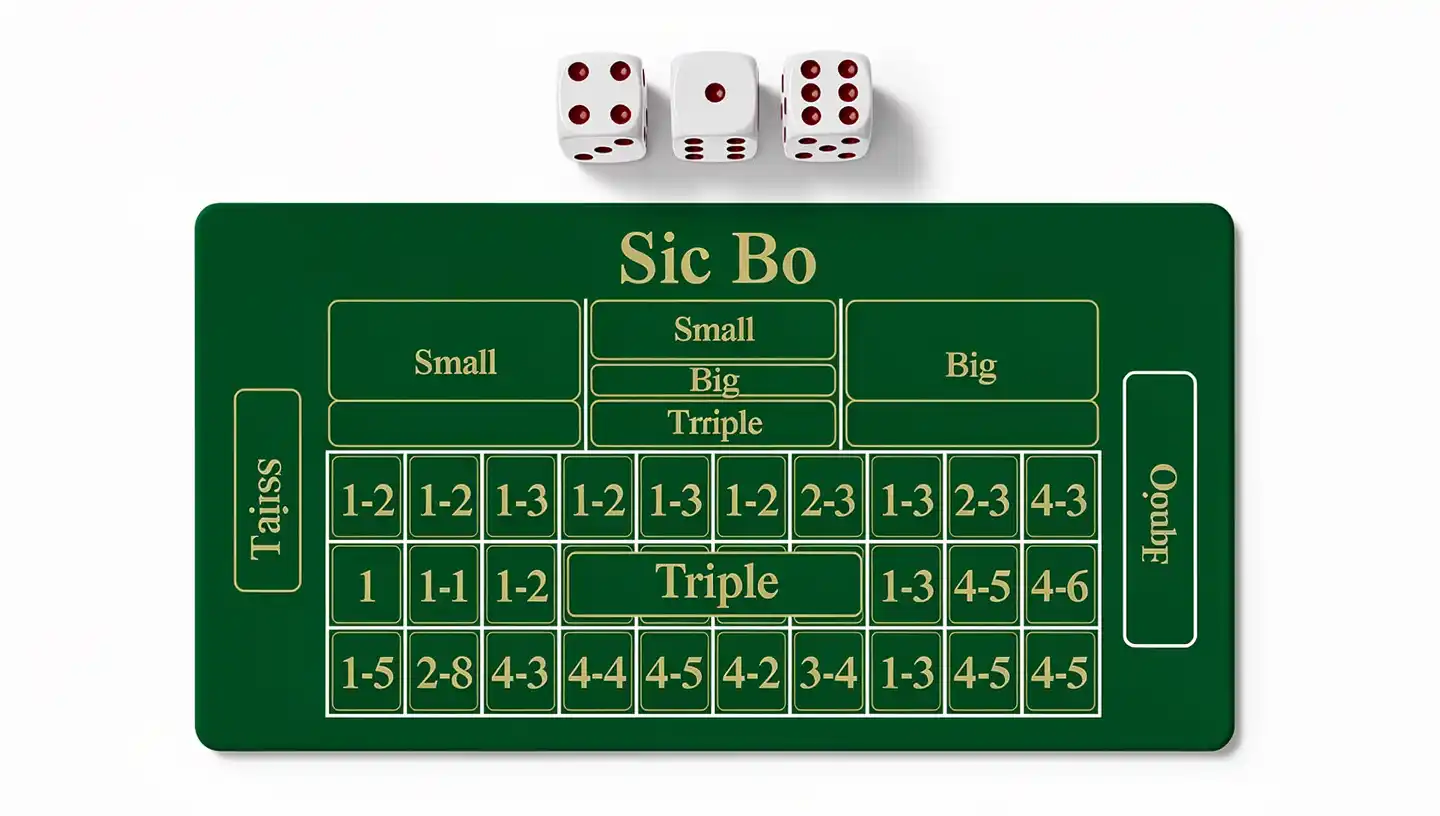
Sic Bo takes a completely different approach, built entirely around dice rather than cards, with betting variety standing in for the kind of in-hand decisions blackjack revolves around. It rewards a different instinct than blackjack does, closer to picking the right bet than playing the right hand, and the pace tends to move noticeably faster since there is no drawing or standing involved at all.
Many players who enjoy the social energy of a casino floor but find card counting concepts a little dry tend to gravitate toward it fairly quickly once they finally give it a proper honest try.
Roulette sits somewhere between the two, simple enough to learn in a few minutes but with enough betting combinations to keep things interesting over a long session.
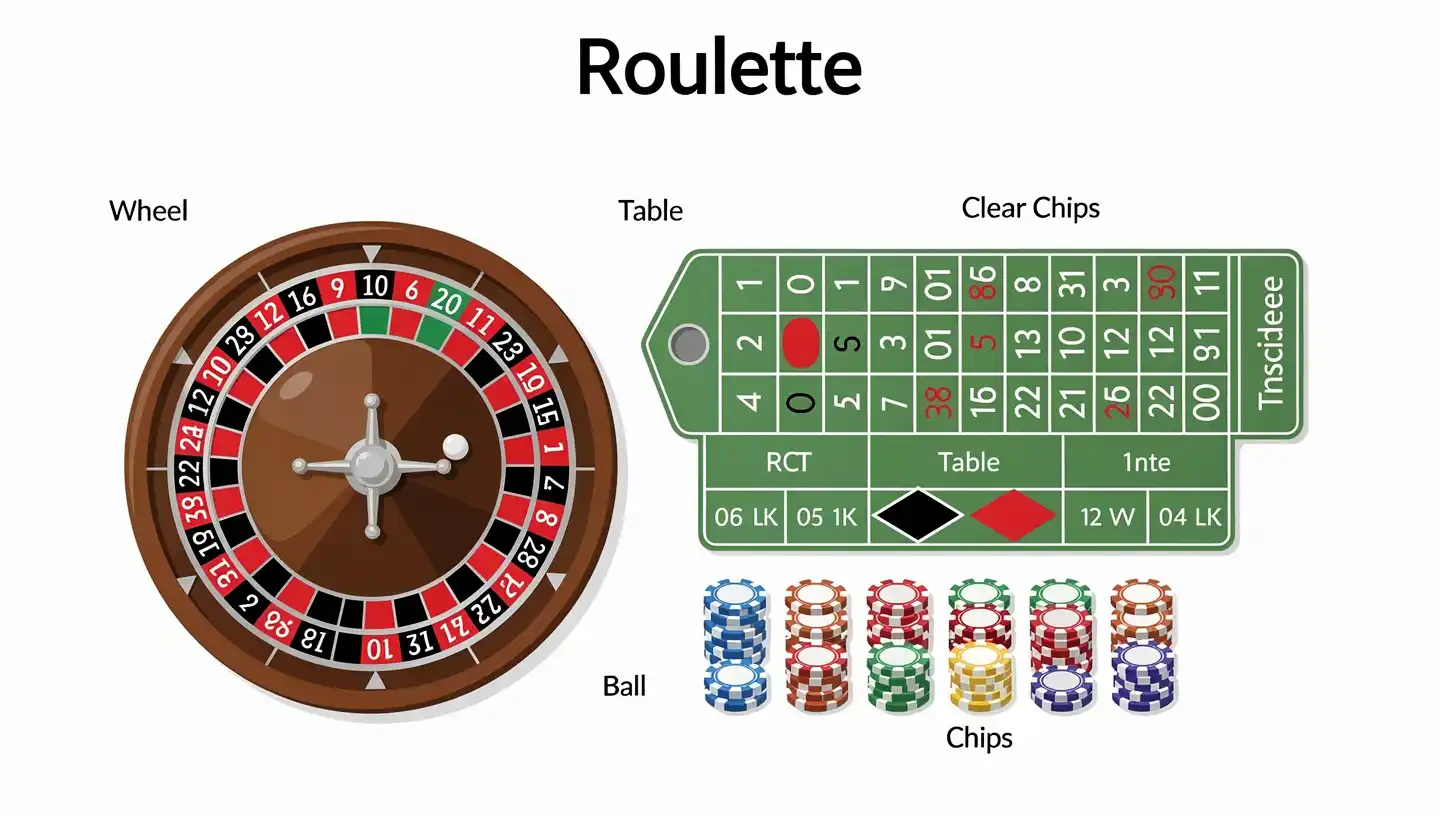
None of these games require you to unlearn anything from blackjack, so trying them costs nothing but a little curiosity and perhaps a smaller starting bet while you get a feel for how each one plays out in practice.
Whichever games you settle on, it is worth treating your bankroll the same way regardless of which table you are sitting at. Setting a loss limit before you play, rather than deciding in the middle of a bad run, is the single easiest habit to build, and it works exactly the same whether you are at a blackjack table, a baccarat table, or standing at the roulette wheel.
Our guide on responsible gambling limits covers exactly how to set one up in a couple of minutes, and it applies just as much at a blackjack table as anywhere else in the casino, whether you are just starting out or have been playing for years.
Blackjack rewards patience more than most casino games, and it is one of the few where the small decisions genuinely add up over time. Learning the basic rules covered here gets you to the table with confidence, and picking up the small strategy habits over your next few sessions is what actually closes the gap between the house and you, hand after hand.
Frequently asked questions
What are the basic rules of blackjack?
You and the dealer are each dealt two cards, and you try to get closer to 21 than the dealer without going over. You can hit to take more cards or stand to keep your total, and the dealer must follow a fixed rule of hitting on 16 or less and standing on 17 or higher regardless of the situation at the table.
What happens if I get a blackjack?
A blackjack is a starting hand of an ace plus a 10-value card, totaling 21 on your first two cards dealt. It beats every other hand except a tie with the dealer’s own blackjack, and it typically pays 3:2 instead of the standard 1:1 payout, though some tables reduce this to 6:5, which is worth avoiding if you have a choice of tables.
When should I hit or stand?
As a general rule, stand on 12 through 16 if the dealer’s visible card is 2 through 6, and hit on 12 through 16 if the dealer shows 7 through ace. Always hit on any total of 11 or lower, since there is no risk of busting no matter what card comes next.
What is a soft hand in blackjack?
A soft hand is any hand containing an ace that can be counted as 11 without going over 21, such as an ace and a 6 forming a soft 17. Soft hands give you more flexibility, since you cannot bust by taking another card while the ace still counts as 1 if needed, which changes the correct play compared to a hard hand showing the same total.
Is card counting illegal?
Card counting is not illegal in the traditional sense, since it involves nothing more than tracking cards that have already been played using your own memory rather than any device or outside assistance. Casinos are private businesses, though, and can legally ask a suspected counter to leave or stop playing blackjack at their tables. Our guide on how blackjack card counting works covers the method itself and why casinos treat it so seriously despite it not breaking any actual law.