Every bet on a craps table looks roughly the same from the outside: chips on felt, a payout printed nearby, and a dealer sliding you winnings when the dice cooperate. Underneath that, the numbers are wildly different. Some bets on that table are among the best value in any casino. Others quietly cost you more than ten times as much for the same dollar wagered. This guide breaks down the real math behind every craps bet, from the one wager with genuinely zero house edge to the proposition traps that look exciting and cost a fortune over time.
How craps odds actually work
Every craps bet is priced using three numbers that work together. True odds are the actual mathematical probability of a bet winning, based purely on how many ways the dice can produce that result. Payout odds are what the casino actually pays you when you win. The gap between those two numbers is the house edge, expressed as a percentage of your wager that the house keeps over the long run.
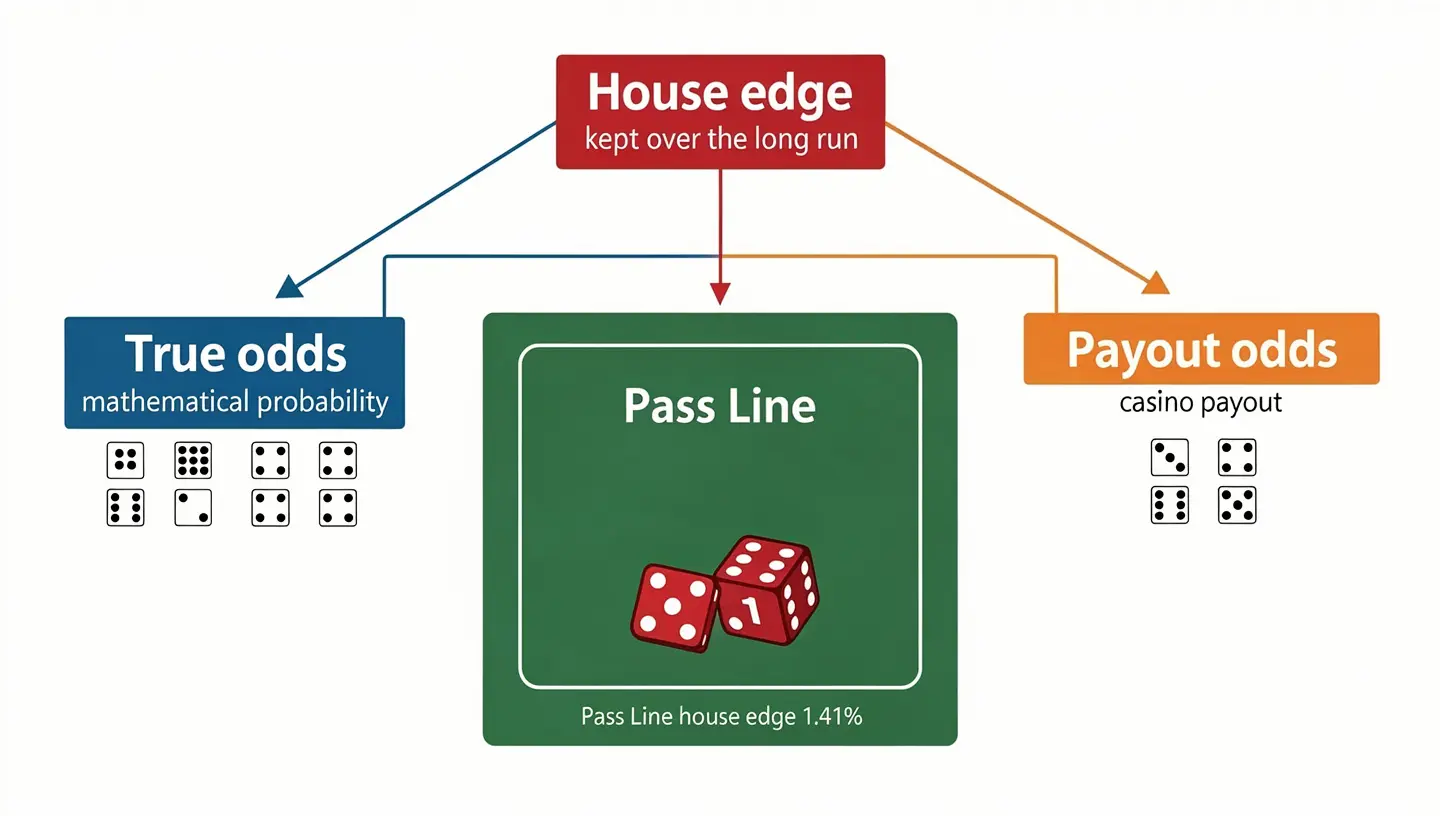
Say you bet $100 on the Pass Line, where the house edge sits at 1.41 percent. Over the long run, you’d expect to lose about $1.41 for every $100 wagered on that bet. That doesn’t mean you lose exactly $1.41 every session, since short-term swings can go either way. It means that across thousands of bets, your average result settles near that number. The lower the house edge, the better the bet is for your bankroll, and that single idea is the foundation for everything else in this guide.
The dice math behind every craps bet
Two six-sided dice produce 36 possible combinations, and those combinations are not evenly spread across the numbers 2 through 12. Some totals can be made far more ways than others, and that difference is the entire reason craps payouts look the way they do.
| Number | Ways to roll it | Probability |
|---|---|---|
| 2 or 12 | 1 | 2.78% |
| 3 or 11 | 2 | 5.56% |
| 4 or 10 | 3 | 8.33% |
| 5 or 9 | 4 | 11.11% |
| 6 or 8 | 5 | 13.89% |
| 7 | 6 | 16.67% |
Seven leads the table with six ways to appear, which is exactly why it decides so much of the game. On the come-out roll, seven is your friend, since it wins the Pass Line instantly along with eleven. Once a point is set, seven turns into the enemy, since rolling it before the point comes back around ends the bet as a loss. If you want a full walkthrough of how a round unfolds from the first roll onward, the craps rules guide covers the come-out roll and point phase in detail.
Pass Line and Don’t Pass odds
Pass Line payout and house edge
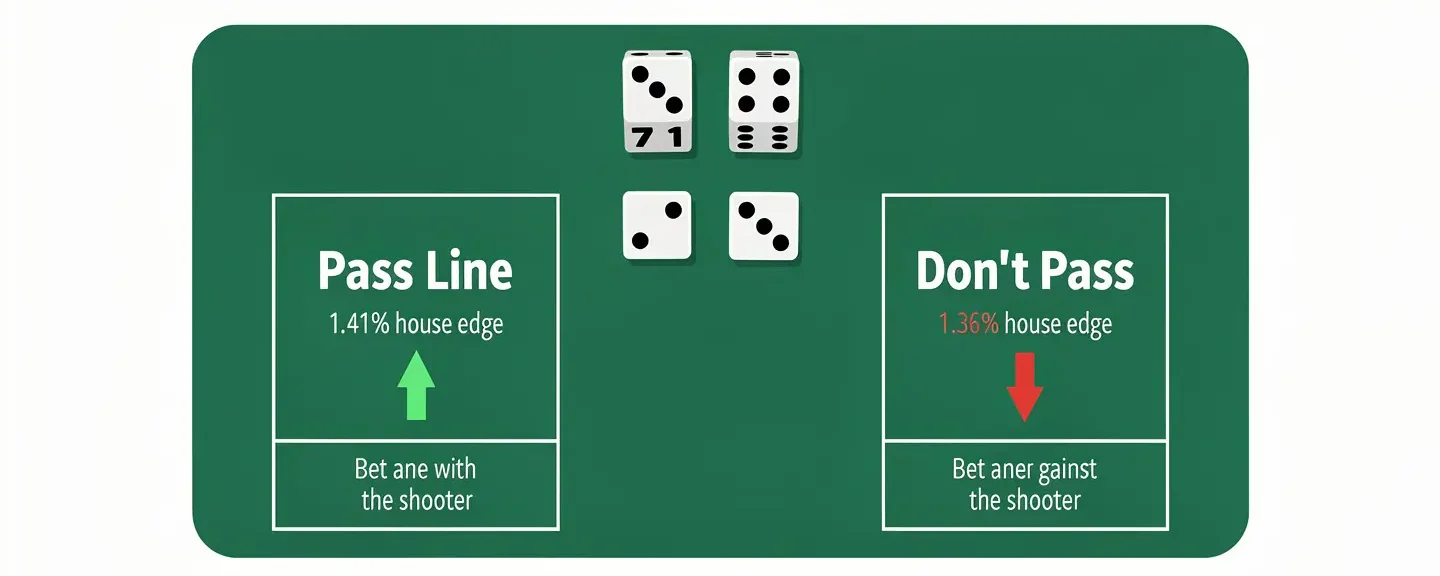
The Pass Line bet pays even money, 1 to 1, so a $10 bet wins $10. It wins instantly on a come-out roll of 7 or 11, loses instantly on 2, 3, or 12, and any other number becomes the point. From there, the Pass Line wins if that point number comes up again before a 7. The house edge on the Pass Line sits at 1.41 percent, one of the strongest standalone wagers in any casino.
Don’t Pass payout and house edge
The Don’t Pass bet also pays even money and bets against the shooter. It wins on a come-out roll of 2 or 3, loses on 7 or 11, and pushes on 12, meaning your bet is simply returned. Once a point is set, Don’t Pass wins if a 7 shows up before the point does. The house edge here runs slightly lower than the Pass Line, at 1.36 percent, making it a fraction better on paper, even though betting against the table can feel unwelcome at a lively live game.
Come and Don’t Come bets explained
A Come bet works exactly like a fresh Pass Line bet, except you can only place it after a point has already been set. The next roll becomes that Come bet’s own personal come-out roll, resolving instantly on a 7 or 11, losing instantly on 2, 3, or 12, and turning any other number into that bet’s own point to chase. A Don’t Come bet mirrors it the same way Don’t Pass mirrors the Pass Line, betting that a 7 shows up before the new point does. Both let you add fresh action to the table after the shooter’s main point is already locked in, and both carry the same house edge figures as their Pass Line and Don’t Pass counterparts.
The Odds bet, the only zero house edge wager in the casino
The Odds bet is the single best wager in any casino. Once a point is set, you can back your Pass Line, Don’t Pass, Come, or Don’t Come bet with an Odds bet, and it pays out at the true mathematical probability of that outcome, with nothing added on top for the house. The house edge on this bet is exactly 0 percent.
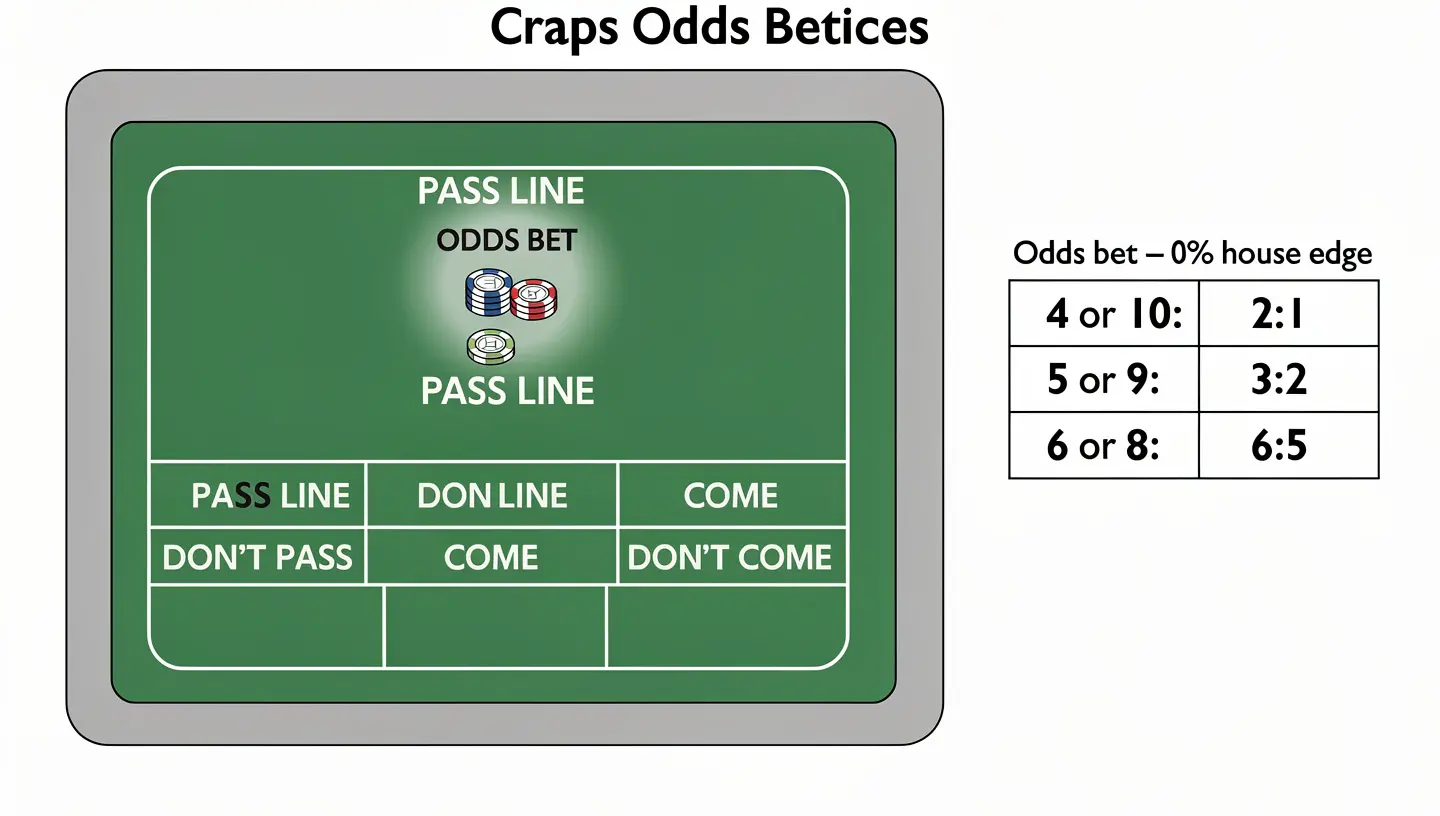
The Odds bet cannot be placed on its own. It only exists as a backup to one of the four main line bets, once a point is on the table. Because it pays true odds instead of even money, the payout ratio changes depending on which point number you’re backing.
| Point number | Odds payout (taking) | House edge |
|---|---|---|
| 4 or 10 | 2 to 1 | 0% |
| 5 or 9 | 3 to 2 | 0% |
| 6 or 8 | 6 to 5 | 0% |
Taking Odds vs Laying Odds
Taking Odds means backing a Pass Line or Come bet, betting that the point comes up before a 7. Laying Odds is the reverse, backing a Don’t Pass or Don’t Come bet by betting that a 7 shows up before the point. Since a 7 is more likely than any single point number, laying odds means risking more to win less. On a point of 4, for example, taking odds pays 2 to 1, while laying odds against that same 4 means betting 2 to win 1. Both directions carry the same 0 percent house edge, just structured differently depending on which side of the table you’re playing.
What is 3-4-5x odds
Most tables cap how much you can add in Odds relative to your base bet, and the most common structure in the United States is 3-4-5x odds. That means you can take 3 times odds on points of 4 or 10, 4 times odds on 5 or 9, and 5 times odds on 6 or 8. A $10 Pass Line bet under this structure allows $30 in odds on a 4 or 10, $40 on a 5 or 9, and $50 on a 6 or 8. Combining a Pass Line bet with maximum odds drags your combined house edge down to somewhere around 0.37 percent, among the lowest figures you’ll find anywhere on a casino floor.
Place bets and Buy bets compared
A Place bet lets you wager directly on 4, 5, 6, 8, 9, or 10 coming up before a 7, without needing to wait for that number to become a Come bet’s point. Unlike the Odds bet, Place bets do not pay true odds, so the casino keeps a built-in edge here regardless of which number you choose.
| Number | Payout | House edge |
|---|---|---|
| 6 or 8 | 7 to 6 | 1.52% |
| 5 or 9 | 7 to 5 | 4.00% |
| 4 or 10 | 9 to 5 | 6.67% |
A Buy bet targets the same numbers but pays true odds instead of the reduced Place bet payout, in exchange for a commission the casino charges upfront, usually 5 percent. On the 4 and 10, a Buy bet’s house edge of roughly 4.76 percent beats the Place bet’s 6.67 percent, which is why experienced players often buy the 4 and 10 rather than placing them, while sticking to a straight Place bet on 6 and 8 where the difference barely matters. Some players test this kind of bet sizing using funds from a bonus type that covers table games, since it keeps the real bankroll untouched while you compare Place and Buy payouts for yourself.
Field bet and Hardways explained
The Field bet is a one-roll wager covering 2, 3, 4, 9, 10, 11, and 12 at once. Roll any of those numbers and you win, usually at even money, though 2 and 12 sometimes pay double or triple depending on the table. Roll a 5, 6, 7, or 8 instead and the Field bet loses. Despite covering seven different numbers, the house edge on a standard Field bet sits around 5.56 percent, since the four missing numbers, especially 6, 7, and 8, come up far more often than the ones the bet actually covers.
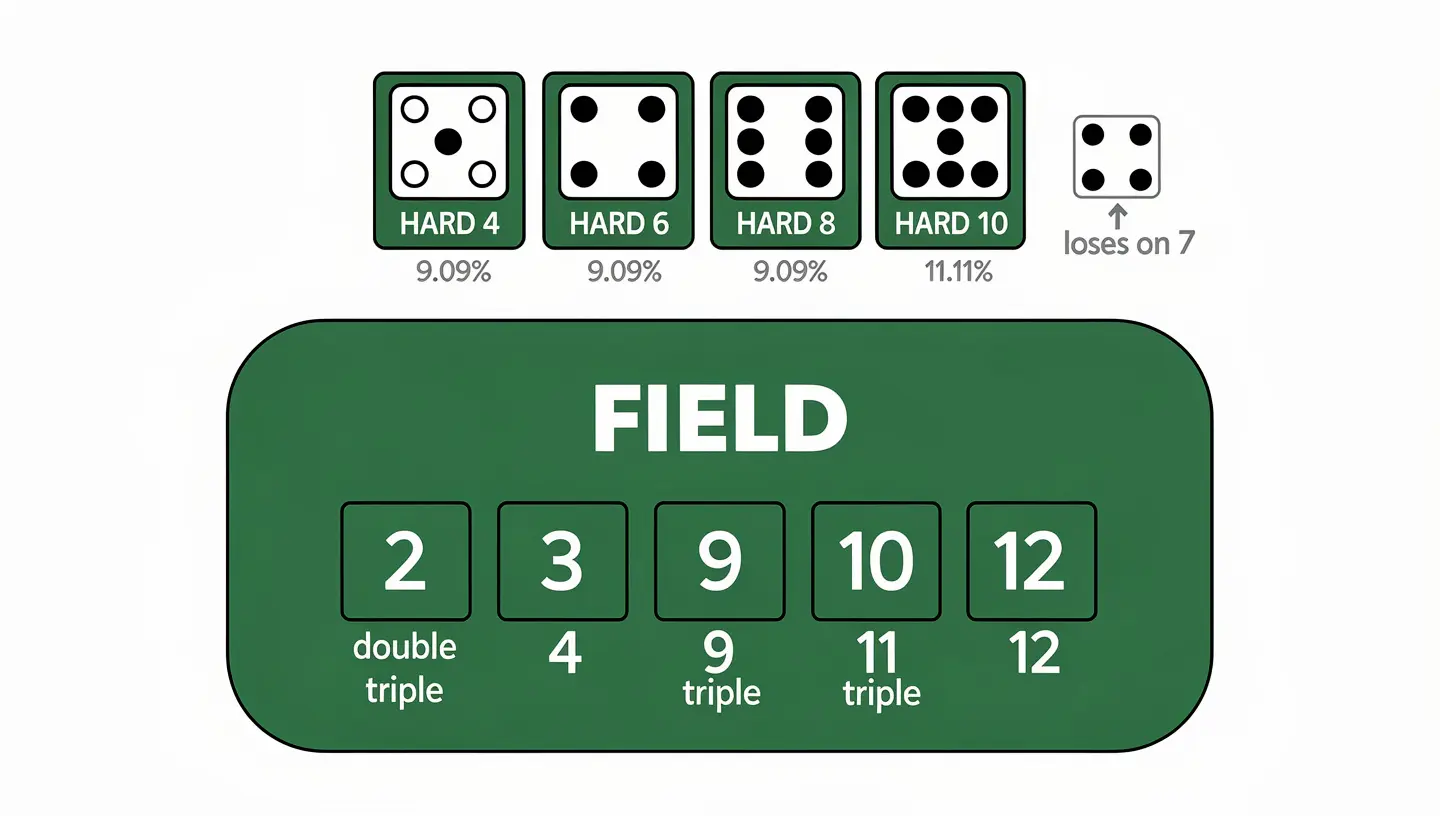
Hardways bets win if a specific number rolls as a matching pair, such as two 3s for a hard 6, before that same total shows up any other way or a 7 appears first. Hard 6 and hard 8 carry a house edge of about 9.09 percent, while hard 4 and hard 10 run higher, around 11.11 percent. These are fun bets to have riding during a session, but they sit firmly in the entertainment category rather than anything resembling a sound betting plan.
Proposition bets and why most of them are traps
Proposition bets, sitting in the center of the table and handled by the stickman, resolve on a single roll and carry the steepest house edges anywhere on the layout.
| Bet | Wins if | House edge |
|---|---|---|
| Any Seven (Big Red) | Next roll is a 7 | 16.67% |
| Any Craps | Next roll is 2, 3, or 12 | 11.11% |
| Horn | Next roll is 2, 3, 11, or 12 | 12.50% |
| Snake Eyes or Boxcars | Next roll is a 2 or 12 | 13.89% |
Any Seven is the single worst bet on the entire table. For every $100 wagered on it, the house expects to keep $16.67, compared with just $1.41 on the Pass Line. You’d need to win far more often than the dice allow just to break even with what a Pass Line bettor already gets. Dice games built around one-roll wagers like this show up elsewhere too, and the same lesson applies when comparing these craps proposition bets with the fast, flashy-looking wagers found in sic bo.
Big 6 and Big 8, the bet to avoid
The Big 6 and Big 8 bets deserve a specific warning of their own. They win on the exact same condition as a Place bet on 6 or 8, rolling that number before a 7. The difference is the payout. Big 6 and Big 8 pay even money, 1 to 1, while a Place bet on the same numbers pays 7 to 6. That single difference pushes the house edge on Big 6 and Big 8 up to 9.09 percent, compared with just 1.52 percent on the equivalent Place bet. It’s the exact same outcome with a far worse payout attached, and there is no situation where choosing Big 6 or Big 8 over a Place bet makes sense.
Best craps bets ranked by house edge
- Odds bet: 0%, the only bet in any casino with zero built-in house edge
- Don’t Pass / Don’t Come: 1.36%, slightly better than the Pass Line
- Pass Line / Come: 1.41%, the standard foundation bet at the table
- Place 6 or 8: 1.52%, the best non-line bet available
- Buy 4 or 10: 4.76%, better than placing the same numbers once you’re betting $20 or more
Worst craps bets to avoid
- Any Seven: 16.67%, the single worst bet on the table, avoid it entirely
- Snake Eyes / Boxcars: 13.89%, exciting to hit, expensive to chase
- Horn: 12.50%, splits your wager across four numbers, all with double-digit edges
- Any Craps / Hardways: 9.09% to 11.11%, treat these as entertainment, never as strategy
- Big 6 / Big 8: 9.09%, the same bet as Place 6/8 with a much worse payout
The most common mistake beginners make is chasing the flashy payouts in the middle of the table without checking the house edge attached to them first. A $5 bet on Any Seven costs you roughly $0.83 per bet on average, while the same $5 on the Pass Line costs about seven cents. Over a full session, that gap adds up fast.
How craps odds compare to other casino games
Craps holds up well against nearly everything else on the casino floor once you stick to the right bets. A Pass Line bet backed with maximum odds pushes the combined house edge down to roughly 0.37 percent. For comparison, basic strategy blackjack runs close to 0.5 percent, and baccarat sits around 1.06 percent on the banker bet.
A double-zero American roulette wheel carries a much steeper 5.26 percent, thanks to that extra green pocket sitting on the wheel, while its single-zero counterpart drops to 2.70 percent. Craps earns its strong reputation mainly because of the Odds bet, since very few games anywhere hand you a wager with genuinely zero house edge, let alone one you can stack directly behind an already low-edge bet. Anyone weighing craps against a spinning wheel instead of dice can find the full breakdown of pocket counts and payouts in the roulette variants guide.
How to read and calculate craps payouts
Craps payouts are written as ratios like 7:6, 9:5, or 30:1, and casinos phrase them as “to” rather than “for.” A payout of 7 to 6 means a $6 wager wins $7, on top of getting your original $6 back. Reading it as “7 for 6” instead would wrongly suggest your original stake gets swallowed into that $7, so the wording matters more than it looks.
To work out a Place bet on 8, which pays 7 to 6, break your wager into $6 units. A $30 bet is five units of $6, so multiply five by $7 to get a $35 payout if the 8 rolls before a 7. The same logic applies to any ratio on the table, and betting in the correct increments for that ratio, multiples of $6 for a 6 or 8, multiples of $5 for a 5 or 9, avoids the dealer having to round your payout down.
Tips for using craps odds to your advantage
Set a session bankroll before you sit down and stick to it regardless of how the dice are running. Build your bets around the Pass Line or Don’t Pass, add maximum Odds once a point is set, and treat everything in the center of the table as optional entertainment rather than a core strategy. Checking general responsible gambling limits before your first session is a smart habit no matter which casino game you end up playing, since a fixed loss limit takes a lot of the guesswork out of deciding when to walk away. Groups such as BeGambleAware are also worth knowing about if a session ever stops feeling like entertainment and starts feeling like something harder to step away from.
If you’re testing these numbers online, the platform matters just as much as the bets you choose. A dice roll that isn’t genuinely random makes every house edge figure in this guide meaningless, so it pays to spend a couple of minutes confirming a site is properly licensed before you deposit anything. Sticking to a reputable online casino with a certified random number generator means the numbers in this guide actually hold up once real money is on the line. Independent references such as Wizard of Odds break these same figures down bet by bet if you want to verify the math for yourself.
What is the best bet in craps?
The Odds bet is the best bet in the entire casino, carrying a 0 percent house edge. Since it can only be placed behind a Pass Line, Don’t Pass, Come, or Don’t Come bet, the best overall combination is a Pass Line bet backed with maximum Odds, which pushes your combined house edge down to roughly 0.37 percent.
What is the difference between true odds and payout odds?
True odds are the actual mathematical probability of a bet winning, based purely on dice combinations. Payout odds are what the casino actually pays you when that bet wins. The house edge is the gap between the two, and it’s how the casino makes money on every bet except the Odds bet.
Why does the Odds bet have no house edge?
The Odds bet pays out at the exact true mathematical probability of the point number coming up before a 7, with nothing added on top for the casino. It’s the only wager in craps, and one of the only bets in any casino game, priced this way.
What is 3-4-5x odds in craps?
It’s the most common odds limit structure at U.S. tables, allowing 3 times your base bet in odds on points of 4 or 10, 4 times on 5 or 9, and 5 times on 6 or 8. A $10 base bet allows $30, $40, or $50 in odds depending on the point.
Why should I avoid Big 6 and Big 8?
Big 6 and Big 8 win on the same condition as a Place bet on 6 or 8, but they pay even money instead of 7 to 6. That gap alone raises the house edge from 1.52 percent to 9.09 percent for the exact same outcome, so a Place bet is always the better version of this wager.
What is the worst bet in craps?
Any Seven, sometimes called Big Red, is the worst bet on the table at a 16.67 percent house edge. It pays out whenever a 7 shows up on the very next roll, but the odds against it are steep enough that the payout never comes close to making up for how often it loses.
Does craps have better odds than blackjack or roulette?
A Pass Line bet backed with maximum odds, at roughly 0.37 percent, is competitive with basic strategy blackjack’s 0.5 percent house edge, and both easily beat European roulette’s 2.70 percent and American roulette’s 5.26 percent. The catch is that craps also offers some of the worst bets in any casino, so the comparison only holds if you stick to the right wagers.
How much does the house edge cost me per session?
It depends on the bet and how much action you put through it. A $10 bet with a 1.41 percent house edge, like the Pass Line, costs about 14 cents per bet on average over the long run. The same $10 on Any Seven, at 16.67 percent, costs roughly $1.67 per bet, nearly twelve times more expensive for the same entertainment.