A blackjack strategy chart is the one tool in the entire casino that actually changes the odds in your favor. Blackjack is the rare game where your decisions matter, and every hand you are dealt has one mathematically correct play. Learn that play, and you can shrink the house edge down to roughly half a percent, about as close to even as any game on the floor gets.
This guide explains what a blackjack strategy chart actually shows, how to read it, how the right move shifts with the number of decks in play, and the full set of hard totals, soft totals, and pairs you need to know before you sit down.
What Is a Blackjack Strategy Chart?
A blackjack strategy chart, also called a basic strategy chart, lays out the mathematically optimal decision for every possible hand you could hold against every card the dealer could be showing. It tells you exactly when to hit, stand, double down, split, or surrender, based purely on your total and the dealer’s upcard.
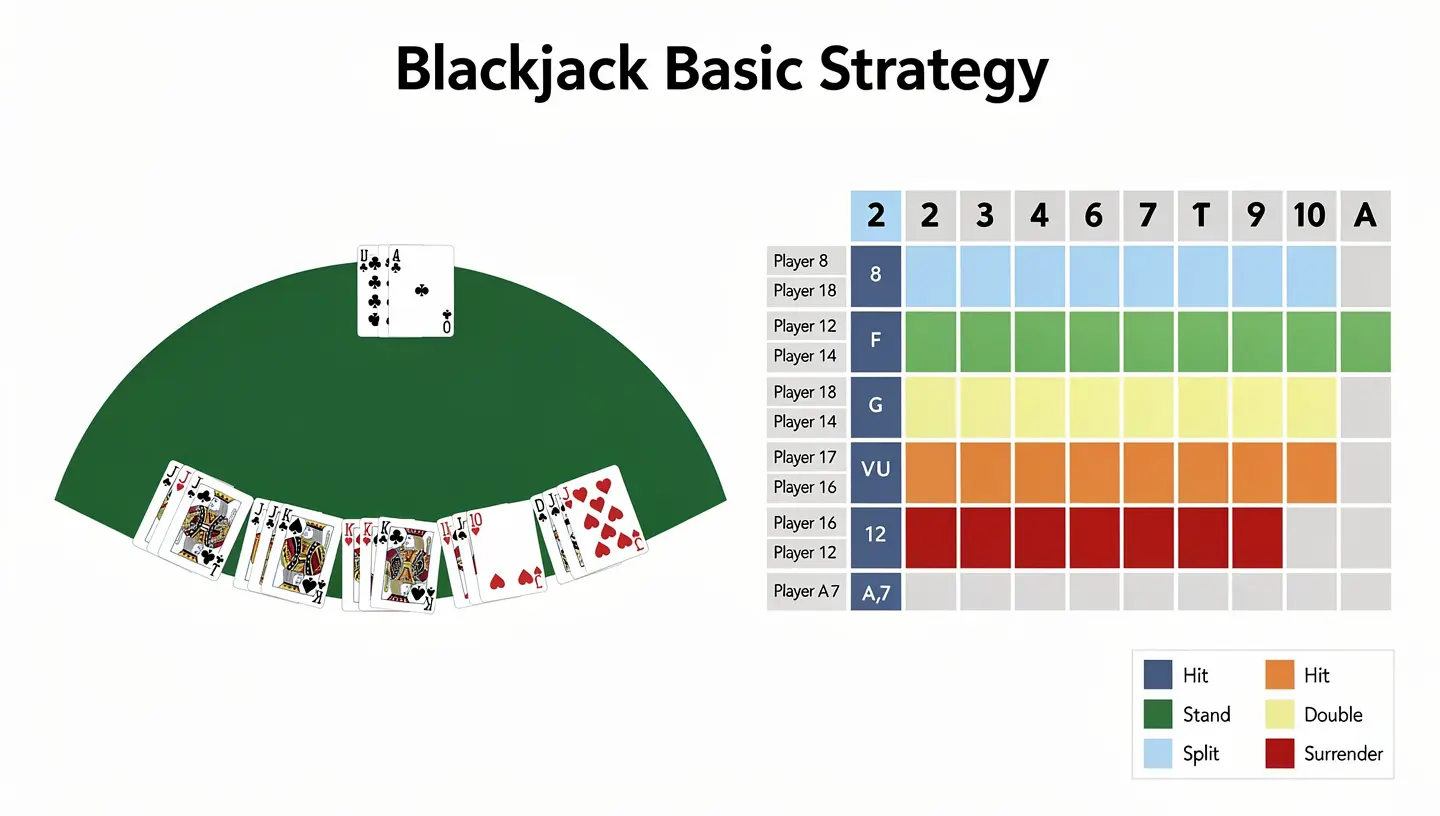
The chart works because blackjack is not random the way a slot machine spin is. The dealer follows fixed rules, your cards are visible, and one of the dealer’s two cards is face up, so the single best response to any situation can actually be calculated. Following the chart perfectly does not let you beat the house, since no chart can promise that. What it does is lower the house edge to roughly 0.5 percent in a standard 3 to 2 game, which means the casino keeps only about fifty cents of every hundred dollars wagered over the long run. A 6 to 5 payout, increasingly common on the Las Vegas Strip, adds close to 1.4 percentage points back onto that edge, nearly tripling your expected cost compared to a 3 to 2 table with identical rules otherwise.
How to Read a Blackjack Strategy Chart
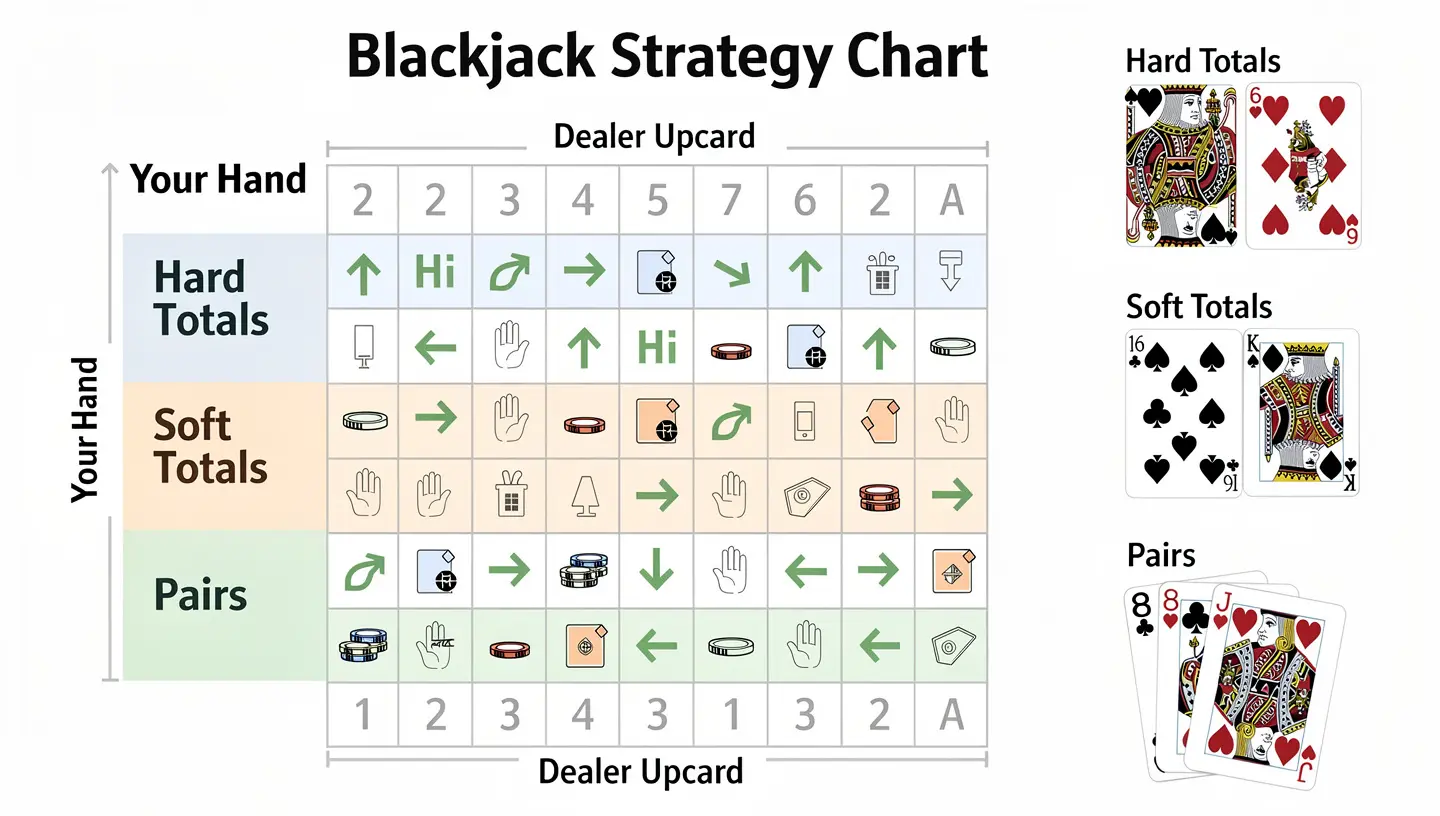
A blackjack strategy chart is a grid. Your possible hands run down the left side, the dealer’s upcard runs across the top from 2 through Ace, and the box where the two meet tells you the correct play. Once you understand the three sections that make up any chart, the whole thing becomes easy to follow.
Hard Totals
A hard total is any hand without an Ace, or one where the Ace has to count as 1 to avoid busting. These make up the majority of hands you will see. The shape of the chart here is intuitive once you think about it: stand on a hard 17 or higher, always hit a hard 8 or lower, and let the dealer’s upcard settle everything in between. A hard 12 through 16 is the real danger zone, where you stand against a weak dealer upcard of 2 through 6, since the dealer is likely to bust there, and hit against a strong 7 through Ace.
Soft Totals
A soft total counts an Ace as 11 without busting, such as Ace and 6 for a soft 17. Since one more card can never bust a soft hand, the chart gets noticeably more aggressive here. You will often hit or double down on soft hands that you would stand on if the same total showed up as a hard hand instead. A soft 18, for example, calls for a stand against weak dealer cards but a hit against a 9, 10, or Ace.
Pairs
When your first two cards match, the pairs section tells you whether to split them into two separate hands. Two rules anchor this entire section: always split Aces and 8s, and never split 10 value cards or 5s. Splitting Aces gives you two fresh shots at 21 instead of one awkward soft 12. Splitting 8s turns a weak hard 16 into two much stronger starting hands. A pair of 10s is already a strong 20 on its own, so breaking it apart to chase something better makes no sense at all.
The Order of Operations
When a new hand lands in front of you, work through your options in a fixed sequence so you never miss a stronger play buried further down the list.
- Surrender? If the table offers it and your hand falls into one of the handful of surrender spots, take it first.
- Split? If you are holding a pair the chart calls for splitting, do that before weighing anything else.
- Double? If the chart calls for doubling on your total, press the bet.
- Hit or Stand? If none of the above apply, fall back to the basic hit or stand decision.
Running through this order every single time keeps you from defaulting to a plain hit when a stronger move was sitting right there on the chart.
The Complete Blackjack Strategy Chart
Here is the full chart broken into its three sections. Find your hand on the left, follow the row across to the dealer’s upcard, and the cell tells you the correct play. This version assumes a standard multi-deck shoe where the dealer stands on soft 17.
| Hard Total | Correct Play |
|---|---|
| 8 or less | Always hit |
| 9 | Double vs dealer 3 to 6, otherwise hit |
| 10 | Double vs dealer 2 to 9, otherwise hit |
| 11 | Double vs dealer 2 to 10, otherwise hit |
| 12 | Stand vs dealer 4 to 6, otherwise hit |
| 13 to 16 | Stand vs dealer 2 to 6, otherwise hit |
| 17 or more | Always stand |
| Soft Total | Correct Play |
|---|---|
| Soft 13 to 14 (A,2 or A,3) | Double vs dealer 5 to 6, otherwise hit |
| Soft 15 to 16 (A,4 or A,5) | Double vs dealer 4 to 6, otherwise hit |
| Soft 17 (A,6) | Double vs dealer 3 to 6, otherwise hit |
| Soft 18 (A,7) | Double vs dealer 3 to 6, stand vs 2, 7, or 8, hit vs 9 through Ace |
| Soft 19 or more | Always stand |
| Pair | Correct Play |
|---|---|
| Aces or 8s | Always split |
| 10s or 5s | Never split |
| 9s | Split vs dealer 2 to 9 except 7, otherwise stand |
| 2s, 3s, or 7s | Split vs dealer 2 to 7, otherwise hit |
| 6s | Split vs dealer 2 to 6, otherwise hit |
| 4s | Split vs dealer 5 to 6, otherwise hit |
How the Chart Changes by Number of Decks
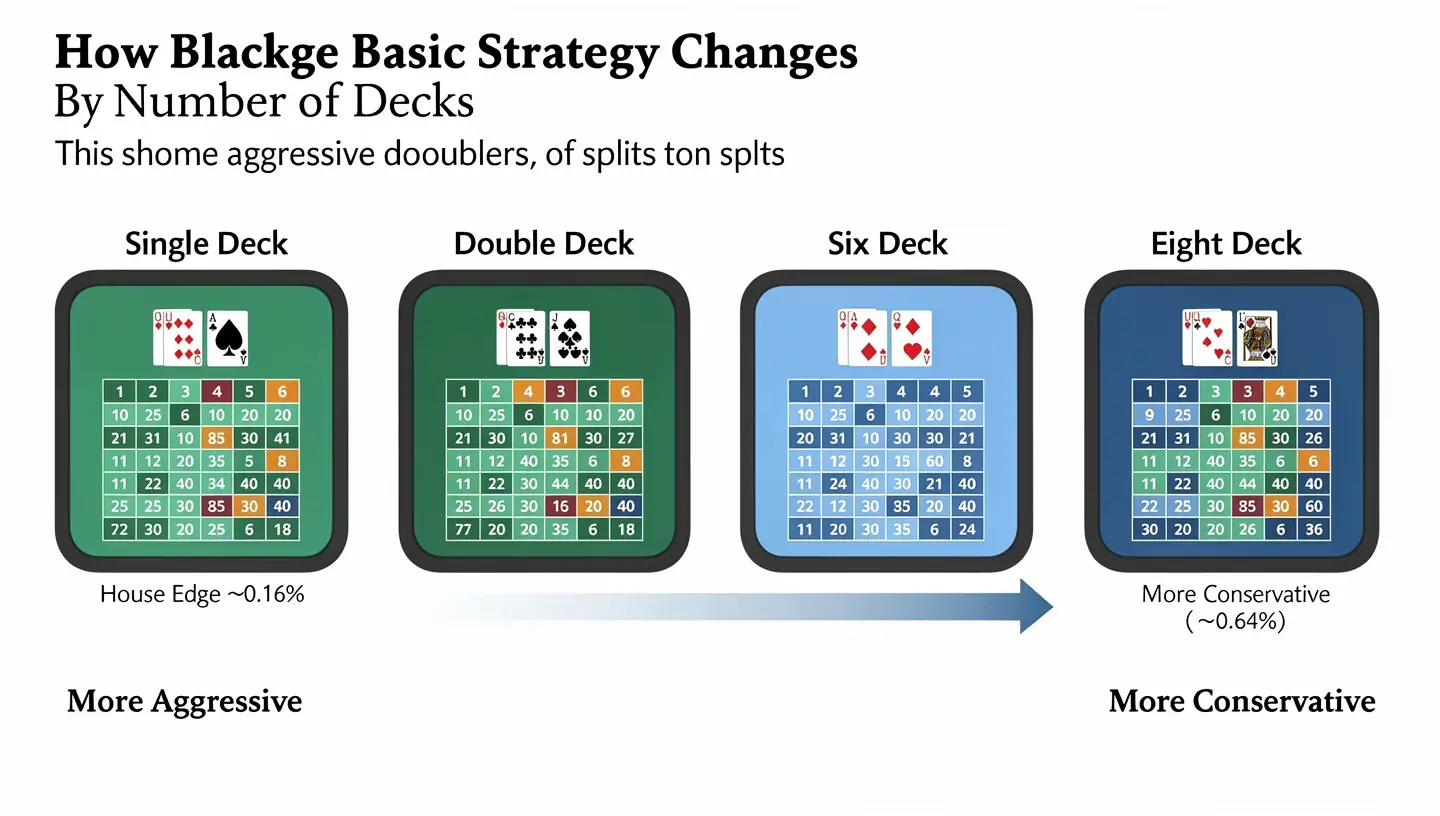
Basic strategy is not a single fixed chart. It shifts slightly depending on how many decks are in the shoe, since each additional deck changes the odds of drawing any particular card. The core moves stay the same across every version, but a handful of borderline calls flip. Fewer decks favor the player, and the chart becomes a bit more aggressive on doubles and splits as a result.
Single and Double Deck Strategy
Single deck blackjack is the most player friendly format before any rule variations are factored in, carrying a base house edge as low as roughly 0.16 percent with otherwise equal rules. It opens up a few extra doubling spots, such as doubling a soft 13 or 14 against dealer cards a multi-deck chart would simply tell you to hit against. Double deck strategy sits very close to single deck, with only minor differences around the same low totals.
Six and Eight Deck Strategy
Six deck and eight deck strategy are nearly identical to each other and represent the standard shoe game found across most casinos today. These charts run a touch more conservative than single or double deck versions, doubling down in slightly fewer spots since the odds of any specific next card are more stable with that many cards in play. A six deck game with otherwise equal rules typically runs closer to a 0.64 percent house edge, noticeably higher than single deck but still very playable with correct strategy.
Table Rules That Change the Chart
A handful of rules printed on the felt shift both the chart and the house edge, and it is worth knowing what each one means before you sit down.
| Rule | What It Means |
|---|---|
| S17 | Dealer stands on soft 17, better for the player |
| H17 | Dealer hits soft 17, slightly worse for the player |
| Double After Split (DAS) | Allows doubling after splitting a pair, player friendly |
| Late Surrender | Lets you fold a bad hand and reclaim half your bet |
None of these rules require memorizing an entirely new chart from scratch, but a few borderline plays do shift depending on which version you are sitting down to. Our guide on blackjack rules covers exactly how each of these variations works at the table, along with a few others worth checking before your first hand.
Key Strategy Decisions Explained
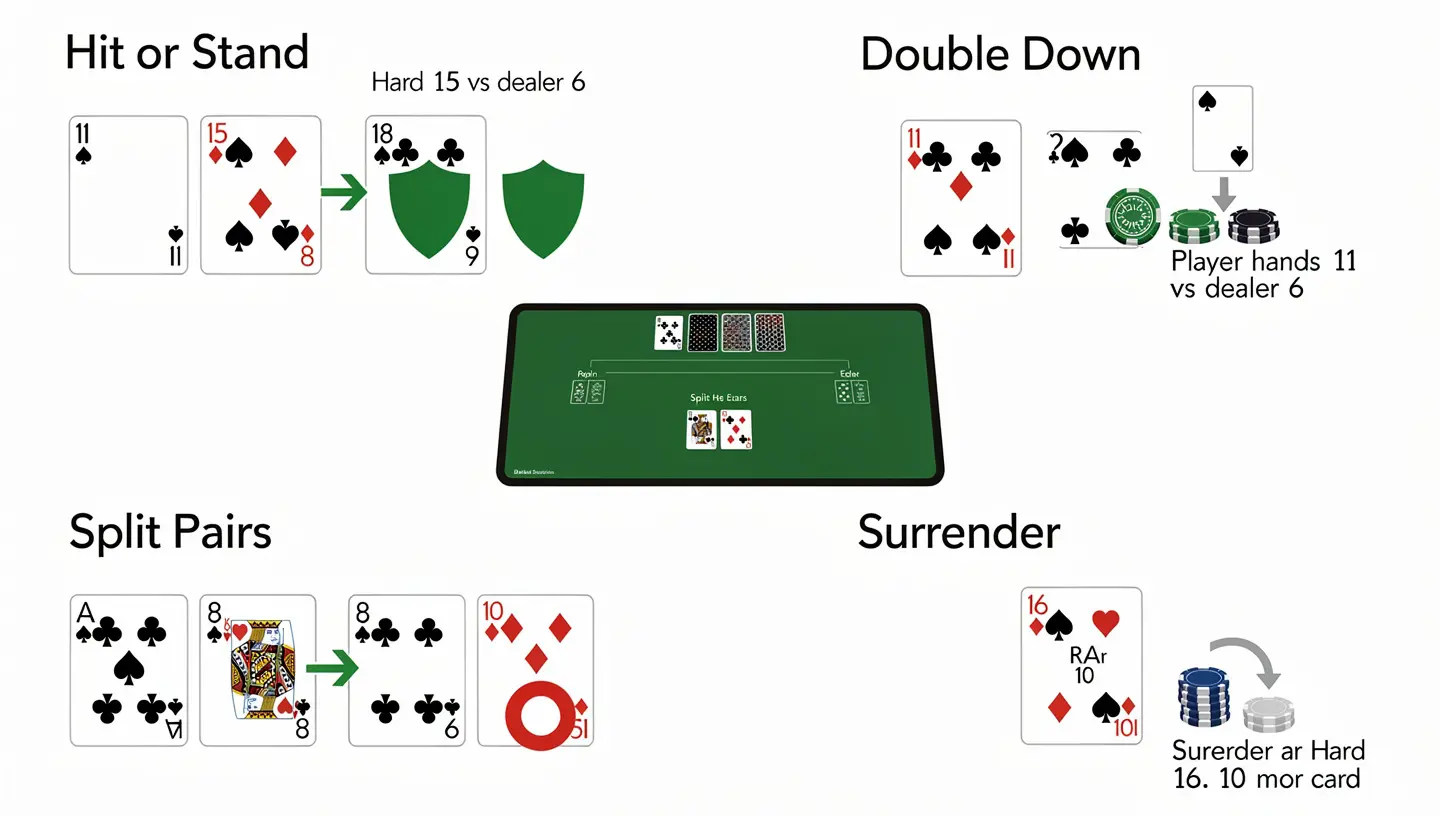
The chart breaks down into four recurring decisions. Understanding the reasoning behind each one is what separates actually knowing basic strategy from just memorizing a grid you do not fully trust.
When to Hit or Stand
This decision comes down to two things: how likely you are to bust, and how likely the dealer is to bust. Always hit a hard 11 or lower, since no single card can put you over 21 from there. Always stand on a hard 17 or higher. In the hard 12 to 16 range, let the dealer’s upcard guide you, standing against a weak 2 through 6 and hitting against a strong 7 through Ace.
When to Double Down
Doubling down means placing a second equal bet in exchange for exactly one more card, and it is how you press an advantage when the math genuinely favors you. The classic doubles are a hard 11 against almost any dealer card, a hard 10 against a dealer 9 or lower, and a hard 9 against a dealer 3 through 6. Several soft hands double as well against weaker dealer upcards. Double only when a single strong card is likely to win the hand outright, never as a pure gamble.
When to Split Pairs
Splitting breaks a pair into two separate hands, each carrying its own bet. The unbreakable rules stay simple: always split Aces and 8s, never split 5s or 10 value cards. Beyond those two, splitting 2s, 3s, 6s, 7s, and 9s mainly makes sense against weaker dealer upcards, where the dealer is more likely to bust anyway.
When to Surrender
Surrender, where a table offers it, lets you fold a losing hand and get half your bet back rather than risk the entire thing. It is a defensive move reserved for genuinely bad spots, most notably a hard 16 against a dealer 9, 10, or Ace, and a hard 15 against a dealer 10. Used correctly in just those situations, surrender shaves a small amount off the overall house edge. Not every table offers it, so check the felt or simply ask the dealer.
Why You Should Always Decline Insurance
When the dealer shows an Ace, the table offers an insurance side bet that pays out if the dealer has blackjack underneath. It sounds like protection, but the math says otherwise. The bet only wins about 31 percent of the time, and the payout does not compensate for how rarely it actually hits. Basic strategy calls for declining insurance on nearly every hand, regardless of how strong your own total looks, since taking it consistently costs money over the long run rather than saving it.
Is a Strategy Card Allowed at the Table?
Yes. A printable basic strategy chart or a small plastic strategy card is completely allowed at the table, and dealers see them constantly. Keeping one beside your chips and glancing at it before a decision is not cheating in any sense, it is simply using a reference the same way you might follow a recipe or a map. The most effective way to use one is as a learning aid you gradually lean on less, starting with the chart open for every hand and slowly covering sections as they become automatic.
Do Betting Systems Like Martingale Work?
Betting systems decide how much you wager from hand to hand, and it matters to be clear about what they can and cannot do. A betting system changes your bet size, not the odds of any individual hand, so nothing about a progression system lowers the house edge or guarantees a profit.
The Martingale system doubles your bet after every loss, aiming to recover everything with a single win. It sounds logical on paper, but a short losing streak escalates the stakes fast enough to run into the table maximum, meaning one bad stretch can wipe out a long run of small wins. The 1-3-2-6 system takes the opposite approach, increasing bets only after wins in a fixed 1, 3, 2, 6 sequence and resetting after any loss, which caps how much you can lose on a single bad streak. Either system can make a session feel more structured, but the actual edge reducer in blackjack has always been correct basic strategy, not how you size your bets.
Simplest Blackjack Strategy for Beginners
You do not need to memorize the entire chart before your first session. A short list of always-rules covers a large share of the hands you will actually see.
- Always split Aces and 8s, and never split 5s or 10 value cards.
- Always stand on a hard 17 or higher, and always hit a hard 11 or lower.
- Decline insurance every single time it comes up.
- Keep a strategy card at the table for everything that falls outside these basics.
- Play 3 to 2 tables whenever possible instead of 6 to 5, since the payout difference matters more than any strategy tweak.
Do those things consistently and you are already playing close to optimal. The point of a strategy chart is not to guarantee a win on any given hand, it is to hand the smallest possible edge back to the house and make your bankroll last considerably longer at the table.
Practicing with a free trainer online before sitting down for real money is one of the fastest ways to make these decisions feel automatic rather than something you have to think through under pressure. Running through a hundred or so practice hands with a chart open in front of you is usually enough to make most of the common calls feel instinctive rather than something you have to look up every single time.
Once you are ready to put a chart to use for real money, it is worth spending a few minutes checking the operator itself before you deposit anywhere. A license alone does not guarantee fair play, but it gives you somewhere to turn if a dispute ever comes up, and it usually means the casino’s games have gone through independent testing before ever reaching the public. Checking this ahead of time, rather than after a problem shows up, is one of the simplest habits worth building into your routine before you ever place a real money bet. Our guide on how to verify a casino license covers exactly what to check, including how to confirm a license number against a regulator’s own public records rather than trusting a homepage badge at face value.
Payout speed matters too once a good session actually pays off, since even the best strategy chart in the world means little at a casino that takes a week to release your winnings. Withdrawal times vary a lot between operators and payment methods, and knowing what to expect ahead of time saves you from an unpleasant surprise right after a strong night at the tables. Game selection and rule variety count for something as well, so it is worth checking whether an operator actually offers 3 to 2 tables before assuming every site treats blackjack the same way. Our roundup of the best payout online casinos compares operators on that exact point rather than relying on marketing claims plastered across a homepage. A fast, dependable payout process paired with genuinely favorable table rules is worth more than any single welcome bonus once you actually sit down to play, and the two together tell you far more about an operator than either one does on its own.
If you are still narrowing down where to play, it is worth looking past the game selection and checking the operator’s overall reputation first, since even the strongest strategy chart cannot save a session at a site you cannot trust. Our guide on choosing a reputable online casino covers what separates a trustworthy operator from one that just markets itself well, which matters just as much as the rules printed on any individual blackjack table.
Basic strategy lowers the house edge, but it does not remove variance from a single session, and a cold run can happen to even a player following the chart perfectly. Setting a budget before you sit down is worth doing regardless of how sharp your strategy is, since no chart protects you from a genuinely unlucky shoe running against you for an hour or more. Our guide on setting responsible gambling limits covers practical tools for keeping a session in check no matter which table game you prefer, whether that means a time limit, a loss limit, or simply the discipline to walk away once your budget runs out for the night. Sticking to that plan matters just as much as any single decision on the chart itself, since discipline is what actually keeps a good strategy working over the course of a full session rather than just a handful of hands, and it is the one part of the process that no chart can do for you automatically.
For an independent look at the math behind these numbers across different rule sets, Wizard of Odds breaks down house edge calculations for blackjack in far more technical detail than a single chart can show on its own, covering everything from single deck games to eight deck shoes with every rule variation in between.
Frequently Asked Questions
What is the best blackjack strategy?
Basic strategy is the best blackjack strategy available, since it is the mathematically optimal move for every hand against every dealer upcard. Played correctly at a 3 to 2 table, it lowers the house edge to roughly 0.5 percent, the lowest you can reach through play alone.
Does basic strategy guarantee a win?
No. Basic strategy minimizes the house edge but does not eliminate it, and no system guarantees a win on any single hand or session. What it does is make every decision the statistically best one available, so your bankroll lasts longer over time.
Is a blackjack strategy chart allowed at the table?
Yes. A printable chart or plastic strategy card can be used openly at the table, and dealers are used to seeing them. It is a simple way to play the correct move while a chart is still becoming second nature to you.
Does the chart change for single deck versus six deck?
The core moves stay the same, but a handful of borderline doubles and splits shift depending on deck count. Single and double deck charts are slightly more aggressive on doubling, while six and eight deck charts run a bit more conservative.
Does the Martingale betting system work in blackjack?
No. Martingale changes how much you bet after a loss, not the odds of any hand, so it does not lower the house edge or guarantee a profit. Doubling your bet repeatedly also risks hitting the table maximum during a long losing streak.
What is the simplest blackjack strategy for a beginner?
Start with the always-rules: split Aces and 8s, never split 5s or 10s, stand on a hard 17 or higher, hit a hard 11 or lower, and always decline insurance. Keep a strategy card at the table for everything else while those habits become automatic.