Craps looks like chaos the first time you see it. Players shouting, dice flying across a felt table covered in numbers, chips stacked in a dozen different spots. Underneath all that noise, though, craps runs on a handful of simple rules, and it happens to carry one of the best house edge figures of any game on the casino floor. This guide walks through how a round actually works, what every major bet means, and which wagers are worth your money and which ones exist mainly to separate beginners from their bankroll.
What is craps and how a round works
Craps is a dice game built around two six-sided dice and one player at a time acting as the shooter. Everyone else at the table can bet on the same rolls the shooter makes, so you never need to be the one throwing the dice to take part. A round starts with what’s called the come-out roll, and depending on what lands, that round either ends immediately or moves into a second phase where the shooter keeps rolling until the outcome is decided.
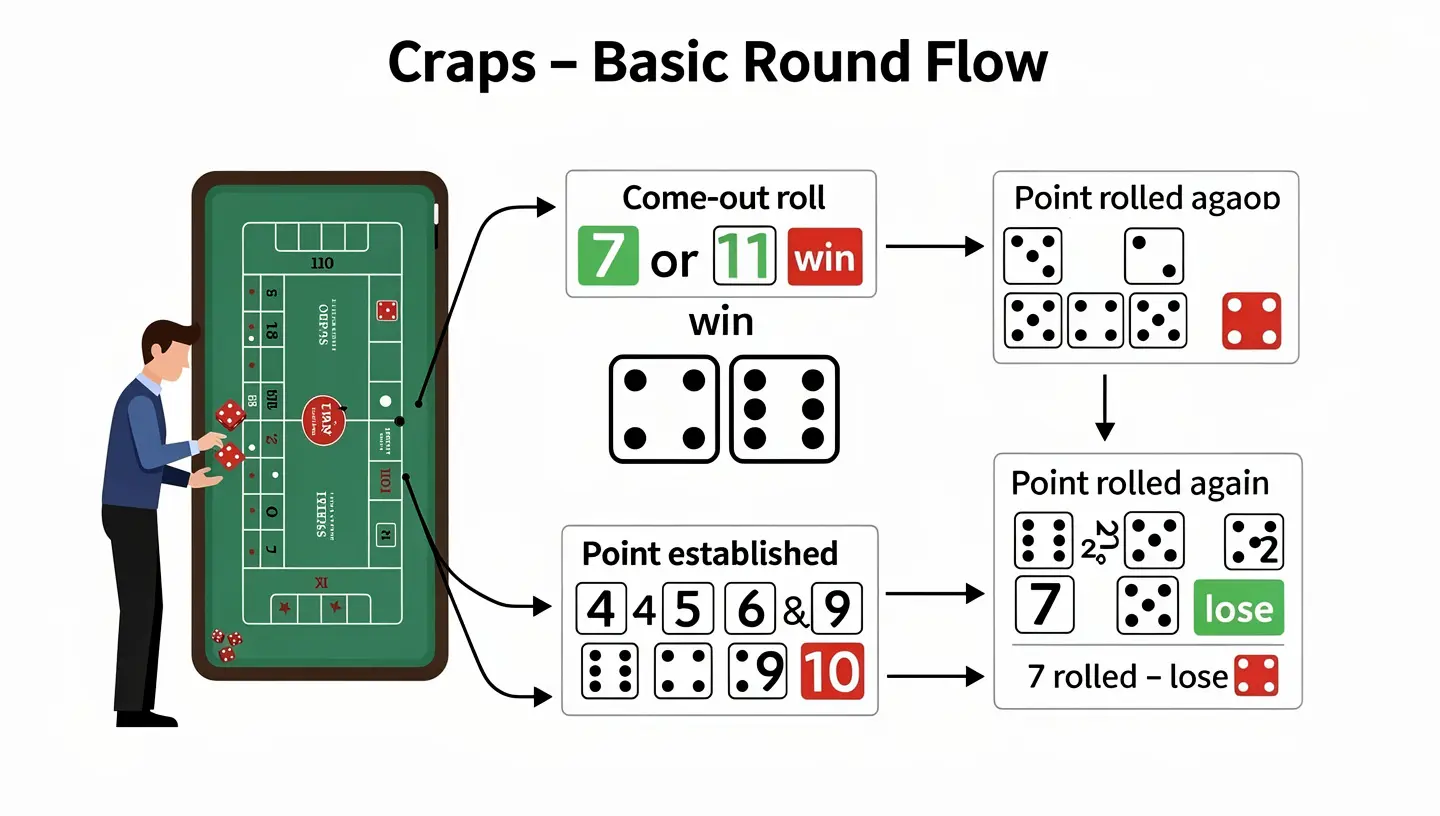
Two things settle almost every bet in craps: whether the shooter rolls a 7, and whether a specific number comes up first. That’s really the whole game once you strip away the terminology. The rest of this guide fills in exactly how the betting works, what each phase is called, and which wagers give you the best shot at walking away ahead.
How to play craps step by step
- Place a Pass Line or Don’t Pass bet. Every round of craps begins with one of these two wagers before the shooter throws the come-out roll.
- The shooter rolls the come-out roll. This is the first throw of the round.
- Check the result. A 7 or 11 is called a Natural and wins the Pass Line instantly. A 2, 3, or 12 is called Craps and loses the Pass Line instantly.
- Any other number becomes the point. A roll of 4, 5, 6, 8, 9, or 10 sets that number as the point, and the round moves into its second phase.
- The shooter keeps rolling. Once a point is set, players can add more bets, and the shooter rolls again and again until one of two things happens.
- The point hits or a 7 shows up. Roll the point number again before a 7 and the Pass Line wins. Roll a 7 first, known as sevening out, and the Pass Line loses, ending the shooter’s turn.
Understanding the come-out roll
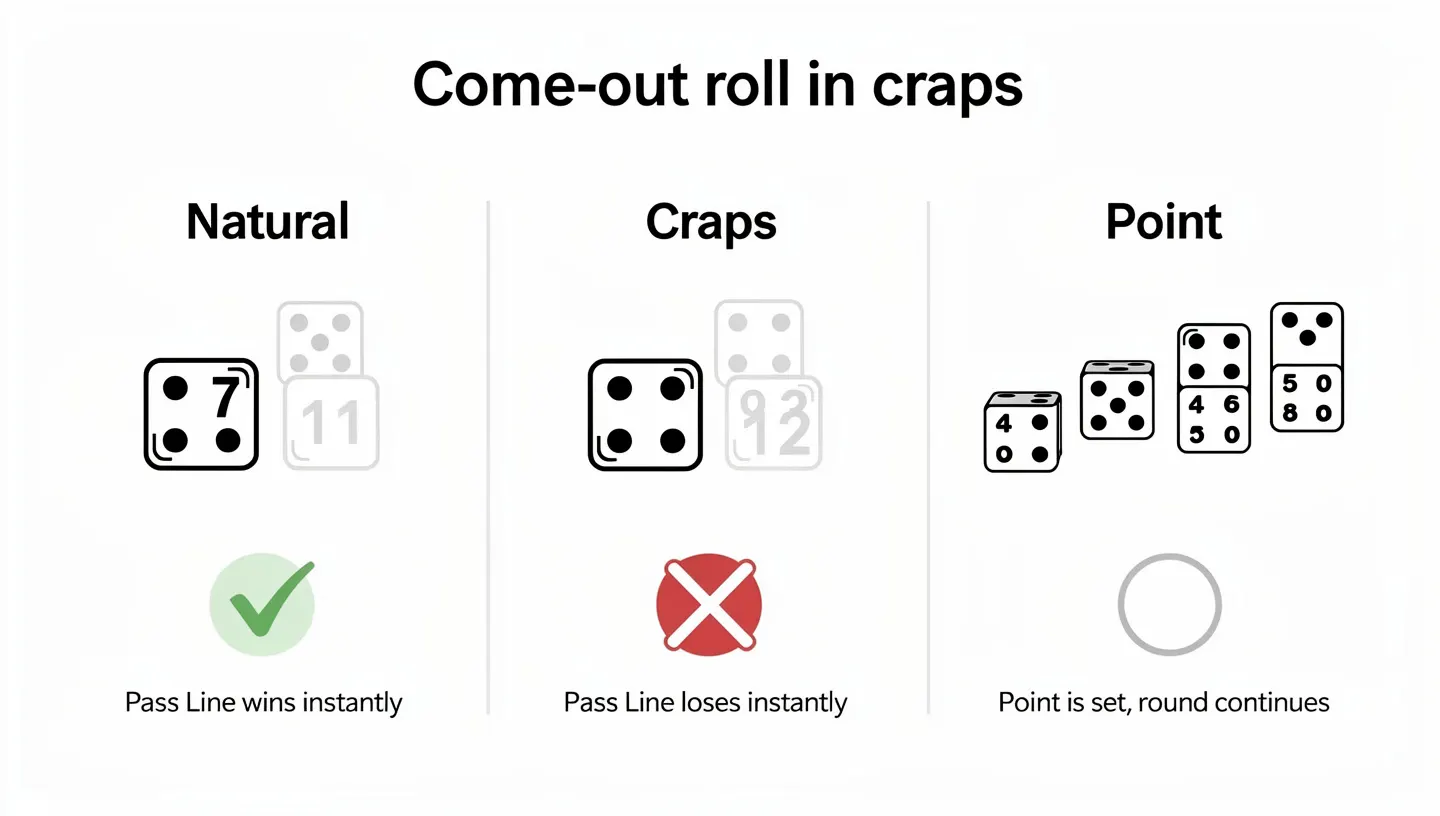
The come-out roll is the first throw of any new round, and its result decides almost everything that follows. There are only three possible outcomes.
| Roll | Called | Pass Line result | What happens next |
|---|---|---|---|
| 7 or 11 | Natural | Wins instantly | Round ends, new come-out roll begins |
| 2, 3, or 12 | Craps | Loses instantly | Round ends, new come-out roll begins |
| 4, 5, 6, 8, 9, or 10 | Point | Neither yet | Round continues into the point phase |
What happens when a point is established
Once a point number is set, the dealer marks it with a small disc called the puck, flipped to its white “ON” side and placed on that number. From here, the shooter keeps rolling until one of two things happens: the point number comes up again, which wins the Pass Line, or a 7 shows up first, which loses the Pass Line and ends the shooter’s turn. This second outcome is what players mean when they talk about sevening out. It’s also worth knowing that 6 and 8 are the two most common point numbers, since there are more dice combinations that add up to either of them than any other point.
Craps table layout and who runs the game
A craps table has three casino staff running the game at a physical table, though online versions handle all of this automatically. Learning who does what makes the whole table feel far less intimidating.
The puck, the boxman and the stickman explained
The puck is the small disc, white on one side reading “ON” and black on the other reading “OFF,” that shows whether a point is currently active and which number it sits on. The boxman is the seated supervisor who manages the table’s chip bank, handles buy-ins, and keeps track of each player’s action. The stickman stands across from the boxman, uses a long curved stick to return the dice to the shooter after each roll, calls out the results, and manages the proposition bets sitting in the center of the table. Knowing these three roles ahead of time means nothing at the table will catch you off guard.
Core craps bets every beginner should know
Craps offers dozens of possible wagers, but a small handful cover almost everything a new player needs. Start here before touching anything else on the table.
Pass Line bet
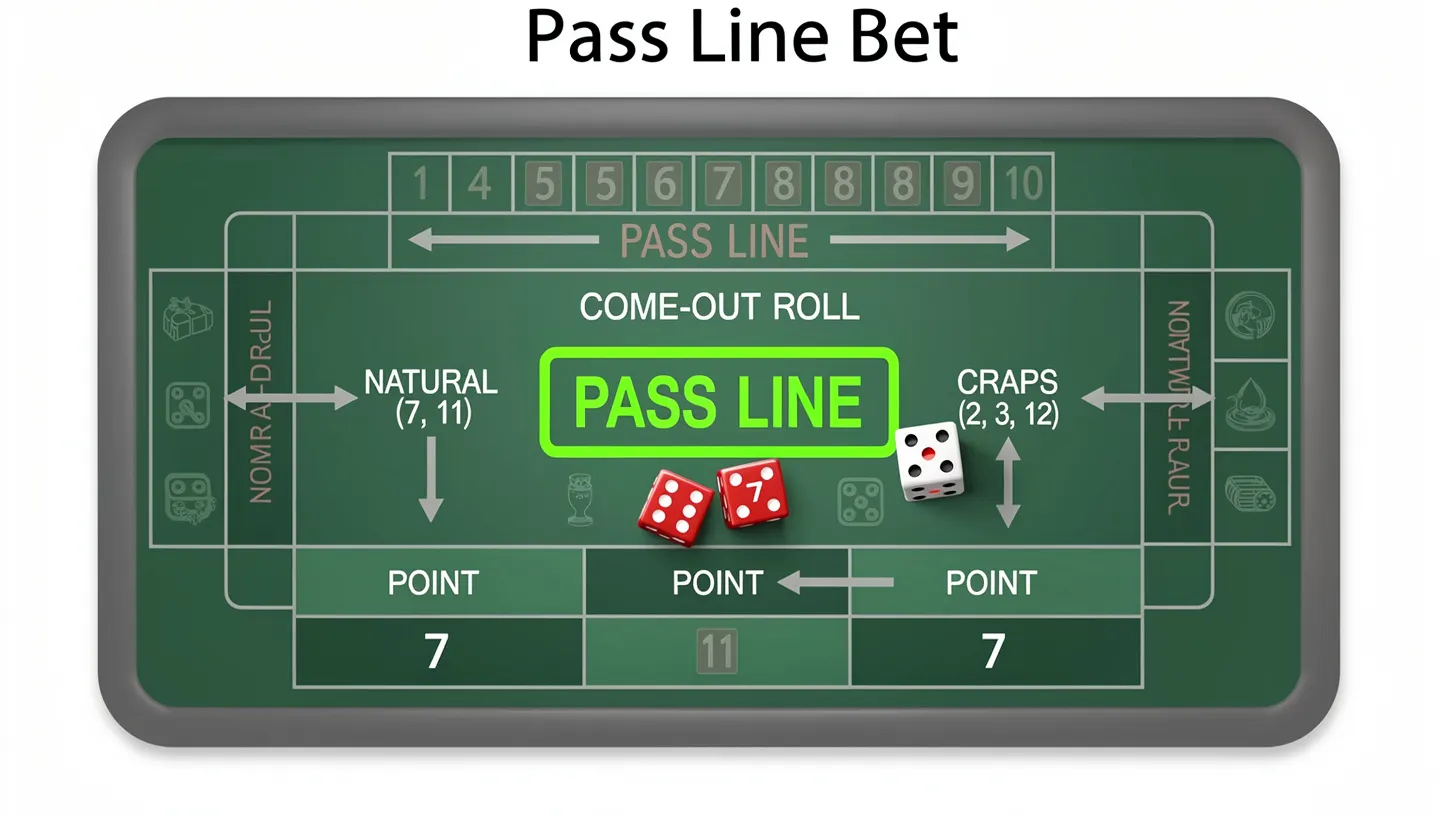
The Pass Line bet is the most common wager in craps and the natural starting point for anyone new to the game. Place it before the come-out roll. It wins on a Natural, loses on Craps, and during the point phase it wins if the point comes up again before a 7. The house edge on the Pass Line sits at roughly 1.41 percent, one of the lowest figures at any casino table.
Don’t Pass bet
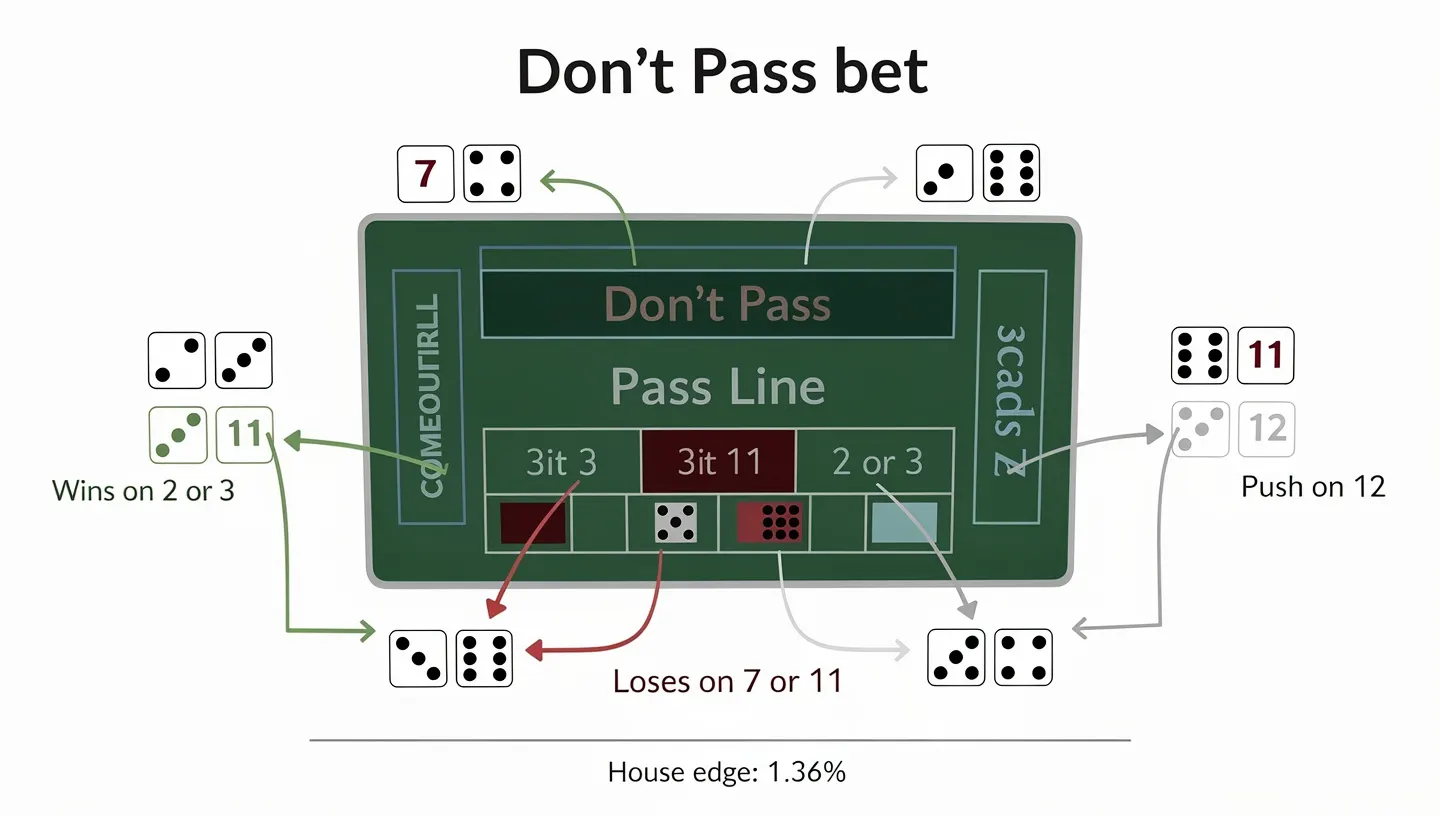
The Don’t Pass bet is the mirror image of the Pass Line. It loses on a Natural, wins on a 2 or 3, and pushes, meaning neither wins nor loses, if a 12 is rolled. Once a point is set, the Don’t Pass bet wins if a 7 shows up before the point does. The house edge here runs slightly lower than the Pass Line, at around 1.36 percent, though betting against the table this way can feel unwelcome at a lively land-based game since you’re rooting against everyone else.
Come bet and Don’t Come bet
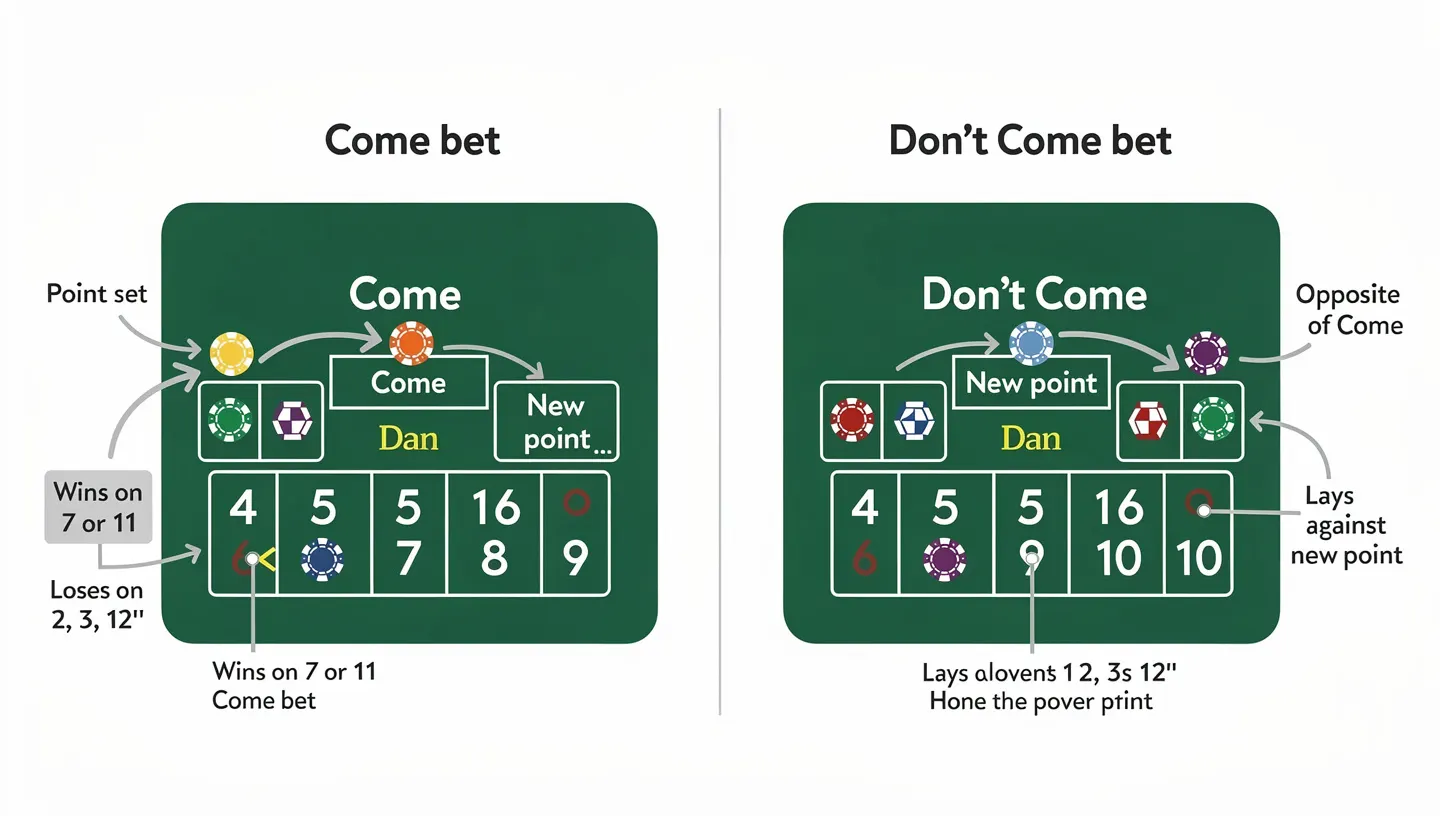
A Come bet works exactly like a fresh Pass Line bet, except you can only place it after a point has already been set. The very next roll becomes that bet’s own personal come-out roll. Roll a 7 or 11 and it wins immediately, roll a 2, 3, or 12 and it loses immediately, and any other number becomes that Come bet’s own point to chase. A Don’t Come bet mirrors it the same way Don’t Pass mirrors the Pass Line. These two let you keep adding action to the table after the shooter’s point is already locked in.
Odds bet, the only zero house edge bet in the casino
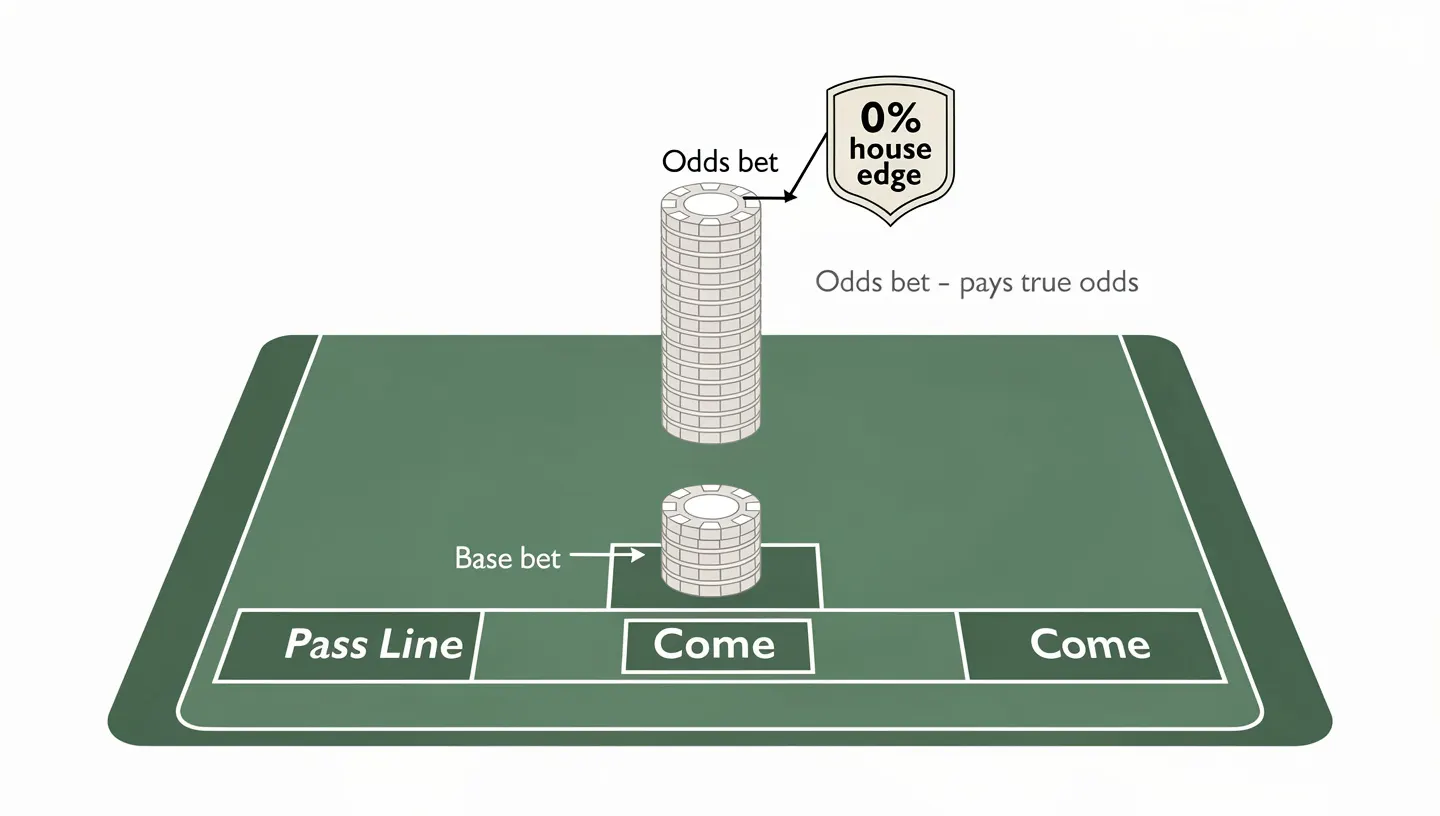
The Odds bet deserves special attention because it’s genuinely one of the best wagers available anywhere in a casino. Once a point is established, you can back your Pass Line or Come bet with an Odds bet, sometimes called Free Odds, and it pays out at the true mathematical odds of that point number coming up before a 7. There is no house edge attached to it whatsoever. The reverse version, Lay Odds, works the same way behind a Don’t Pass or Don’t Come bet. Most tables cap how much you can add in Odds relative to your original bet, often 3x, 5x, or more, so it pays to ask the table limit before you sit down. Combining a Pass Line bet with maximum Odds is the closest thing craps has to a genuinely mathematically sound approach.
Place bets and Buy bets
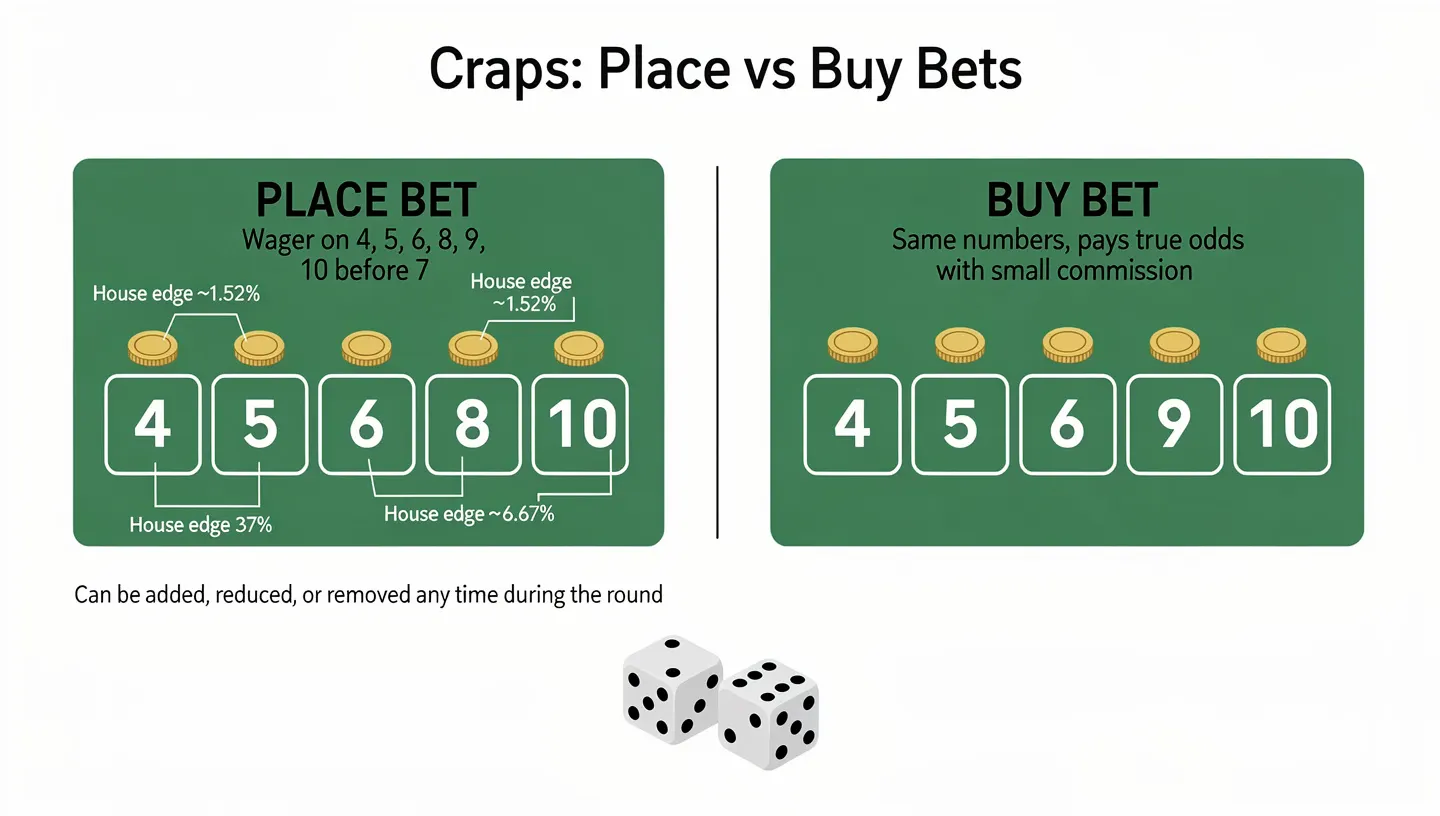
A Place bet lets you wager directly on 4, 5, 6, 8, 9, or 10 coming up before a 7, without needing to wait for that number to become a Come bet’s point. These can be added, reduced, or removed at any point in the round. Place bets on 6 or 8 carry a house edge around 1.52 percent, among the better bets on the table, while 4 and 10 run closer to 6.67 percent. A Buy bet works the same way but pays true odds instead of the reduced Place bet payout, in exchange for a small commission the casino takes upfront.
Field bet and proposition bets explained
The Field bet sits in a large section of the table and covers a single roll. Bet on the Field and you win if the next roll shows 2, 3, 4, 9, 10, 11, or 12, with 2 and 12 sometimes paying double or triple depending on the table. Roll a 5, 6, 7, or 8 and the Field bet loses.
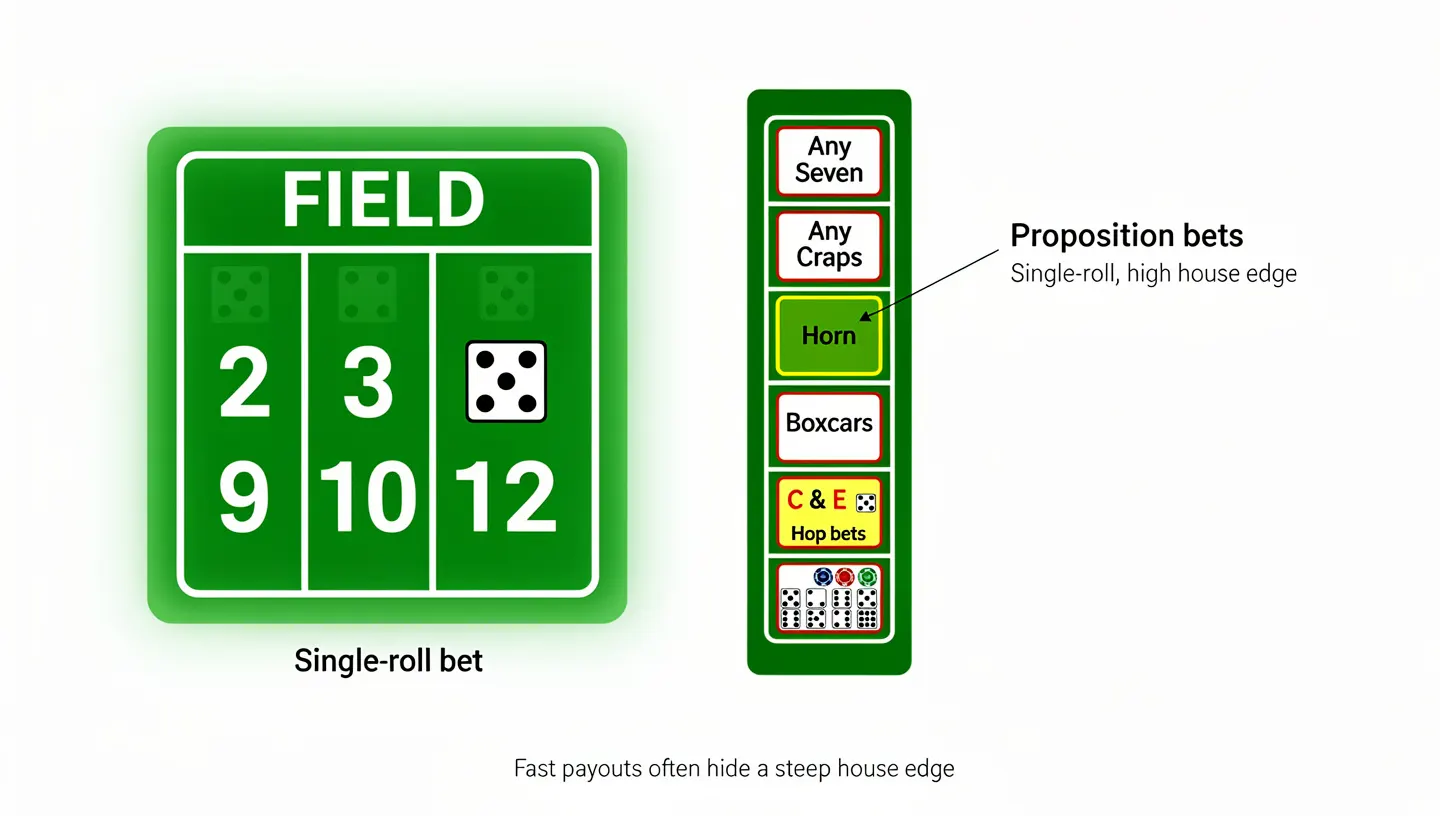
Proposition bets, also called prop bets, sit in the center of the table and get handled by the stickman. These are one-roll wagers with big payouts and, almost without exception, a rough house edge attached.
| Bet | Wins if | Approximate house edge |
|---|---|---|
| Any Seven | Next roll is a 7 | 16.67% |
| Any Craps | Next roll is 2, 3, or 12 | 11.1% |
| Horn | Next roll is 2, 3, 11, or 12 | 12% or more |
| Boxcars | Next roll is a 12 | 13.9% |
A few smaller variations show up on most tables too, including the C and E bet, which combines Any Craps with a bet on 11, and Hop bets, which let you name a specific dice combination for the very next roll. None of these are bad fun in small doses, but none belong anywhere near the core of a sensible betting plan. Craps isn’t the only casino game where the fastest looking payouts hide the steepest house edge, and the same lesson applies when comparing the proposition bets here with the one-roll style wagers found in sic bo.
Hardways bets explained
A Hardways bet wins if a specific number rolls as a matching pair, called “the hard way,” before it rolls any other combination or before a 7 appears. Hard 4 means rolling two 2s, hard 6 means two 3s, hard 8 means two 4s, and hard 10 means two 5s. Roll the same total using different numbers on each die instead, known as “the easy way,” and the Hardways bet simply keeps riding until it either hits the hard way or loses to a 7 or the easy version of that number. House edge on hard 6 and hard 8 sits around 9 percent, while hard 4 and hard 10 run closer to 11 percent. These are exciting bets to have riding, but they belong in the same category as proposition bets: fun in small amounts, not something to build a session around.
Craps table etiquette
A live craps table moves fast and has its own set of unwritten rules. Keep these in mind and you’ll fit right in from your first session.
- Use one hand only when picking up and throwing the dice.
- Make sure the dice hit the far wall of the table for the roll to count.
- Keep the dice visible above the table at all times, never near your chips or off the felt.
- Never switch out the dice once they’ve been passed to you as shooter.
- Place bets yourself in areas you can reach, but let the dealer handle proposition and center bets for you.
- Keep your hands clear of the table surface once the dice are in the air.
How craps house edge compares to other casino games
Craps holds up well against almost anything else on the floor once you stick to the right bets. The Pass Line sits at roughly 1.41 percent, and adding maximum Odds pushes the combined edge on your total money at risk even lower than that. For comparison, basic strategy blackjack runs close to 0.5 percent, which is why card counters and casual players alike treat it as one of the fairer games on the floor when played correctly. Baccarat sits around 1.06 percent on the banker bet, not far behind the Pass Line, while a double-zero American roulette wheel carries a much steeper 5.26 percent thanks to that extra green pocket. Slot machines can run anywhere from 5 percent up past 14 percent depending on the game, volatility, and paytable.
Craps earns its reputation as a strong game for the player mainly because of the Odds bet, which no other common casino game offers in quite the same form. Very few table games hand you a wager with genuinely zero house edge, and fewer still let you stack that wager directly behind one of the lowest-edge bets already on the table. That combination is what keeps experienced players coming back to the craps table over games with flashier themes but worse underlying math.
Common beginner mistakes to avoid
The biggest mistake new players make is skipping the Odds bet entirely, either because nobody explained it or because it looks more complicated than it is. Leaving that bet on the table means walking away from the single best value in the building. A second common mistake is jumping straight into proposition bets because of the flashy payouts, without realizing the house edge on most of them sits well into double digits. A third is trying to learn every bet on the layout during a first session. Sticking with Pass Line, Come bets, and Odds is more than enough while you get comfortable with the pace of the game.
Craps variants worth knowing
Standard craps isn’t the only version you’ll come across, and knowing the names ahead of time can save you some confusion when a table sign doesn’t match what you expected. Crapless craps removes the instant loss on 2, 3, and 12 during the come-out roll, turning those numbers into points instead, which changes the math on several bets and generally shifts the edge further toward the house on the Pass Line. New York craps drops Come and Don’t Come bets entirely and adds a commission to Place bets instead, giving the whole game a noticeably different rhythm.
Simplified craps, sometimes found on smaller or automated tables, trims the betting menu down to the basics for a faster-paced game aimed at newer players or lower-stakes rooms. A wheel-based game with its own set of house rules worth comparing is roulette, where the difference between a single-zero and double-zero wheel plays a similar role to the rule differences you’ll find across these craps variants. None of these show up as often as the standard version, but recognizing the name will keep you from getting caught off guard.
Tips for playing craps as a beginner
Set a budget before you sit down and treat it as the full cost of your entertainment for the session, not money you expect to bring home. Stick to Pass Line, Come bets, and Odds until the flow of the game feels natural, then branch out from there if you want. Watch out for the Gambler’s Fallacy, the mistaken idea that a shooter is “due” for a 7 after a long run of good rolls, or that a cold table is about to turn hot. Every roll is independent of the last one, and the dice have no memory of what came before, no matter how convincing a hot streak feels while it’s happening. Reading through general responsible gambling limits before your first session is a smart habit no matter which casino game you end up playing, and setting a walk-away number in advance takes a lot of the emotion out of a rough run at the table. It also helps to decide beforehand how many losing come-out rolls in a row you’re willing to sit through before calling it a night, since that kind of rule is far easier to stick to when it’s made in a calm moment rather than mid-session.
If you’re testing the game online first, the platform you choose matters just as much as the bets you pick. A dice roll that isn’t genuinely random makes every house edge figure in this guide meaningless, so sticking to a properly licensed site is worth the extra few minutes of research before you deposit anything. Look for a Curaçao gambling license or an equivalent regulator, since that means the random number generator behind the dice has been certified by an outside lab, and the odds you’re reading throughout this guide actually hold up once real money is on the line. Checking for that kind of certification takes a couple of minutes on a casino’s footer or about page, and it’s worth doing before your first deposit rather than after a bad session leaves you wondering whether the game was ever fair to begin with.
Some players like to test their first few sessions using funds from a welcome offer rather than risking their own deposit right away. That approach can work well for craps specifically, since the Pass Line and Odds bets are cheap enough on the house edge that a modest bonus can stretch across a decent number of rolls while you get comfortable with the pace of the game. Checking the site’s bonus types before you deposit is worth the extra few minutes, since not every promotion allows table games like craps to count toward the wagering, and a bonus that excludes craps entirely won’t help you practice the bets covered in this guide. Independent sources such as Wizard of Odds break the house edge figures above down bet by bet if you want to check the math for yourself before you play.
What is the easiest bet in craps for beginners?
The Pass Line bet is the simplest place to start. You win on a Natural, lose on Craps, and then just wait to see if the point comes up again before a 7. It also carries one of the lowest house edges on the whole table at around 1.41 percent.
What is the house edge on the Pass Line bet?
The Pass Line carries a house edge of approximately 1.41 percent. The Don’t Pass bet runs slightly lower, at roughly 1.36 percent, though both are among the best standard bets in the casino.
What is an odds bet and why does it have no house edge?
An Odds bet is a supplementary wager placed behind your Pass Line, Don’t Pass, Come, or Don’t Come bet once a point is set. It pays out at the true mathematical probability of that point hitting before a 7, with nothing added on top for the casino, which is why it carries zero house edge. It’s one of the only bets in any casino game where this is true.
What does seven out mean in craps?
Sevening out means the shooter rolls a 7 after a point has already been established, before that point comes up again. It ends the Pass Line bet as a loss, ends most other active bets tied to that shooter, and passes the dice to the next player at the table.
Are proposition bets worth playing in craps?
They’re fun in small amounts but carry some of the steepest house edges on the table, often 11 percent or higher. If you’re playing to maximize your odds rather than chase a big single payout, proposition bets are best kept to a minimum or skipped entirely.
What is the Gambler’s Fallacy in craps?
It’s the mistaken belief that past rolls affect future ones, such as assuming a 7 is “overdue” after several rolls without one. Every roll of the dice is completely independent, and the dice carry no memory of previous results, no matter how long a streak has run in either direction.
Can I play craps for free before betting real money?
Yes, most online casinos and craps-focused sites offer free play versions with no deposit required. Practicing the come-out roll, the point phase, and the basic Pass Line and Odds bets for free is one of the most useful ways to get comfortable before wagering anything, and organizations such as the UK Gambling Commission require certified operators to make free-play modes behave identically to the real-money version.
What is the difference between craps and other casino dice games?
Craps uses two dice and centers on the shooter’s roll deciding everyone’s bets at once, with a fixed sequence of come-out roll and point phase. Other dice games such as sic bo strategy rely on three dice and a completely different betting layout, so the rules and house edges between the two games don’t translate directly, even though both are built around the roll of the dice.