Blackjack card counting is not the photographic memory trick movies make it out to be. Nobody memorizes every card that comes out of the shoe. What a counter actually does is track the ratio of high cards to low cards left in the deck, since that ratio tells you whether the next hand favors you or the dealer. When the deck is rich in tens and Aces, the odds tilt toward the player, and a counter simply bets more when that happens and less when it does not.
This guide breaks down why the technique works, walks through the actual steps of doing it, and gives an honest picture of the legal status, the real advantage you can expect, and why casinos still watch for it decades after it was first published and studied extensively. None of it requires a genius level memory, just consistent practice and a willingness to keep basic addition running quietly in your head while everything else at the table happens around you.
What Is Blackjack Card Counting?
Card counting is a method of tracking which cards have already left the shoe so you can estimate what remains in play for the hands still to come, and it forms the foundation for everything else covered throughout the rest of this guide. A deck loaded with tens and Aces is good for the player, since those cards make blackjacks more likely and give the dealer better odds of busting on a stiff hand.
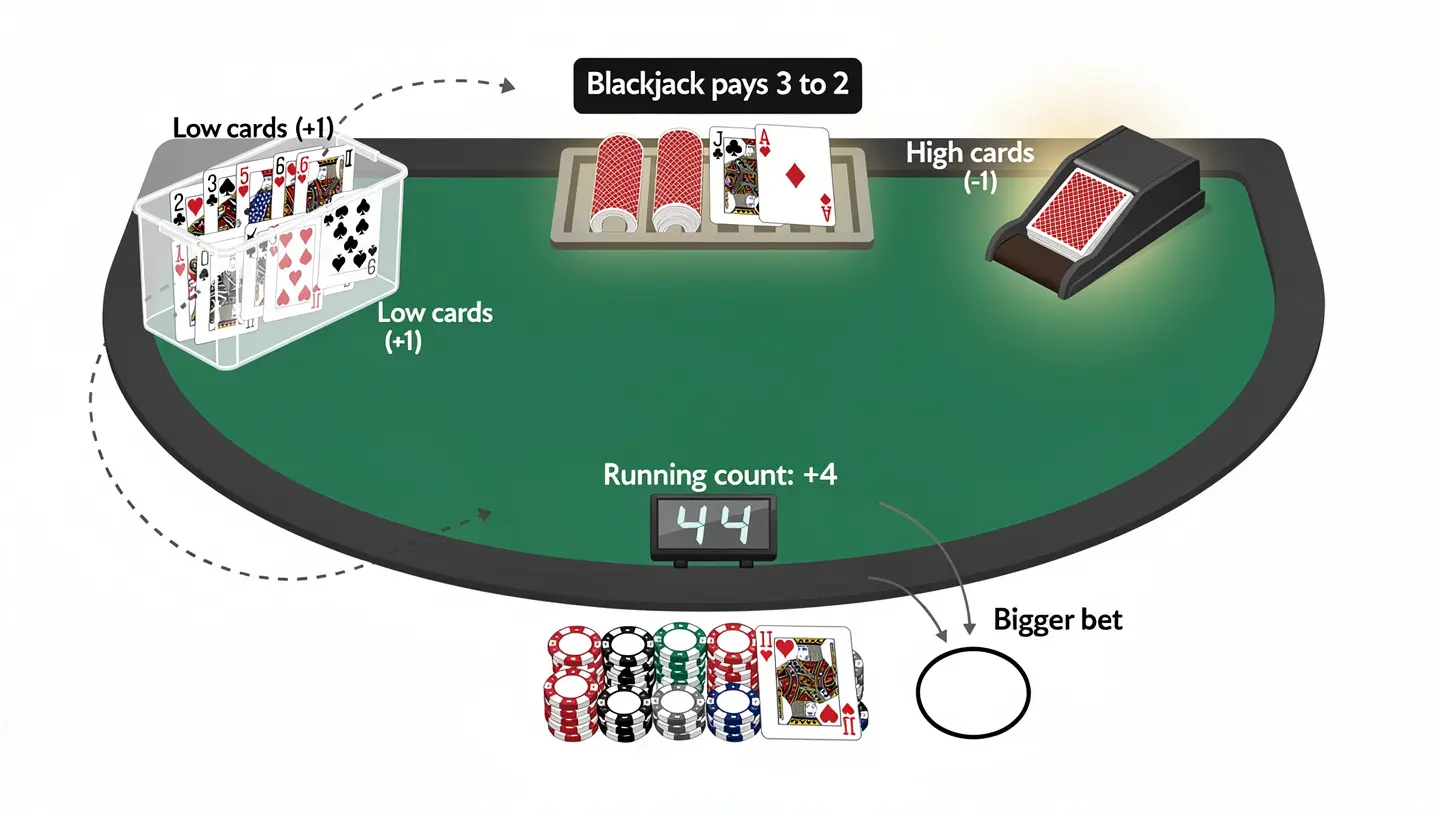
A deck loaded with small cards favors the dealer, since the house has to hit stiff totals regardless of what a player does. A counter assigns a simple value to each card as it appears, keeps a running tally in their head, and uses that tally to decide how much to bet and occasionally how to deviate from standard play. The entire system rests on one simple fact: a deck is not shuffled between every hand at most physical tables, so the cards already played genuinely change the odds of what comes next.
Why Card Counting Works
The edge does not come from one single source. It builds up from small advantages across several parts of the game, and understanding where that edge actually comes from makes the whole technique feel less mysterious and more like a series of small, compounding decisions.
| Source of Advantage | Share of Total Edge |
|---|---|
| Standing on stiff totals at the right count | About 40% |
| Taking insurance only when favorable | About 34% |
| Doubling down more often at high counts | About 9% |
| Getting paid on more blackjacks | About 7% |
| Surrendering more precisely | About 6% |
| Splitting pairs more effectively | About 4% |
The single biggest chunk of that edge comes from knowing when to deviate from basic strategy on stand and hit decisions, followed closely by the insurance side bet, which most players get wrong by either always taking it or always skipping it rather than basing the decision on the actual count in front of them. The remaining sources add up to smaller but still meaningful pieces of the overall picture.
How to Count Cards Step by Step
The most common approach, called the Hi-Lo system, breaks down into four repeatable steps that any player can learn with enough consistent practice over time.
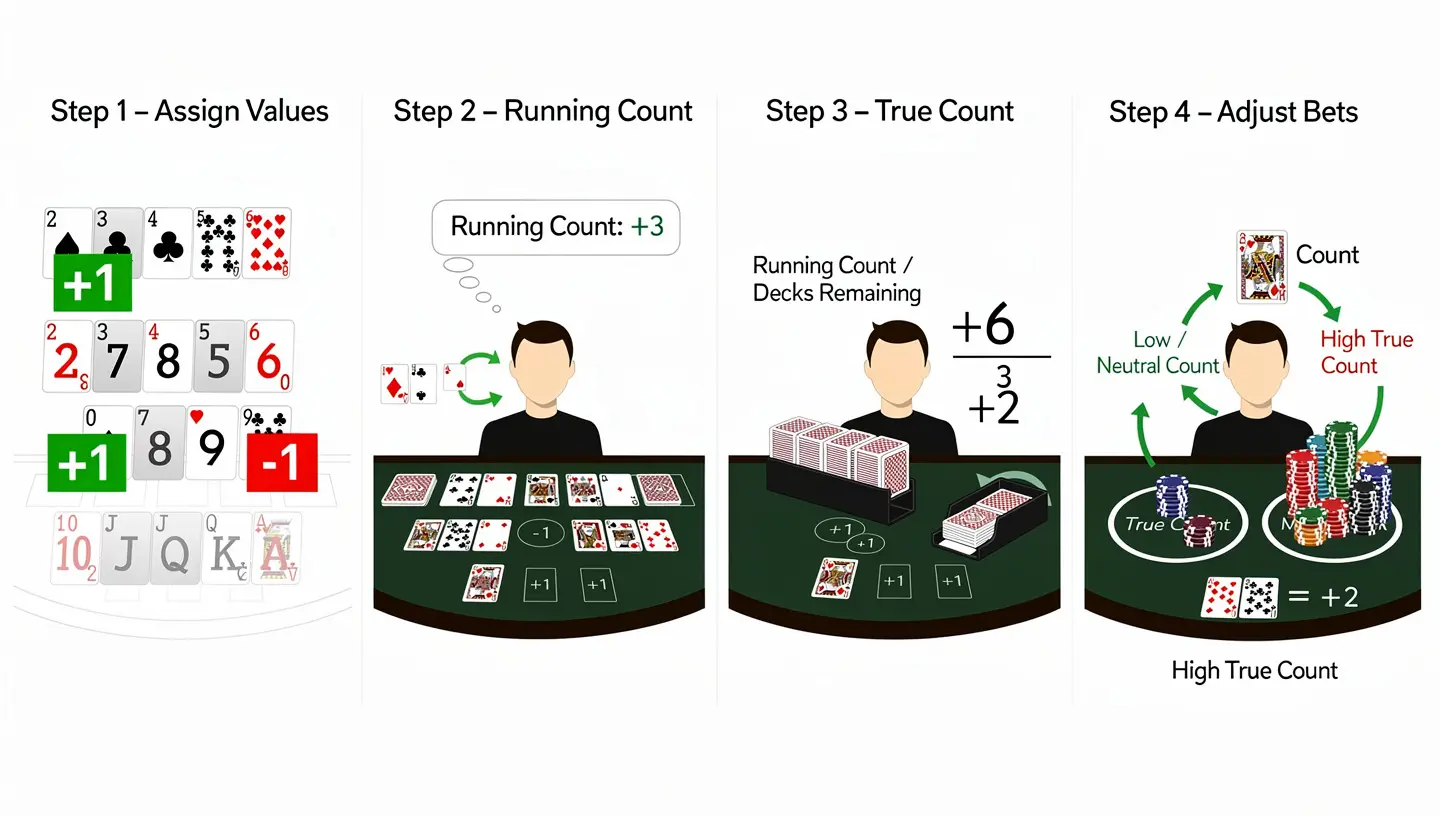
Step 1: Assign a Value to Every Card
In the Hi-Lo system, cards 2 through 6 are worth plus one, cards 7 through 9 are worth zero, and cards 10 through Ace are worth minus one each. Every card dealt at the table, yours, the dealer’s, and everyone else’s, gets counted, not just the cards in your own hand.
Step 2: Keep a Running Count
As each card appears, add or subtract its value from a running total in your head. A shoe that has produced a lot of small cards pushes the count up, since those low cards are now out of play and the remaining deck is richer in tens and Aces than it was before. This running total starts fresh at zero the moment a new shoe goes into play and climbs or falls as each round is dealt.
Step 3: Convert to a True Count
The running count alone is not quite enough once more than one deck is in play, since the same running count means something different with two decks left in the shoe versus six full decks. Dividing the running count by the estimated number of decks remaining gives the true count, which is the number that actually reflects your edge at that moment. This estimation of decks remaining is itself a skill that takes practice, since you are essentially eyeballing the discard tray and guessing how much of the shoe is left before the next shuffle.
Step 4: Adjust Your Bets
Once you know the true count, you bet small at a neutral or negative count and increase your bet as the true count climbs higher. This is the entire point of the exercise. Counting perfectly but betting the same amount on every hand accomplishes nothing, since the edge only turns into money when more is riding on the favorable hands, and it is the step most beginners underestimate once they start practicing the mental math involved in the earlier steps.
Other Card Counting Systems Worth Knowing
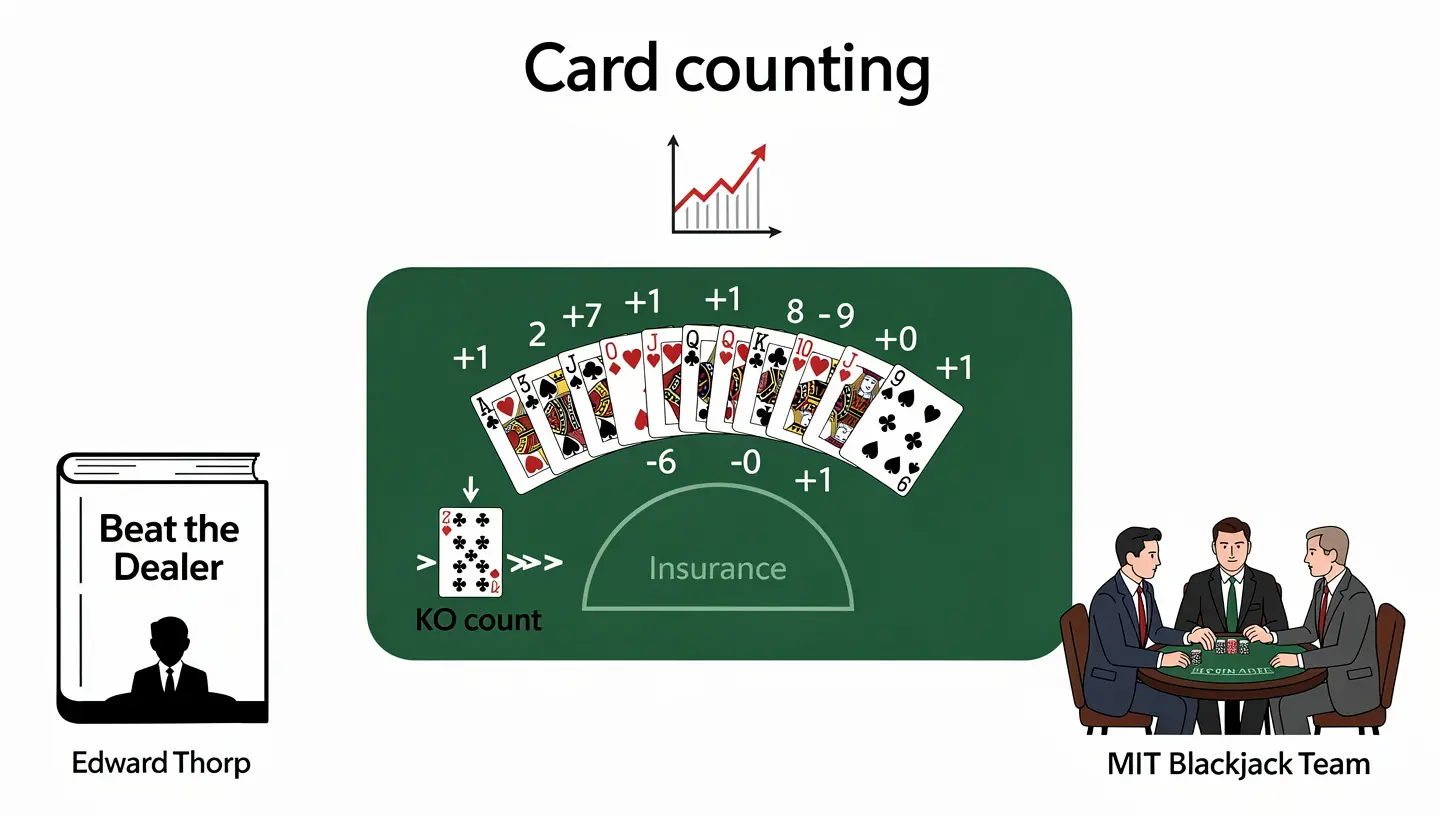
Hi-Lo is the most widely taught system among beginners and professionals alike, but it is not the only one. The KO count, short for Knock-Out, adds the card 7 as a plus one value alongside the standard low cards, which removes the need to convert to a true count at all, trading a small amount of accuracy for a much simpler process at a busy table where mental bandwidth is already stretched thin. More advanced systems like Hi-Opt I, Zen Count, and Omega II assign different values to different card ranks and sometimes require a separate side count of Aces, squeezing out a slightly larger edge in exchange for a noticeably harder system to run cleanly under pressure. Most beginners are better served starting with Hi-Lo and only exploring these more complex systems once the basics feel automatic and no longer require conscious effort to maintain during a live session.
The Insurance Bet and Card Counting
When the dealer shows an Ace, the table offers insurance, a side bet that pays out if the dealer has a ten underneath for blackjack. Basic strategy says decline it every single time, since in a fresh shoe the odds do not favor the bet at all. A counter treats this differently. Roughly 30.87 percent of cards in a fresh six deck shoe are worth ten, and insurance only becomes a good bet once that figure climbs above 33.33 percent. When the true count is high enough to push the proportion of tens past that threshold, taking insurance actually becomes profitable, which is exactly why it accounts for such a large share of a counter’s total edge, second only to the standard hit and stand decisions themselves.
The History of Card Counting
Card counting traces back to Edward Thorp, a mathematics professor who used early computers to work out that blackjack could be beaten with the right system applied consistently over time. His 1962 book, Beat the Dealer, was the first to lay out a workable counting method for the public, and it sent casinos scrambling to adjust rules and shuffling procedures almost overnight. Casinos briefly changed dealing procedures and even considered removing blackjack entirely before settling on countermeasures like multiple decks and earlier shuffling instead. Every counting system that followed, from Hi-Lo to KO to the more complex multi-level systems, built directly on the math Thorp first published decades ago.
The MIT Blackjack Team
No discussion of card counting is complete without the team that turned it into a documented, decades long operation spanning multiple casinos and cities. Starting in 1979, a group connected to students at MIT began experimenting with counting techniques, but their execution was inconsistent until Bill Kaplan, a Harvard Business School graduate who had already run a successful team in Las Vegas, took over training. In August 1980 the group launched formally with seven players and roughly $89,000 in outside investment, a substantial sum for the time and a serious commitment from everyone involved.
The team ran on a spotter and big player structure that divided labor carefully among the group. Spotters sat at multiple tables making small bets while quietly counting, and once a shoe turned favorable, they signaled a big player to walk over and start betting large sums on the hot count before walking away once the count dropped again. New members had to pass a rigorous checkout process, often playing through several full shoes with near flawless accuracy before being trusted with real money. The operation eventually inspired the book Bringing Down the House and the 2008 film 21, cementing card counting in pop culture far beyond the blackjack world itself, even though the real operation looked far less glamorous than either version portrayed.
Is Card Counting Illegal?
No. Counting cards in your head is not illegal anywhere in the United States, and it is not a form of cheating, since you are only using information that is already visible at the table to every player who cares to pay attention. What is illegal in most jurisdictions, including Nevada specifically, is using an electronic or mechanical device to help with the count. A casino is a private business, though, and it retains the right to refuse service to anyone it believes is counting, meaning a suspected counter can legally be asked to leave or barred from playing blackjack there again even though no law has technically been broken. This distinction between illegal and simply unwelcome trips up a lot of new players who assume the two mean the same thing.
Since a casino can bar a counter at its own discretion, it is worth understanding what kind of operator you are actually dealing with before you ever sit down. A license alone does not guarantee fair treatment, but it gives you somewhere to turn if a dispute ever comes up, and it usually means the operator’s games have gone through independent testing before ever reaching the public. This matters just as much whether you are counting cards or simply playing straightforward basic strategy for fun. Our guide on how to verify a casino license covers what to check before trusting any operator with your bankroll, including how to confirm a license number against a regulator’s own public records.
How Casinos Detect Card Counters
Trained pit staff and surveillance teams watch for the same handful of tells, honed over decades of dealing with suspected counters at every level of skill. A sudden, dramatic jump in bet size right as the count turns favorable is the single biggest red flag, since it is exactly the behavior a counter is supposed to show. Staring intently at the discard tray, mouthing numbers, or playing for unusually long stretches without normal distraction also draws attention. Once a casino suspects a player, the most common response is simply reshuffling the shoe the moment that player raises a bet significantly, which erases whatever edge the count had built up. In more serious cases, security will politely ask the player to leave the blackjack tables or the property entirely.
Rule variations matter more to a counter than to an average player, since a game with worse penetration or fewer decks changes how quickly a favorable count actually builds, and some operators are simply more transparent about posting these details than others. Checking penetration and deck count before sitting down can save a counter a lot of wasted effort at a game that was never going to offer much of an edge in the first place. If you are comparing operators before settling on somewhere to practice basic strategy or eventually attempt a count, our guide on choosing a reputable online casino covers what separates a trustworthy site from one that just markets itself well.
Realistic Expectations for Card Counters
Hollywood tends to make card counting look like a guaranteed path to easy money, and that picture is misleading in almost every way that matters to someone considering trying it themselves. A skilled solo counter playing modern rules typically holds somewhere between a 0.5 and 1.5 percent edge over the house, a real but modest advantage that requires a large bankroll and many hours of play to turn into meaningful profit. Team play, similar to what the MIT group ran, can push that figure closer to 2 to 4 percent by concentrating bets specifically on favorable counts, but running an actual team well takes serious capital, trust, and discipline that most casual groups never manage to pull off. It is worth being skeptical of anyone offering to bring you into a card counting team online, since a large share of those arrangements turn out to be poorly run at best and outright scams at worst.
Card counting does not remove variance, and even a mathematically sound counter can sit through a long losing stretch before the edge shows up in the results over enough hands played. Setting firm limits before you sit down protects you regardless of how confident you feel about the count on any given night, since a small edge over hundreds of hands still leaves plenty of room for a genuinely rough session along the way. Our guide on setting responsible gambling limits covers practical tools for keeping any session in check, whether or not counting is part of your approach at the table.
Do You Need Basic Strategy Before Counting Cards?
Yes, without exception. Card counting only tells you when the odds favor you and by how much. It does not tell you whether to hit, stand, double, or split on any given hand, that decision still comes from basic strategy, just adjusted slightly at extreme counts through what are called index plays. Trying to count cards without first knowing basic strategy inside and out is a waste of the effort, since a counter who plays hands incorrectly gives back the entire edge counting was supposed to create, sometimes even turning a theoretical advantage into a net loss over time. Our full blackjack strategy chart covers every hard total, soft total, and pair you need locked in before counting is worth attempting at all.
It is also worth knowing that none of this applies to standard online blackjack. Software driven games shuffle a fresh virtual deck after every hand, so there is no depleting shoe to track and no count to build. Live dealer blackjack streamed from a studio is closer to a real table, though most operators reshuffle far more often than a physical casino would specifically to limit this kind of play. This single distinction trips up a surprising number of players who assume the same skills that work at a physical table carry over directly to a screen.
Before spending real money learning any of this at a table, it helps to understand every piece of the standard game first, from how dealer hits work to what side bets are actually worth your time. Our guide on blackjack rules is worth reading in full, since a solid grip on the basic game always comes before adding a count on top of it. None of the counting knowledge in this guide means anything if the underlying rules of the game itself are still shaky, so treat that as the true starting point rather than skipping ahead straight to running counts. Spending a week or two playing purely on basic strategy, without worrying about the count at all, is a far better use of early practice time than trying to juggle both skills at once from the very first session.
For a deeper technical breakdown of the math behind every number covered throughout this guide, Wizard of Odds offers one of the most detailed independent analyses of card counting available anywhere online, including the exact formulas behind the insurance threshold and the true count conversion.
Frequently Asked Questions
Is card counting illegal?
No, counting cards in your head is legal everywhere in the United States. Using a device to help count is illegal in most places, and casinos can legally ask a suspected counter to stop playing blackjack or leave the property, even though no actual law has been broken.
Can online casinos be beaten with card counting?
Standard software driven blackjack shuffles a fresh deck after every hand, so there is no shoe to track and counting has nothing to work with. Live dealer blackjack behaves more like a physical table, though most operators reshuffle frequently enough to blunt the technique considerably.
How much money can you realistically make counting cards?
A solo counter typically holds an edge between 0.5 and 1.5 percent, which requires a large bankroll and many hours of play to produce meaningful profit. It is a slow, grinding edge rather than a fast path to significant winnings, no matter how it gets portrayed in film.
Do I need to be good at math to count cards?
You need to be comfortable with simple addition and subtraction done quickly under pressure, not advanced math. The Hi-Lo system only involves adding or subtracting one at a time as each card appears, which most people can learn with consistent practice.
What is the easiest card counting system to learn?
Hi-Lo is generally considered the easiest balanced system for beginners, since each card is worth plus one, zero, or minus one. The KO count is even simpler in practice, since it skips the true count conversion step entirely.
Can casinos really tell if you are counting cards?
Trained staff and surveillance can often spot the telltale signs, especially a large bet increase right as the count turns favorable. Skilled counters work to disguise their betting patterns, but detection remains a real risk at any table game with consistent, predictable play over time.