How to play Sic Bo comes down to one simple idea: three dice get shaken, and you bet on what shows up. There is no hand to build, no card to draw, and no decision to make once your chips are down beyond picking where to place them in the first place. That simplicity is exactly why the game has survived for centuries and still fills tables in casinos around the world today.
This guide walks through the table setup, the full sequence of a round, every bet worth knowing, and the real house edge behind each one, including a common mistake several other guides get wrong about the actual numbers involved. By the end you should be able to sit down at any Sic Bo table, live or online, and know exactly which bets are worth your money.
What Is Sic Bo?
Sic Bo is an ancient Chinese dice game whose name roughly translates to precious dice or dice pair, depending on which source you happen to read. It made its way from private games in China to casino floors across Macau, then spread into Las Vegas, Atlantic City, and online casinos worldwide.
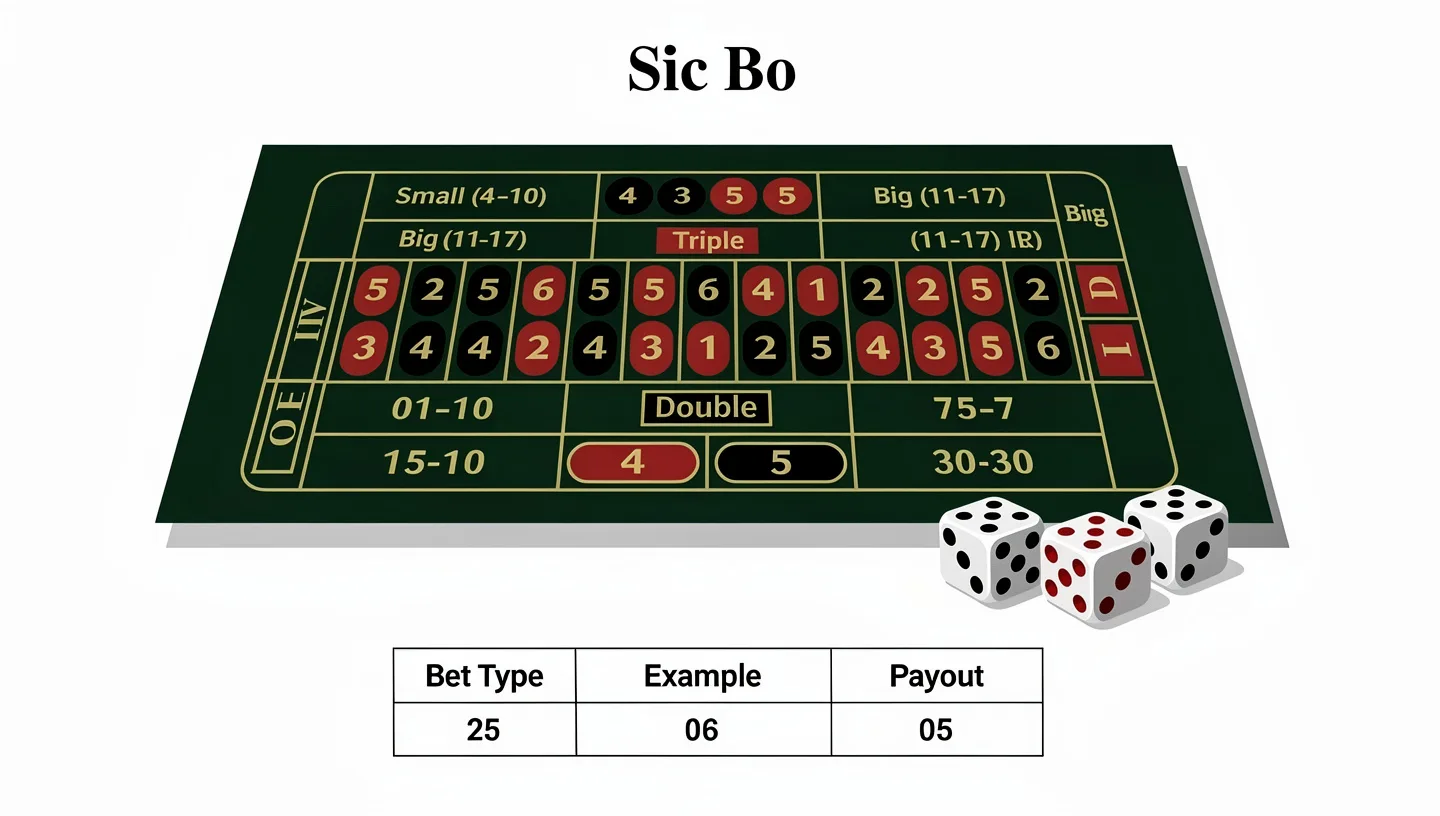
The rules have stayed remarkably simple across all that history: three dice, a table full of betting options, and a payout chart that tells you exactly what each bet is worth before you ever place it. American casinos sometimes market close cousins of the game under names like Chuck-a-Luck or Grand Hazard, though the layout and betting variety of true Sic Bo remains far more elaborate, often filling an entire table with dozens of distinct wagering options rather than just a handful.
Why Play Sic Bo?
Sic Bo appeals to players for reasons that have little to do with strategy and everything to do with pace and simplicity. A round finishes in under a minute, there is no waiting on other players to make decisions, and the rules take only a few minutes to learn even for someone who has never touched a casino table before. The huge spread of available bets also means you can tailor the risk to your own mood, from a steady, low variance session on Small and Big to a handful of long shot Triple bets placed purely for the adrenaline. It is a social game too, with a full table of players often reacting together to a single shake of the dice in a way that solo games like slots simply cannot match.
The Sic Bo Table and Equipment
A Sic Bo table looks intimidating at first glance, covered edge to edge with numbers and betting boxes, but the equipment behind it is straightforward once you know what each piece does. Three dice sit inside a shaker, sometimes called a dice cage or dice dome, which either a dealer shakes by hand or an electronic mechanism shakes at the push of a button. Most modern casinos use the electronic version, since it removes any question about fairness that a hand shake might raise. Many tables run with two dealers working together, one handling chips and payouts while the other manages the shaker and keeps the round moving at a steady pace.
Many tables also display a small digital board showing the outcomes of recent rounds. It is worth treating that board as pure trivia rather than useful information, since every shake of the dice is completely independent of the one before it. A run of matching results means nothing about what comes next, no matter how convincing the pattern looks on the screen. Plenty of players still enjoy glancing at it purely out of curiosity, which is fine as long as it never factors into an actual betting decision.
How to Play Sic Bo Step by Step
Learning how to play Sic Bo takes only a few minutes, since the entire process repeats the same five steps every single round without any variation once you know the rhythm of it.
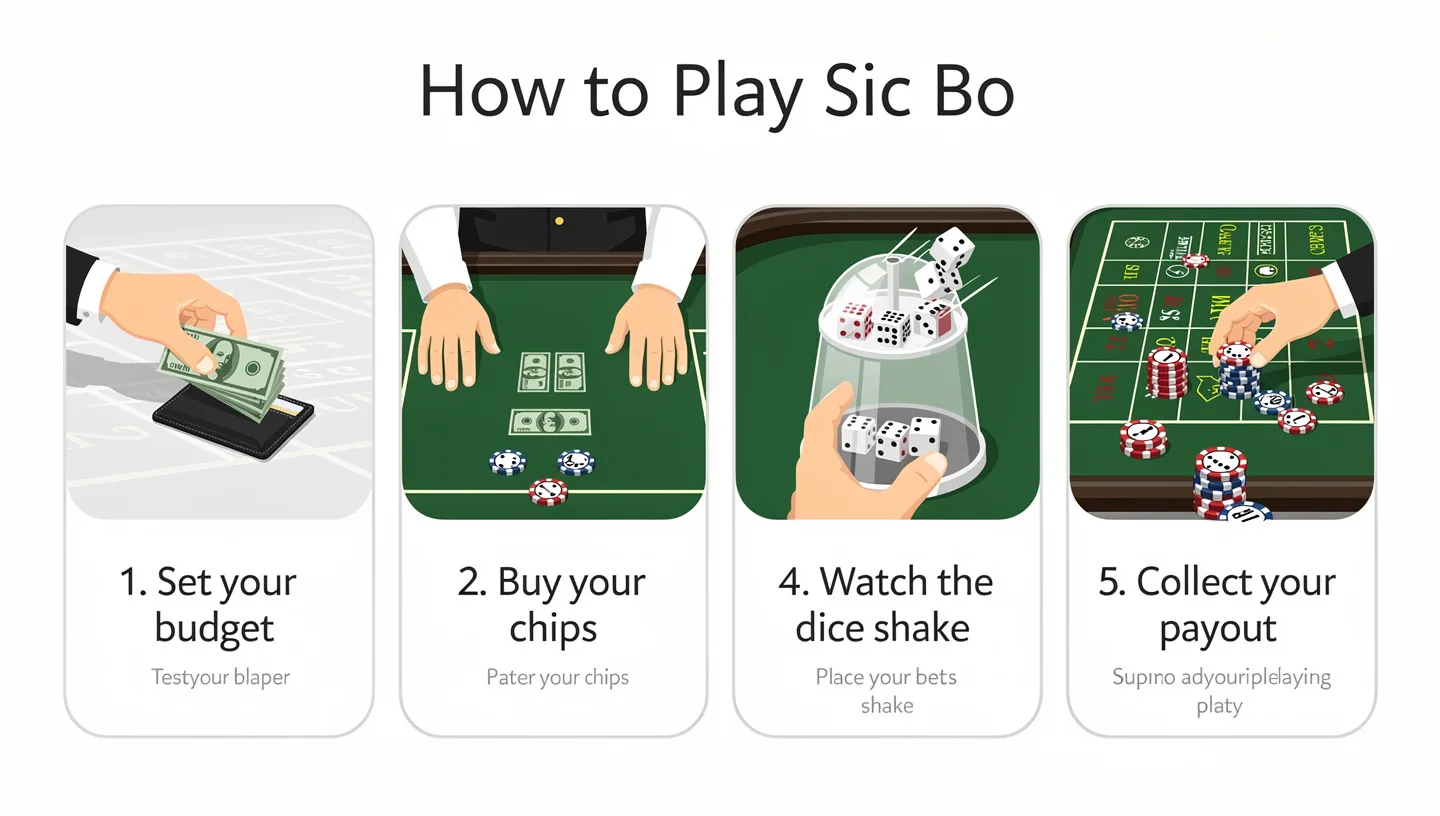
1. Set Your Budget
Decide how much you are comfortable spending before you sit down, and treat that number as part of your entertainment budget rather than money you expect back. Avoid pulling extra funds from a credit or debit card mid session, since that is one of the fastest ways to lose track of how much you have actually spent, especially at a game that moves as quickly as this one does.
2. Buy Your Chips
Place your cash on the table rather than handing it directly to the dealer, who will exchange it for chips and set them down in front of you. This is standard practice at every table game, not just Sic Bo, and it exists to keep the exchange transparent for everyone watching, including the pit boss and any surveillance cameras overhead.
3. Place Your Bets
Put your chips on whichever betting boxes match the outcomes you think are likely. The table itself displays every available bet along with its payout, so you always know exactly what you stand to win before the dice are even shaken, which makes it easy to compare options at a glance rather than guessing.
4. Watch the Dice Shake
Once betting closes, the dealer activates the shaker. A few seconds later, the dice settle and the result is revealed for the whole table to see, with no room for interpretation once the numbers are showing.
5. Collect Your Payout
Winning bets get paid out according to the odds printed on the table, and losing bets are cleared away. The whole cycle then starts again, often within less than a minute, which is part of why Sic Bo moves so much faster than most table games and can burn through a session quicker than players expect.
A Sample Sic Bo Round
Say you place $10 on Big and another $5 on the number 4 as a single number bet. The dealer activates the shaker, and the dice settle on 3, 5, and 6. That total comes to 14, which falls inside the Big range of 11 to 17, so your $10 Big bet wins and pays out $10 in profit. Your $5 single number bet on 4 loses outright, since none of the three dice showed a 4. You walk away from that one round $5 ahead overall, and the table resets for the next shake within seconds.
Sic Bo Bets Explained
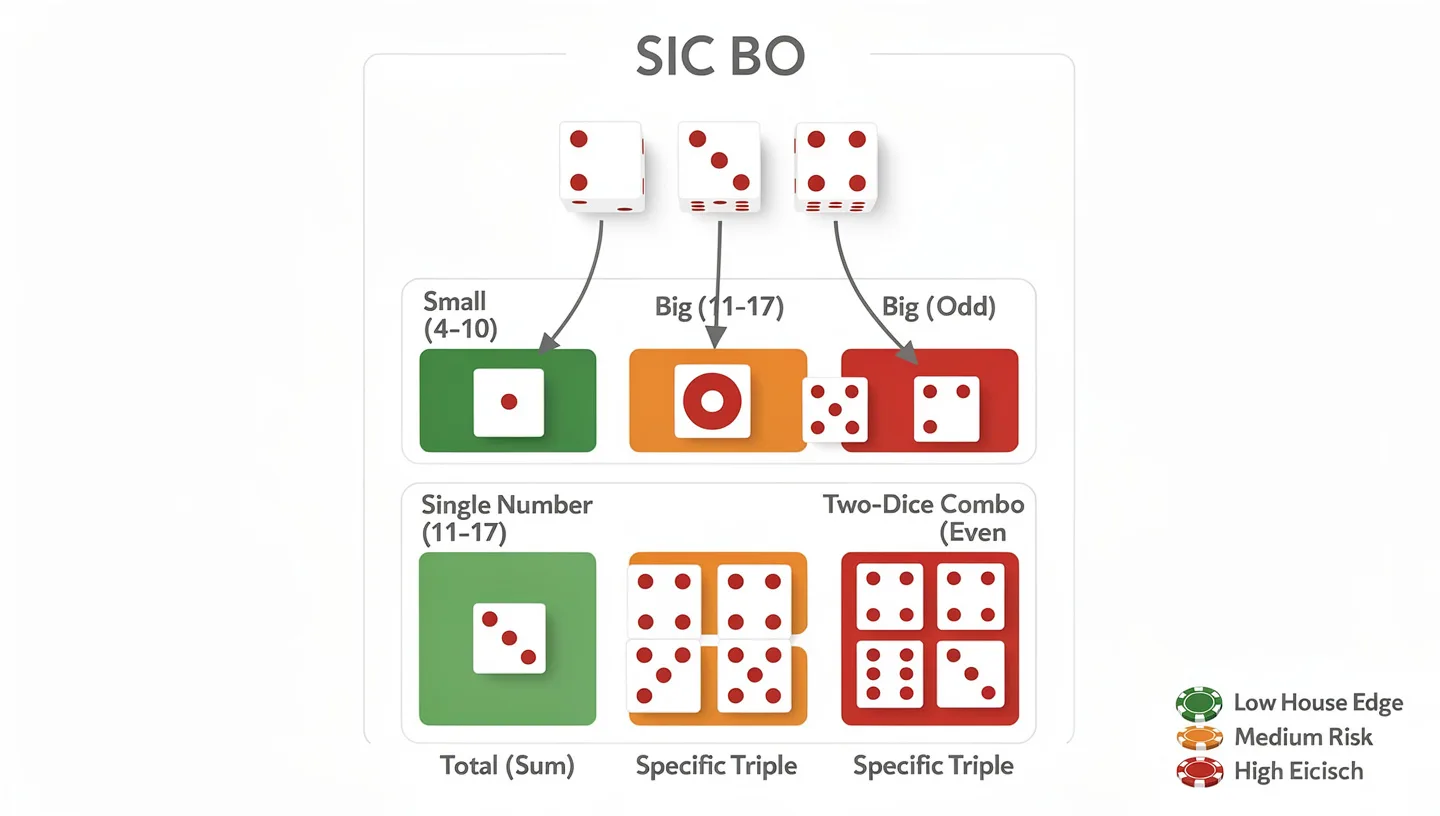
Sic Bo offers more betting options than almost any other casino game, which can feel overwhelming at first. Most of them fall into a handful of clear categories once you understand the underlying logic behind each one.
Small and Big Bets
A Small bet wins if the total of all three dice lands between 4 and 10. A Big bet wins if the total lands between 11 and 17. Both bets lose automatically if the dice come up as a triple, regardless of the number showing. This exclusion is exactly why these bets carry such a low house edge compared to almost everything else on the table, and it is the single most important rule to understand before placing your first wager.
Odd and Even Bets
These work the same way as Small and Big, just based on whether the total is an odd or even number instead of high or low. Triples also void this bet automatically, keeping the house edge in the same low range as Small and Big, which makes these two pairs of bets essentially interchangeable in terms of long term value regardless of which pair a player happens to prefer.
Single Number Bets
You pick one number from 1 to 6 and win if it appears on any of the three dice. The payout scales with how many dice show your number, typically 1 to 1 for one match, 2 to 1 for two matches, and 3 to 1 for all three. This bet sits in a middle tier of house edge, better than the worst options but noticeably weaker than Small and Big, making it a reasonable choice for players who want a bit more variety without leaping straight to the riskiest bets on the felt.
Two-Dice Combination Bets
You choose two specific numbers and win if both appear among the three dice, regardless of what the third die shows. These usually pay 5 to 1 or 6 to 1 depending on the casino, and the actual odds behind this bet are one of the most commonly misreported numbers in the entire game, which is worth its own section further down given how often the wrong figure gets repeated across gambling guides.
Total (Sum) Bets
You bet on the exact total of all three dice, anywhere from 4 to 17. Totals near the middle of that range, like 10 or 11, are far more likely to occur than extreme totals like 4 or 17, so the payouts scale accordingly, with the rarest totals paying the most and the more common ones paying considerably less. This scaling exists specifically to keep the house edge from swinging too wildly from one total to the next, even though it still varies more than most players expect once you compare the numbers directly.
Specific Double Bets
You bet that two of the three dice will show the same specific number, such as two fives. This typically pays 10 to 1 and sits in the middle of the pack in terms of house edge, worse than most totals but still nowhere near as steep as a full triple bet, making it a reasonable middle ground for players who want a bigger payout without going all the way to the longest shots on the table.
Triple Bets
An Any Triple bet wins if all three dice match, regardless of the number, usually paying 30 to 1. A Specific Triple bet requires all three dice to match one particular number you chose in advance, which is far rarer and typically pays 150 to 1 or more, making it the longest shot on the entire table by a wide margin and one that most experienced players avoid entirely despite the tempting payout number attached to it.
Sic Bo Odds, Payouts, and House Edge
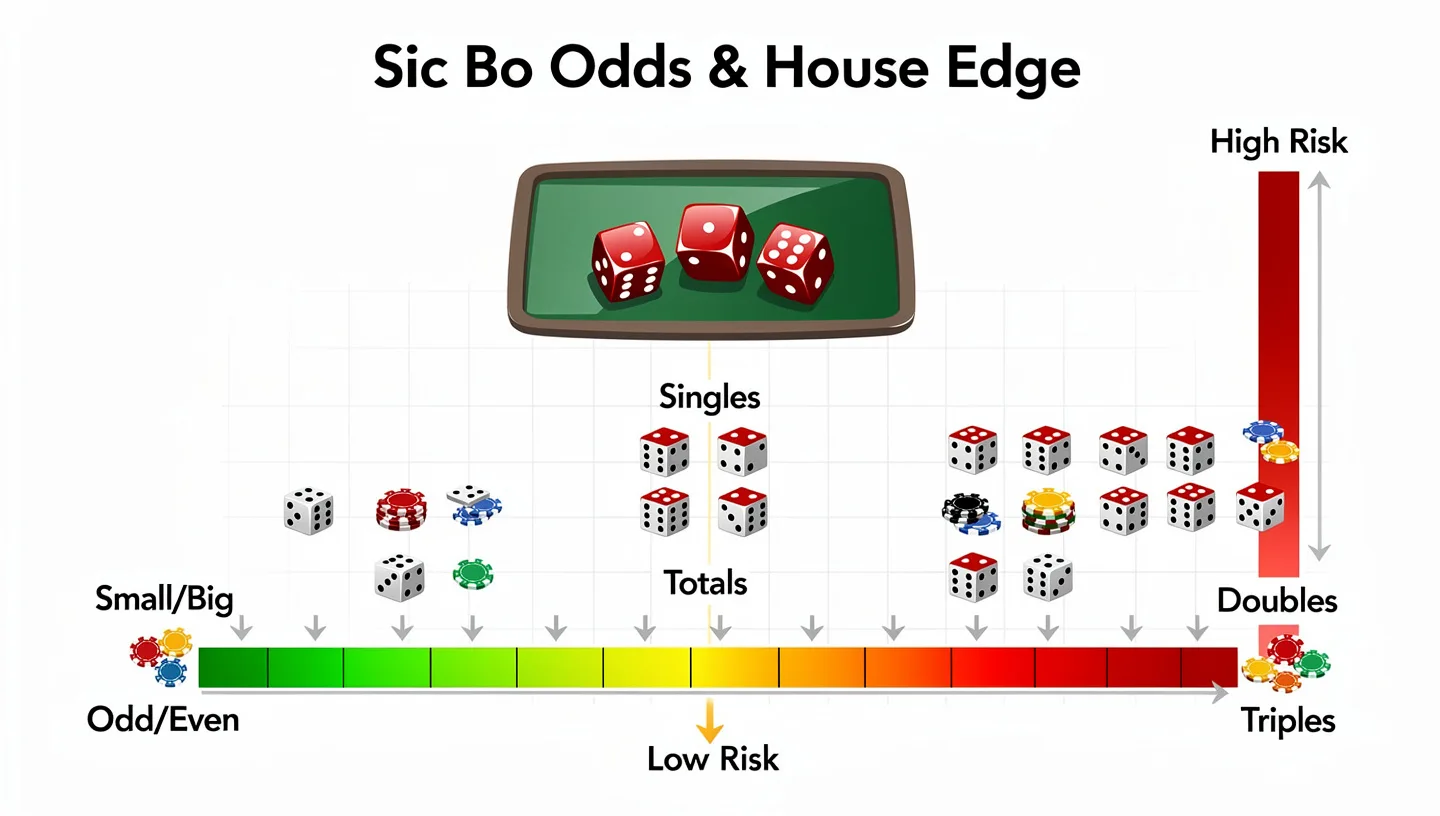
Every bet on the table carries a different house edge, and the gap between the best and worst options is enormous, often the widest spread you will find at any single table game in the entire casino.
| Bet Type | Typical Payout | House Edge |
|---|---|---|
| Small or Big | 1 to 1 | About 2.78% |
| Odd or Even | 1 to 1 | About 2.78% |
| Single Number (one match) | 1 to 1 | About 7.87% |
| Total of 10 or 11 | 6 to 1 | About 12.5% |
| Two-Dice Combination | 5 to 1 | About 16.67% |
| Specific Double | 10 to 1 | About 18.52% |
| Any Triple | 30 to 1 | About 13.89% |
| Total of 4 or 17 | 60 to 1 | About 15.28% |
| Specific Triple | 150 to 1 | About 30.09% |
Small, Big, Odd, and Even sit clearly at the top of the list, and it is not particularly close once you line every bet up side by side like this. For a wider comparison of how this stacks up against other casino games, resources like Wizard of Odds break the math down in even more detail using every one of the 216 possible dice outcomes, running the numbers on every single bet type available at a standard table.
Why Some Totals Hit More Often
The payout for a Total bet is not random guesswork, it is built directly from how many different ways each number can actually appear across the three dice. There is only one way to roll a total of 4 (a 1, 1, and 2) and only one way to roll a total of 17 (a 5, 6, and 6), which makes both extremely rare. A total of 10 or 11, by contrast, can happen through dozens of different combinations of the three dice, which is exactly why those middle numbers show up far more often over a long session. This pattern forms a rough bell curve across all 216 possible outcomes, with totals near the middle bunching up heavily and the extremes on either end thinning out fast. That is also the whole reason the payout table pays so much more for a total of 4 than it does for a total of 10, since the casino has to compensate for just how rarely the extreme numbers actually land.
Why the Combination Bet House Edge Is Often Reported Wrong
A surprising number of guides list the Two-Dice Combination bet at a 2.78 percent house edge, the same figure as Small and Big. That number is incorrect for the standard 5 to 1 payout found at most casinos. Working through the actual probability, the real house edge on a 5 to 1 combination bet lands closer to 16.67 percent, a massive difference from what gets repeated across the internet. The confusion likely comes from a rarer 6 to 1 payout offered at a handful of tables, mainly in parts of Australia, where the math genuinely does work out closer to 2.78 percent. Always check the payout printed on the actual felt in front of you rather than trusting a number from a generic guide, since the house edge on this particular bet swings wildly depending on which payout your casino actually offers, and assuming the lower figure without checking could leave you betting far more than you realize on a much weaker option.
Pay Tables Vary by Casino, Read the Felt
The example above is not an isolated quirk. Payout tables for several Sic Bo bets shift depending on where you are playing, sometimes by a meaningful margin. Macau tables, the historic home of the game, often stick close to the payouts covered throughout this guide. Atlantic City casinos frequently offer slightly different odds on Total bets compared to their Macau counterparts. Australian casinos, as mentioned above, sometimes pay 6 to 1 on the combination bet instead of the more common 5 to 1, genuinely lowering the house edge on that specific wager. None of this means one region is better or worse across the board, but it does mean the payout chart sitting on the felt in front of you is the only number that actually matters, not whatever figure you remember from a guide written with a different casino in mind.
The Best and Worst Sic Bo Bets
If you only remember one thing from this entire guide, make it this: Small, Big, Odd, and Even are the strongest bets on the table, and everything involving a Triple sits at the opposite end. Specific Triple bets in particular carry a house edge over 30 percent, among the worst odds you will find anywhere in a casino, card games and slots included. Two-Dice Combination bets look tempting with their higher payout, but the real house edge covered above makes them a much weaker choice than the flat payout suggests at first glance. A good rule of thumb worth keeping in mind is simple: the bigger the payout printed on the table, the worse your actual odds of walking away with it tend to be.
Does Sic Bo Strategy Exist?
No genuine strategy exists that improves your odds in Sic Bo. Every roll of the dice is independent, the outcome carries zero connection to any previous round, and no betting pattern changes the fixed house edge sitting behind each wager. Anyone selling a Sic Bo system is selling something that does not hold up under basic probability, no matter how convincing the sales pitch sounds or how many testimonials are attached to it. Our full breakdown of sic bo strategy walks through exactly why popular progression systems fail here and what limited habits actually do help a session go smoother.
What actually helps is simpler than any system: stick to Small, Big, Odd, or Even as your primary bets, set a budget before you sit down, and treat the rest of the table as occasional fun rather than a real plan. Betting a small amount on a high payout option purely for the thrill of it is fine, as long as you understand going in that the odds are working hard against you on those particular boxes, and that no amount of clever timing changes that fact.
Is Sic Bo Rigged?
No, not at a properly licensed casino. Every reputable operator uses either a certified electronic shaker or a live dealer following strict procedures, and the physical dice themselves are checked and replaced regularly to prevent any tampering or wear that could skew results. Online versions run on random number generators that go through independent testing before a casino is ever allowed to offer them. The steep house edge on bets like Specific Triple can feel suspicious to a new player who loses several in a row, but that outcome is exactly what the math predicts happening fairly often, not a sign that anything behind the scenes is off. A losing streak on a long shot bet is bad luck working exactly as the odds say it should, not evidence of a rigged table.
Where and How to Play: Live, RNG, Electronic, or Provably Fair
| Format | How It Works | Best For |
|---|---|---|
| Live Dealer | A real dealer runs the shaker, streamed on video | An authentic, watchable casino feel |
| RNG Software | A certified algorithm resolves the round instantly | Speed and privacy |
| Electronic Table | Physical dice shaken by machine at a real casino | Fairness without a hand shake |
| Provably Fair | Blockchain based verification of every result | Players who want to check fairness themselves |
All four formats follow the same rules and payout structure, so the choice really comes down to preference rather than one being genuinely fairer than another at a properly licensed site. Provably fair versions, common at crypto focused casinos, let you independently verify that a specific result was not altered after the fact, which appeals to players who like confirming fairness with their own tools rather than simply trusting a license badge.
Sic Bo vs Craps vs Roulette
| Feature | Sic Bo | Craps | Roulette |
|---|---|---|---|
| Randomizer | Three dice | Two dice | A spinning wheel and ball |
| Rounds per hour | Very fast | Moderate, multi-phase | Moderate |
| Best house edge | About 2.78% | About 1.36% (pass line) | About 2.7% (single zero) |
| Number of bet types | Very high | High | Moderate |
Sic Bo sits closest to Craps in spirit, since both revolve around a wide betting layout built around dice, but Sic Bo resolves everything in one shake rather than a shooter working through a multi-stage sequence of come-out rolls and points. Roulette shares the same simplicity as Sic Bo in that a single spin decides everything at once, though it swaps dice for a wheel and offers a somewhat narrower best case house edge on its strongest bets.
Sic Bo Glossary
- Shoe or shaker: the container the dice are shaken inside
- Coup: a single round of the game, from bets placed to payout
- Small: a bet on a total between 4 and 10
- Big: a bet on a total between 11 and 17
- Triple: all three dice showing the same number
- Double: exactly two of the three dice showing the same number
- Combination bet: a wager on two specific numbers both appearing
- Total or sum bet: a wager on the exact combined value of all three dice
- House edge: the built in mathematical advantage the casino holds on a given bet
- Felt: the betting surface itself, where the payout chart is printed
Sic Bo Table Etiquette
A handful of small habits make the experience smoother for you and everyone else at the table. Place cash on the table rather than handing it directly to a dealer, and let the dealer set your chips down in front of you rather than reaching for them yourself. Collect your winnings promptly once a round pays out, since leaving chips sitting in a betting box can accidentally count as your next wager. Keep bets clear and placed well before the dealer calls for no more action, since a late chip tossed onto the table after betting closes will not count even if the dice have not been shaken yet.
If you want to sharpen your understanding of the full rulebook before your first real session, our guide on sic bo rules covers every detail of gameplay in more depth than a quick overview like this one can, including edge cases and table variations you might not run into during a first visit. Reading through a full rules breakdown once, even after you already know the basics, tends to catch small details that a summary like this one has to skip for the sake of length.
Sic Bo is not the only dice adjacent game worth knowing either. If you enjoy games built around probability and payout charts rather than skill, it is worth understanding how it compares to games where your own decisions actually matter. Our guide to blackjack rules covers a very different type of table game, one where the choices you make during a hand genuinely change your odds rather than leaving everything up to a shake of the dice.
Before you play anywhere for real money, it is worth spending a few minutes checking the operator itself rather than jumping straight to the table. Licensing, how a site handles payouts, and its overall track record all matter more than a flashy welcome bonus once real money is involved, and a great game selection means little at an operator you cannot actually trust. Our guide on choosing a reputable online casino covers what to look for before you commit your bankroll to any particular site.
Sic Bo moves fast, often resolving a new round every thirty to sixty seconds, which means a losing streak can burn through a bankroll far quicker than slower table games where each hand takes longer to play out. Setting a clear limit before you sit down matters more here than at almost any other game in the casino, since the sheer pace of play leaves little room to reconsider mid session once things start moving quickly around you. Our guide on setting responsible gambling limits covers practical tools for keeping a session in check, whether that means a time limit, a loss limit, or simply the discipline to walk away once your budget runs out.
Frequently Asked Questions
What is the objective of Sic Bo?
The objective is to correctly predict some outcome of a roll of three dice, whether that is a total, a specific number appearing, a pair, or a triple. You place your bet before the dice are shaken and get paid according to the odds if your prediction matches the result, with no further decisions required once your chips are down.
What is the best bet in Sic Bo?
Small, Big, Odd, and Even carry the lowest house edge on the table at roughly 2.78 percent each. They are the closest thing to a smart default bet in a game built almost entirely around chance, and sticking mostly to these four options is the simplest way to keep your bankroll lasting longer.
Is Sic Bo the same as Craps?
No, though the two share some family resemblance as dice games with a wide betting layout. Craps uses two dice and involves a shooter rolling repeatedly through a sequence of phases, while Sic Bo uses three dice with every round resolved in a single shake, no shooter or multi-stage sequence involved.
Can I use a betting system in Sic Bo?
You can, but no system changes the underlying house edge, since each roll is a fresh, independent event. Progression systems like Martingale might change how your bankroll moves during a session, but they do not improve your actual odds of winning any individual bet, no matter how the sequence is structured.
How many dice are used in Sic Bo?
Three dice are used every round, shaken together inside a cage or dome before the result is revealed. This is the single biggest difference from Craps, which uses only two, and it is also why Sic Bo offers so many more betting combinations than most other dice games found in a casino.
Can I play Sic Bo online?
Yes, most licensed online casinos offer both a software driven version using a certified random number generator and a live dealer version streamed from a studio. Both follow identical rules and payout structures, so the choice mainly comes down to whether you prefer speed or a more authentic, watchable experience with a real dealer running the shaker.