Roulette looks like one game, but sit down at three different tables and you will find three different sets of odds. American roulette, European roulette and French roulette share the same spinning wheel and the same basic idea, yet the wheel itself, the table rules and the money you can expect to lose over time are not the same. Some of that comes down to a single extra pocket. Some of it comes down to a rule most players have never heard of. This guide walks through the wheel layout, the table rules, the house edge and the bets available on each version, so you know exactly what you are sitting down to play before you place a single chip.
What makes American, European and French roulette different
The three roulette variants split mainly on two things: how many zero pockets sit on the wheel, and whether the table offers extra rules that protect certain bets. American roulette uses a wheel with both a single zero and a double zero, for 38 pockets in total. European roulette drops the double zero and runs on 37 pockets. French roulette uses the exact same 37-pocket wheel as the European version, but it adds two player-friendly rules, La Partage and En Prison, that push the house edge on certain bets even lower.
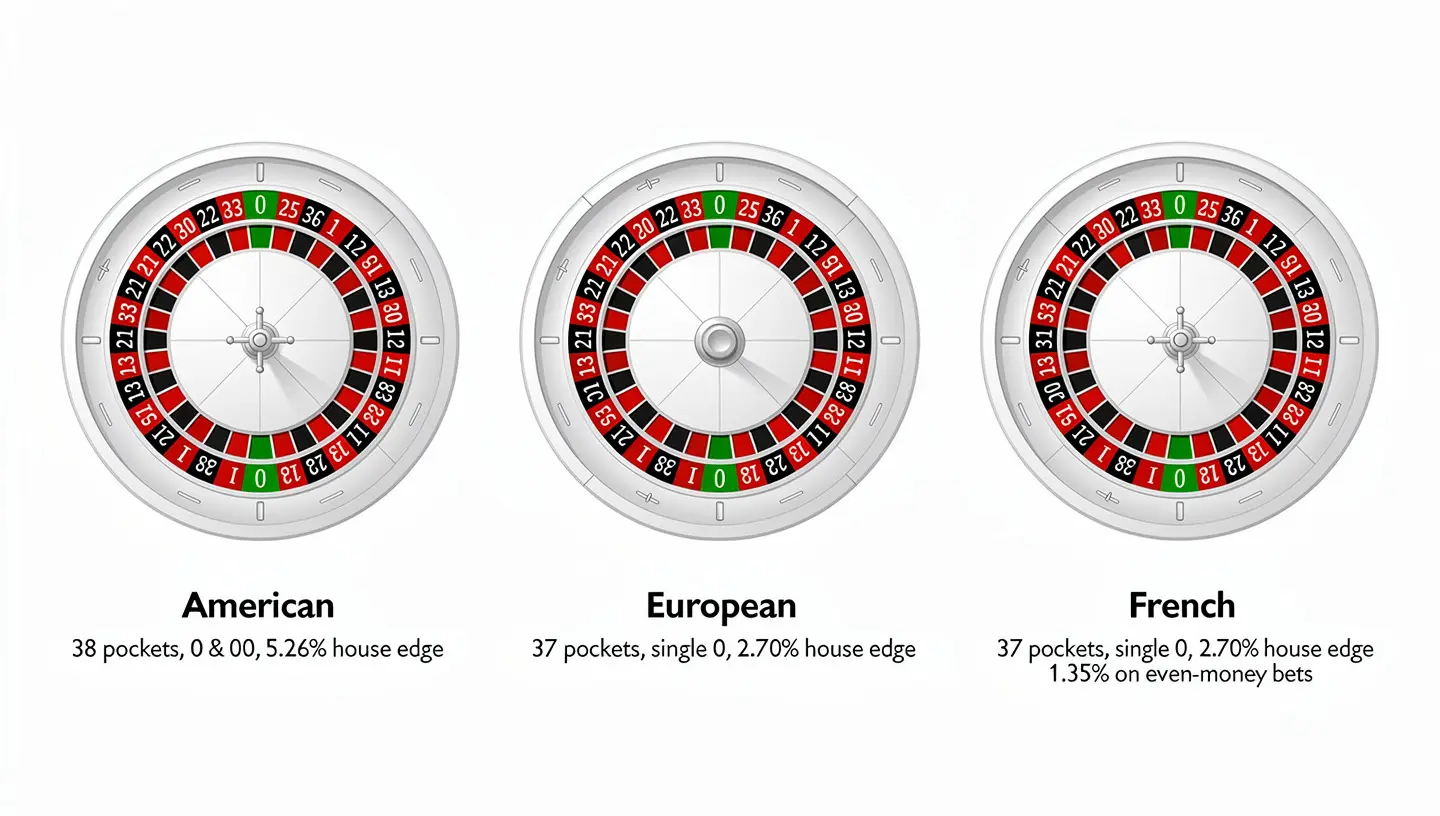
That difference in pockets sounds small, but it changes the house edge on every bet at the table. American roulette carries a house edge of 5.26 percent on almost every bet. European roulette sits at 2.70 percent. French roulette matches European roulette at 2.70 percent on most bets, but even-money bets drop to 1.35 percent once La Partage or En Prison applies.
| Variant | Pockets | Zero pockets | House edge |
|---|---|---|---|
| American roulette | 38 | 0 and 00 | 5.26% |
| European roulette | 37 | 0 | 2.70% |
| French roulette | 37 | 0 | 2.70% (1.35% on even-money bets) |
How the roulette wheels differ
The physical wheel is where the differences start, and it is the fastest way to tell the three versions apart without asking anyone. Roulette’s roots go back to 18th-century France, and the basic wheel design has barely changed since, even though the rules bolted onto it have moved a long way from where they started.
The American roulette wheel
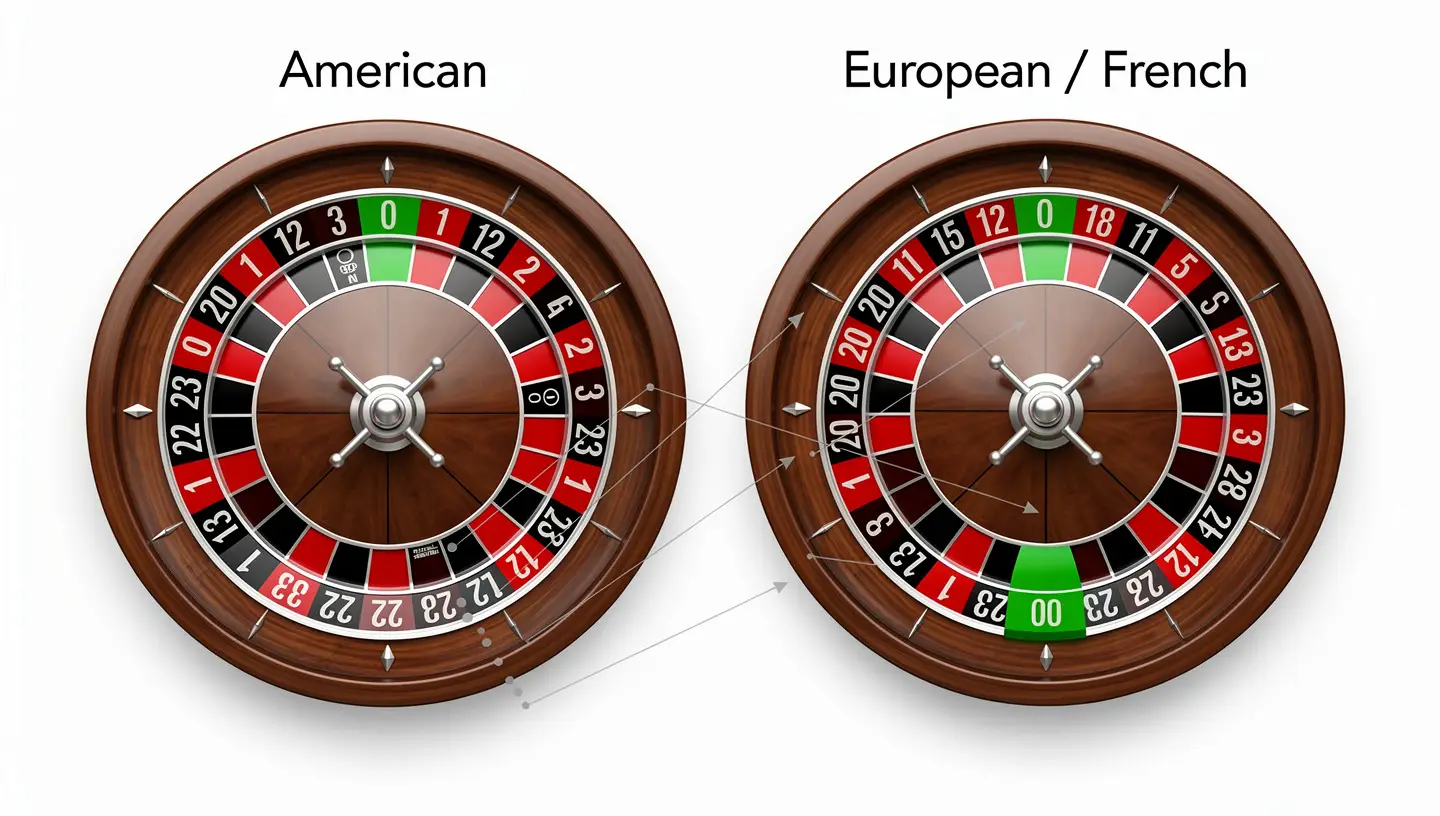
The American wheel carries 38 numbered pockets. Numbers 1 through 36 alternate between red and black, and two green pockets hold the single zero and the double zero. Those two green pockets sit directly opposite each other on the wheel, which is the quickest way to spot an American table from across the room. The number order around the wheel is also arranged differently from the European version, though this mostly matters for players who bet on wheel sections rather than the table grid.
The European and French roulette wheel
European and French wheels are physically identical. Both carry 37 pockets, numbers 1 through 36 plus a single green zero. The two versions use the same wheel and the same number sequence around it, which is why French roulette gets described as European roulette with extra rules rather than a wheel of its own. If you were shown a European wheel and a French wheel side by side with no table attached, you would not be able to tell them apart.
Whichever wheel is in front of you, the pocket count only means what it says if the game itself is fair. That is one reason it is worth knowing how to check a Curaçao gambling license before you sit down, since a properly licensed game runs on a certified random number generator that keeps the physical odds intact.
Table layout and betting grid differences
American roulette tables are rectangular, with the wheel set into the short end and a single dealer running the game. Outside bets, meaning red or black, odd or even, high or low, sit along one long side of the layout. European tables tend to be a little larger, with two dealers working the game, one at the wheel and one collecting chips, and outside bets laid out on both long sides instead of just one.
French table terms and call bets
French roulette tables look different again. The betting grid uses French words instead of English ones, so red and black become Rouge and Noir, odd and even become Impair and Pair, and low and high become Manque and Passe. Alongside the main grid sits a separate area called the racetrack, an oval diagram that mirrors the wheel itself rather than the table numbers. This is where players place call bets, wheel-section wagers announced to the dealer instead of placed by hand.
The best known call bets are Voisins du Zero, which covers 17 numbers clustered around the zero, Tiers du Cylindre, which covers 12 numbers on the opposite third of the wheel, and Orphelins, which covers the eight numbers left over between those two sections. A smaller bet called Jeu Zero focuses tightly on the seven numbers nearest zero, and neighbor bets let a player back any single number along with the two pockets sitting on either side of it on the wheel. None of these bets change the underlying house edge, but they change how a session plays out, since you are covering whole sections of the wheel rather than single numbers or colors.
Not every table labelled French roulette actually runs the full set of French rules, so it is always worth taking a minute to verify a casino’s license and read the table rules before you place real money on the racetrack bets.
House edge and odds compared
The house edge comes from the zero pockets, and the maths behind it is straightforward once you see it written out. Payouts on roulette are calculated as though the wheel had exactly 36 numbers, so a straight-up bet on a single number pays 35 to 1. European roulette actually has 37 pockets, so the true odds of hitting your number are 1 in 37, not 1 in 36. That one-pocket gap is where the 2.70 percent house edge comes from.
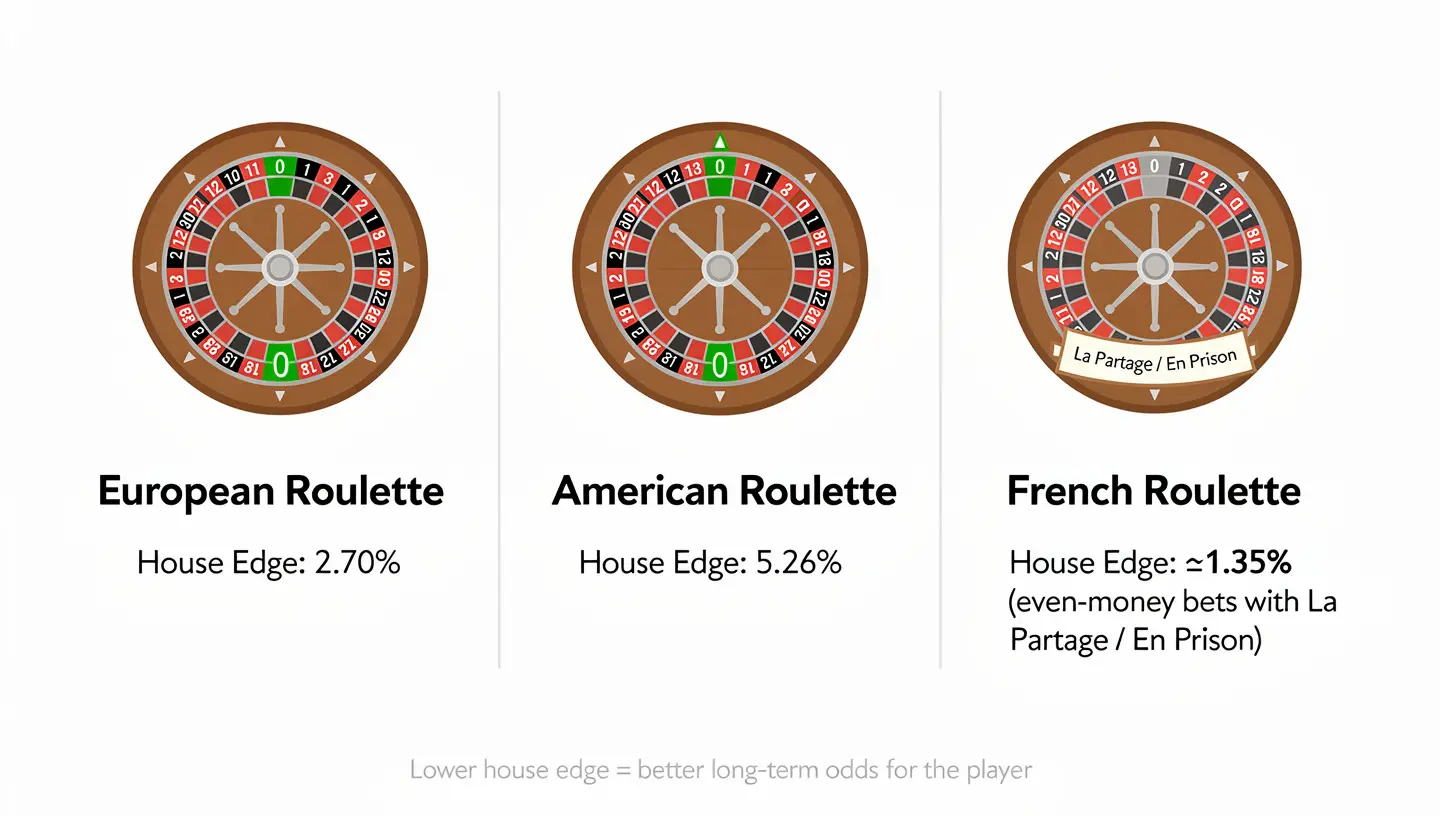
European roulette: (37 minus 36) divided by 37 equals 2.70 percent house edge.
American roulette: (38 minus 36) divided by 38 equals 5.26 percent house edge.
American roulette adds a second zero pocket without changing the payouts, so the gap between the true odds and the payout nearly doubles. Every bet on an American wheel, aside from one exception, carries that 5.26 percent edge. The exception is the five-number bet, sometimes called the basket bet, which covers 0, 00, 1, 2 and 3 in a single wager. It pays 6 to 1, but the house edge on that specific bet climbs to 7.89 percent, making it the worst single wager on the table.
Over a long enough session the gap between variants adds up. On $1,000 wagered across even-money bets, European roulette costs you roughly $27 in the long run, American roulette costs roughly $52.60, and French roulette with La Partage or En Prison cuts that down to about $13.50. None of this guarantees anything over a short session, since roulette stays a game of chance no matter which wheel you sit at, but the long-run numbers explain why serious players lean toward the lower edge whenever it is available. These figures are not marketing claims either. Independent testing labs, the same ones gambling regulators rely on, check every certified wheel and RNG against these exact percentages before a casino is allowed to offer the game for real money. If return to player percentage matters to you when choosing where to play, it is worth comparing sites through a guide on the best payout casino options before picking a table.
La Partage and En Prison rules explained
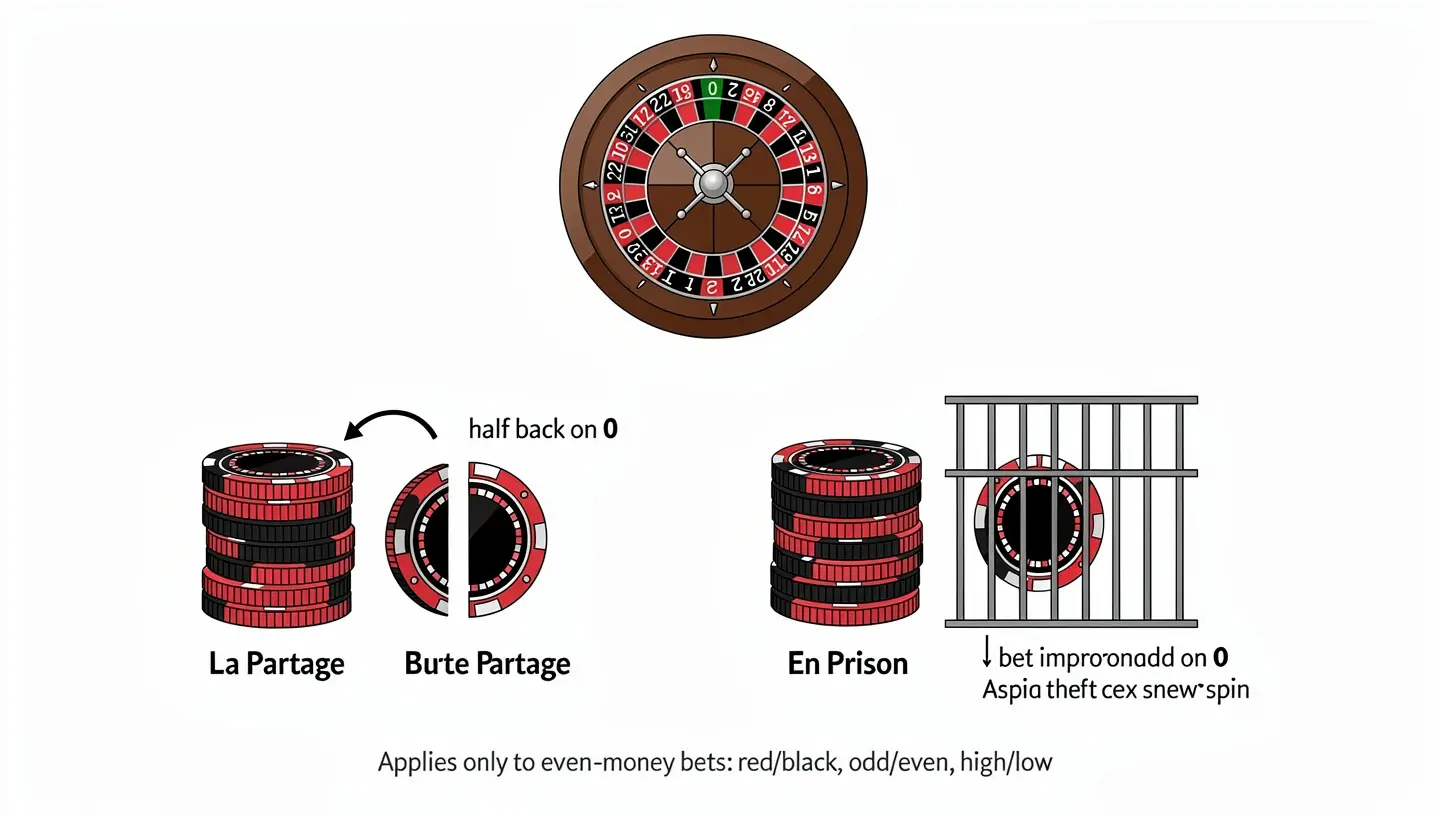
These two rules only apply to even-money bets, meaning red or black, odd or even, and high or low. Inside bets on single numbers or small groups get no benefit from either rule, since both only trigger when the ball lands on zero and you had an even-money bet on the table.
How La Partage works
La Partage is French for sharing. If you place an even-money bet and the ball lands on zero, the casino returns half your stake instead of keeping the whole thing. Bet $20 on black, the ball lands on zero, and you walk away with $10 back rather than losing the full $20. That single rule cuts the house edge on those bets from 2.70 percent down to 1.35 percent, which is one of the lowest edges available on any standard casino game.
How En Prison works
En Prison takes a different route to the same result. When zero hits on an even-money bet, your stake is not returned straight away. Instead it stays on the table, marked as imprisoned, for one more spin. Win that next spin and you get your original stake back with no extra profit. Lose it and the bet is gone completely. The maths ends up identical to La Partage, a 1.35 percent edge on qualifying bets, but the feel is different, since you are trading a guaranteed half-refund for a shot at getting the whole stake back.
Not every casino runs both rules, and some only offer one or the other. Before relying on either rule to shape a betting session, check the table information or the site’s bonus types and promotions page, since some operators tie French roulette availability to specific game bonuses rather than offering it across the board.
Which roulette bets are available in each variant
The core betting menu is the same across all three versions. You can bet on a single number, small groups of numbers, columns, dozens, or the six even-money options. What changes is which extras get added or dropped depending on the wheel.
| Bet type | Payout | American odds | European odds |
|---|---|---|---|
| Straight up (one number) | 35:1 | 2.63% | 2.70% |
| Split (two numbers) | 17:1 | 5.26% | 5.41% |
| Street (three numbers) | 11:1 | 7.89% | 8.11% |
| Corner (four numbers) | 8:1 | 10.53% | 10.81% |
| Six line (six numbers) | 5:1 | 15.79% | 16.22% |
| Column or dozen | 2:1 | 31.58% | 32.43% |
| Even-money bet | 1:1 | 47.37% | 48.65% |
American roulette is the only version with the five-number bet described earlier, since it needs both zero pockets on the layout to exist at all. European and French tables skip it entirely. On the flip side, European and French roulette carry the racetrack call bets described further up, and American tables do not offer them, since the wheel’s number sequence does not line up with those sections the same way. If you enjoy comparing house edges across different table games rather than just roulette, the same kind of pocket-by-pocket logic shows up in blackjack rules, where small rule changes shift the edge in similar fashion.
Triple zero and other rare roulette variants
Once in a while you will come across a wheel with three green pockets instead of two, known as triple zero roulette. It works exactly like the American version but with an extra zero added, pushing the house edge up to roughly 7.69 percent on most bets. Some operators frame the extra pocket as funding a charitable cause tied to the casino, but from a player’s seat it simply means worse odds than a standard American wheel. A small number of tables have gone even further with a quadruple zero layout, which is worth avoiding outright unless you are playing purely for novelty rather than value.
Roulette is not the only wheel-based game where one extra pocket or number quietly reshapes the odds. Dice game sic bo works on a similar principle, where certain bets carry a far steeper house edge than others despite looking just as simple on the surface, so the habit of checking the numbers before you bet carries over well beyond roulette.
Common myths about roulette variants
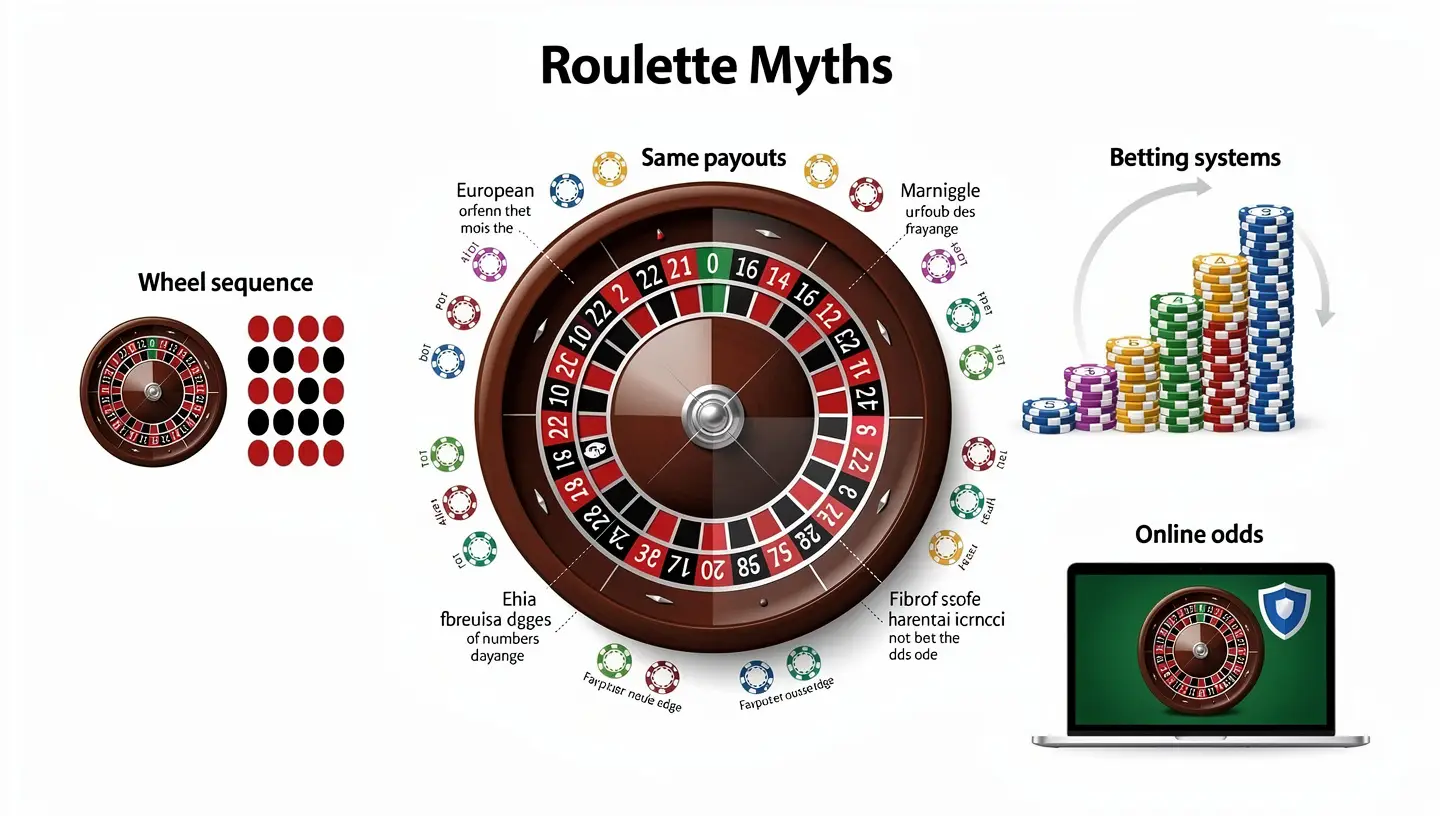
Myth: American roulette pays out more. It does not. Every payout, from the 35 to 1 straight-up bet down to the 1 to 1 even-money bet, is identical across all three variants. What changes is the chance of winning, not the size of the win.
Myth: the number sequence on the wheel affects your odds. It does not, for standard table bets. Betting on red, a dozen, or a single number carries the same probability no matter where those numbers physically sit on the wheel. The sequence only matters for racetrack and neighbor bets, which are based on physical position rather than the table grid.
Myth: a betting system can beat the house edge. Systems like Martingale or Fibonacci change how much you wager and when, not the underlying odds of the wheel. The house edge stays exactly the same on every single spin regardless of what happened on the last one.
Myth: online roulette is rigged against the player. A licensed, tested game runs on the same physical odds described throughout this guide, no more and no less. The doubt usually comes from playing on an untested site rather than from the game itself, which is exactly why sticking to a reputable online casino matters as much as picking the right variant in the first place.
Which roulette variant should you play
If every version were sitting at the same casino with no other differences, French roulette with La Partage or En Prison would be the clear pick for anyone betting on red, black, odd, even, high or low. A 1.35 percent edge is about as good as it gets on a standard casino floor. For inside bets, straight-ups, splits, corners and the rest, La Partage does not apply anyway, so European and French roulette work out identical at 2.70 percent, meaning either one is a fine choice.
European roulette makes a solid second option whenever French tables are not available, since it is far more common worldwide and still carries the lower 2.70 percent edge across every bet type. American roulette should be the last pick when a European or French table is sitting nearby, purely on the numbers. That does not mean American roulette is a bad game to play for fun, especially if it is the only version on the floor or the one you grew up watching, but understand going in that the expected losses run close to double compared with a single-zero wheel.
Whichever variant you settle on, treat roulette as entertainment rather than income, and keep your session inside a budget you are comfortable losing. A quick look at responsible gambling limits before you start is a smart habit regardless of which wheel you end up spinning, and it costs nothing to set a stop point before the first bet goes down. Knowing the odds ahead of time also makes it easier to spot when a session has simply run cold rather than assuming the game itself has turned against you, which is a large part of what makes roulette frustrating for newer players in the first place.
What is the safest roulette bet for beginners?
Even-money bets such as red or black, odd or even, and high or low give you close to a 50 percent chance of winning on every spin. They are the easiest to understand and, on a French table with La Partage or En Prison in play, they also carry the lowest house edge available on the whole layout.
Is French roulette the same as European roulette?
The wheel is identical, 37 pockets with a single zero, but the table rules are not. French roulette can offer La Partage or En Prison on even-money bets, cutting the edge to 1.35 percent on those wagers. European roulette does not include either rule, so it stays at 2.70 percent across the board.
Why does American roulette have a higher house edge?
The extra double zero pocket adds a second way for the house to win without changing any of the payouts. That single pocket pushes the edge from 2.70 percent on a single-zero wheel to 5.26 percent on the double-zero American wheel, nearly doubling the cost to the player over time.
What is the five-number bet in American roulette?
It is a single wager covering 0, 00, 1, 2 and 3 at once, sometimes called the basket bet or the top line. It pays 6 to 1, but the house edge on it runs to 7.89 percent, the worst bet on a standard roulette table, and it only exists on American wheels since it needs both zero pockets.
Do La Partage and En Prison apply to all bets?
No. Both rules only cover the six even-money outside bets, red or black, odd or even, and high or low. Inside bets on single numbers, splits, streets, corners, six lines, columns and dozens get no benefit from either rule and keep the standard 2.70 percent edge.
Which roulette variant has the best odds?
French roulette with La Partage or En Prison offers the best odds available, at 1.35 percent on even-money bets. For every other bet type, European and French roulette are mathematically identical at 2.70 percent, and both beat American roulette’s 5.26 percent by a wide margin.
Can betting systems change the house edge?
No. Systems such as Martingale, Fibonacci or D’Alembert only adjust your bet size after wins and losses. The odds of the wheel itself stay fixed on every spin, so no staking pattern changes the long-run house edge on any variant.
Is triple zero roulette worse than American roulette?
Yes. Adding a third zero pocket pushes the house edge up to roughly 7.69 percent on most bets, well above the 5.26 percent found on a standard American wheel. It is one of the worst versions of roulette available on any casino floor.
Are the betting options the same across all three variants?
Mostly. Straight-up, split, street, corner, six line, column, dozen and even-money bets appear on every version. American roulette adds the five-number bet that the other two do not have, while European and French roulette add racetrack call bets such as Voisins du Zero and Tiers du Cylindre that American tables do not offer. Live dealer rooms often carry all three side by side, in a similar way to how online vs live baccarat tables sit next to each other at the same operator, so switching between wheels usually takes nothing more than picking a different table.