Learning how to play baccarat takes less time than most casino games, since the entire round comes down to two hands and three simple betting options. There is no complicated strategy to memorize before your first game, since the dealer handles almost every decision once the cards are dealt.
This guide walks through the card values, the full sequence of a round, the third card rule that trips up most beginners, the bets worth making, and a few simple strategies to try once you have the basics down. By the time you finish reading, how to play baccarat should feel less like a mystery and more like something you could sit down and try tonight without needing to look anything up mid hand.
Baccarat Card Values
Before anything else, it helps to know what each card is worth at the table. Cards 2 through 9 count at face value. 10s, jacks, queens, and kings are all worth zero.
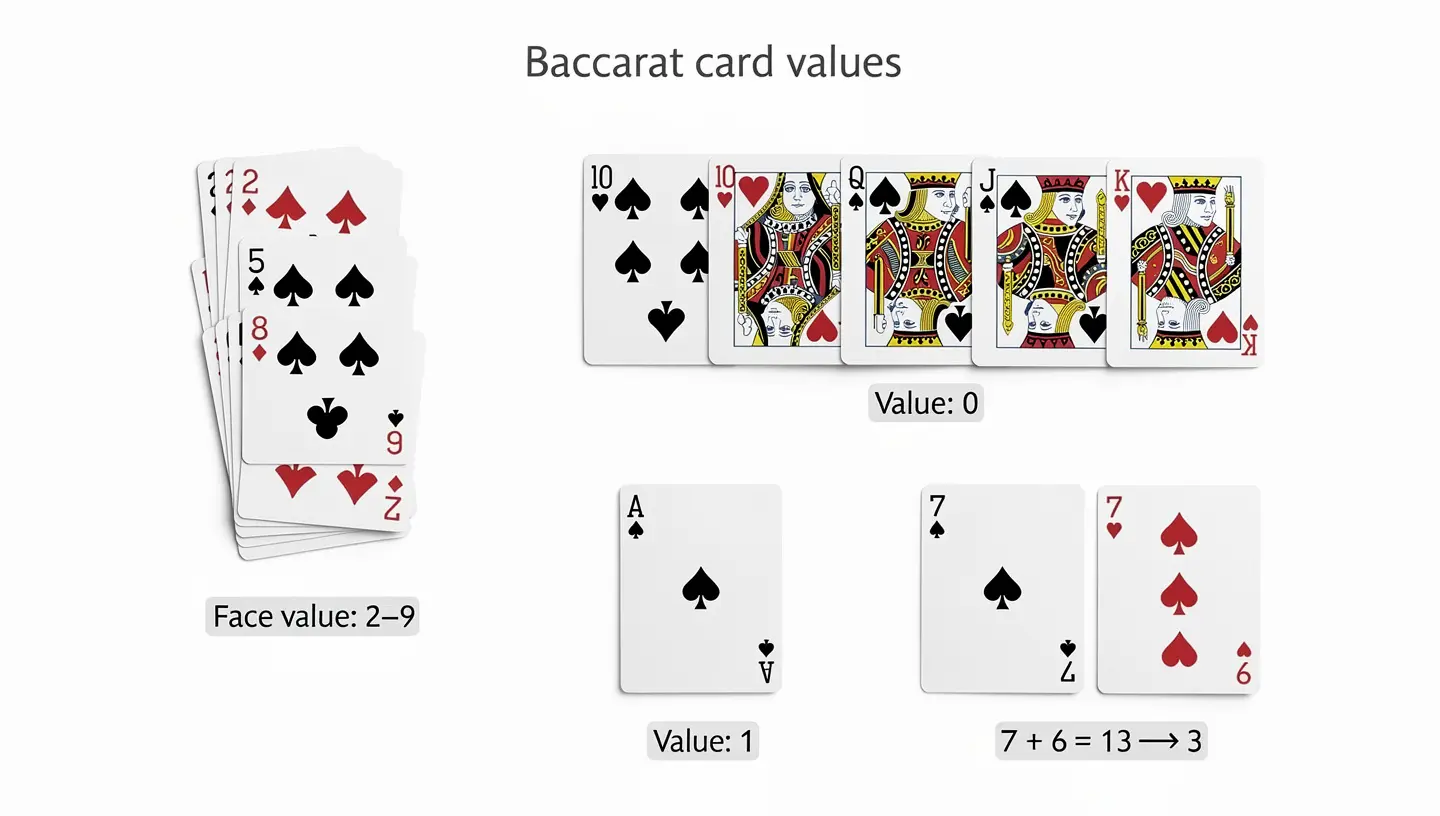
Aces count as one. If a hand’s total goes above nine, only the last digit counts, so a hand of 7 and 6 adds up to 13, which becomes a 3. This single rule explains almost every confusing moment new players run into, so it is worth remembering before anything else clicks into place. Once this piece makes sense, the rest of how to play baccarat falls into place fairly quickly.
How to Play Baccarat Step by Step
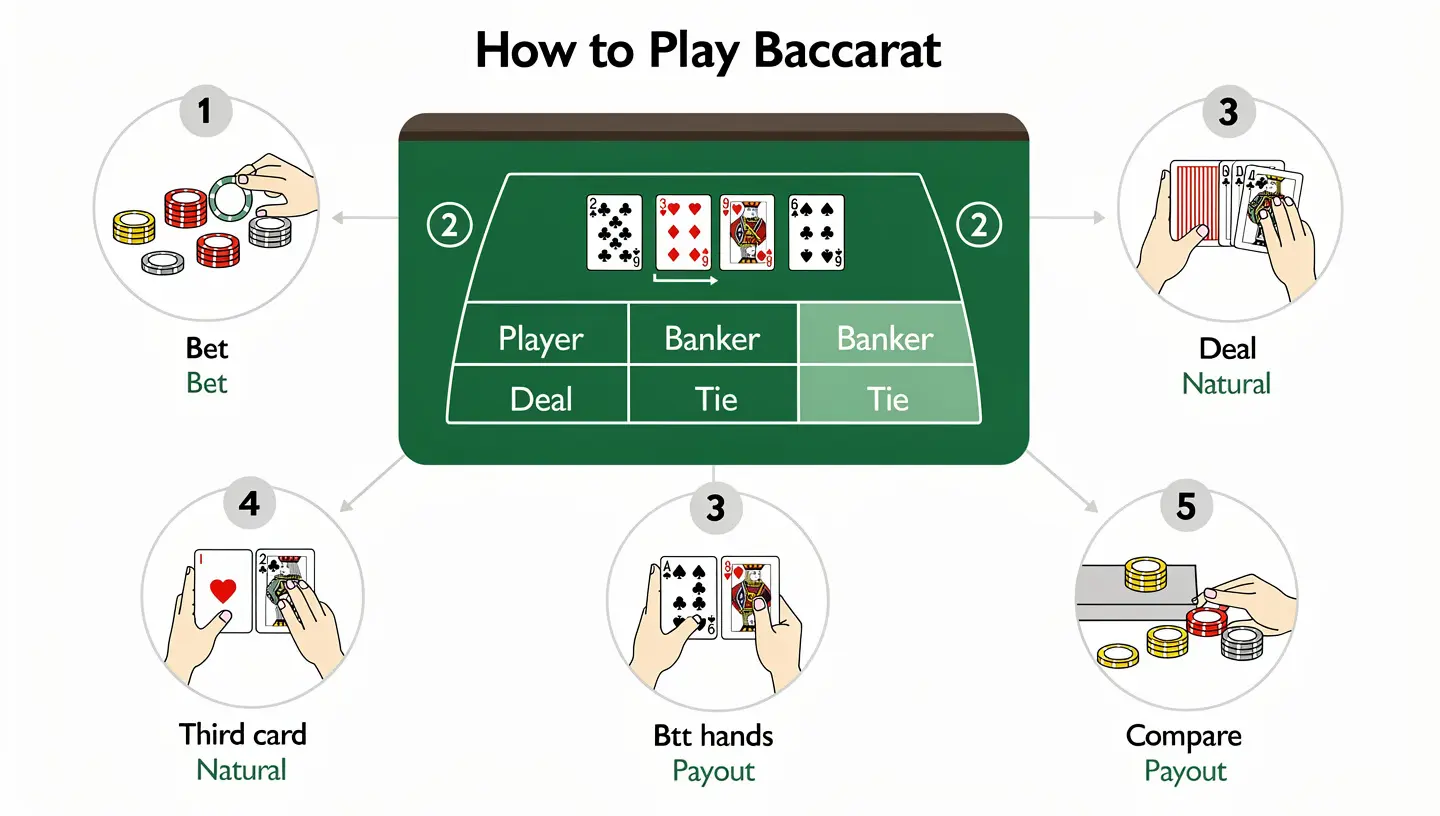
A round of baccarat follows the same basic sequence whether you are sitting at a physical table in a land based casino or clicking through hands online. Understanding how to play baccarat really just means understanding these six steps in order, since nothing about the game changes once you move past this basic sequence.
1. Place Your Bet
Before any cards are dealt at all, choose whether you think the Banker’s hand, the Player’s hand, or a Tie will win. These are the only three outcomes you can bet on, and once your chips are down, they stay put until the round finishes, with no option to change your mind partway through a hand once cards start hitting the table.
2. The Dealer Deals Four Cards
Two cards go to the Player’s hand and two go to the Banker’s hand. Neither hand belongs to an actual person at the table, they are simply the two sides you are betting on, and this confuses more first time players than almost anything else in the game, even more than the third card rule itself once they actually sit down to play.
3. Check for a Natural
If either hand totals eight or nine right away, that hand is called a natural, and the round ends immediately with no further cards drawn. A natural nine beats a natural eight if both hands qualify, and either one ends the round on the spot without any further cards touching the table. This is the fastest possible outcome in the entire game, and it happens more often than most new players expect once they start counting hands.
4. Draw a Third Card if Needed
If neither hand has a natural, fixed rules determine whether the Player and Banker draw a third card. You do not need to make this decision yourself, the dealer follows a set chart every time, which is exactly what makes this part of learning how to play baccarat easier than it first looks once you actually watch it happen at the table a few times.
5. Compare the Final Totals
Once all cards are dealt, whichever hand sits closest to nine wins the round. If both hands land on the same total, the result is a tie, and any bets placed specifically on that outcome pay out at their much higher rate.
6. Winning Bets Get Paid
Bets on the winning hand are paid out, with a small commission taken from winning Banker bets at most tables. Losing bets are collected, and the shoe moves on to the next round without any pause for players to reset or adjust anything at the table, since the cards for the next hand are already waiting in the shoe ready to be dealt.
The Third Card Rule Explained
This is the part that confuses most new players, mainly because it looks more complicated than it actually is in practice. The good news is you never have to apply it yourself, since the dealer always follows the same fixed chart every single time a hand needs a third card.
When the Player Draws a Third Card
The Player’s hand draws a third card whenever its first two cards total zero through five. A total of six or seven simply means the Player stands with no further cards, and this rule never changes regardless of what the Banker’s hand looks like.
When the Banker Draws a Third Card
The Banker’s rules depend on both its own total and whatever card the Player just drew, if any. A Banker total of zero, one, or two always draws. A Banker total of seven always stands. Everything between those two points depends on the specific value of the Player’s third card, which is exactly why casinos hand new dealers a printed chart until the sequence becomes second nature. Our full breakdown of baccarat rules includes the complete third card chart along with every edge case worth knowing, which is worth bookmarking the first few times you play until the pattern sticks.
Baccarat Bets and House Edge
Baccarat only offers three bets, and the odds behind each one are worth understanding before you sit down, since the difference between them adds up more than most new players expect over a long session.
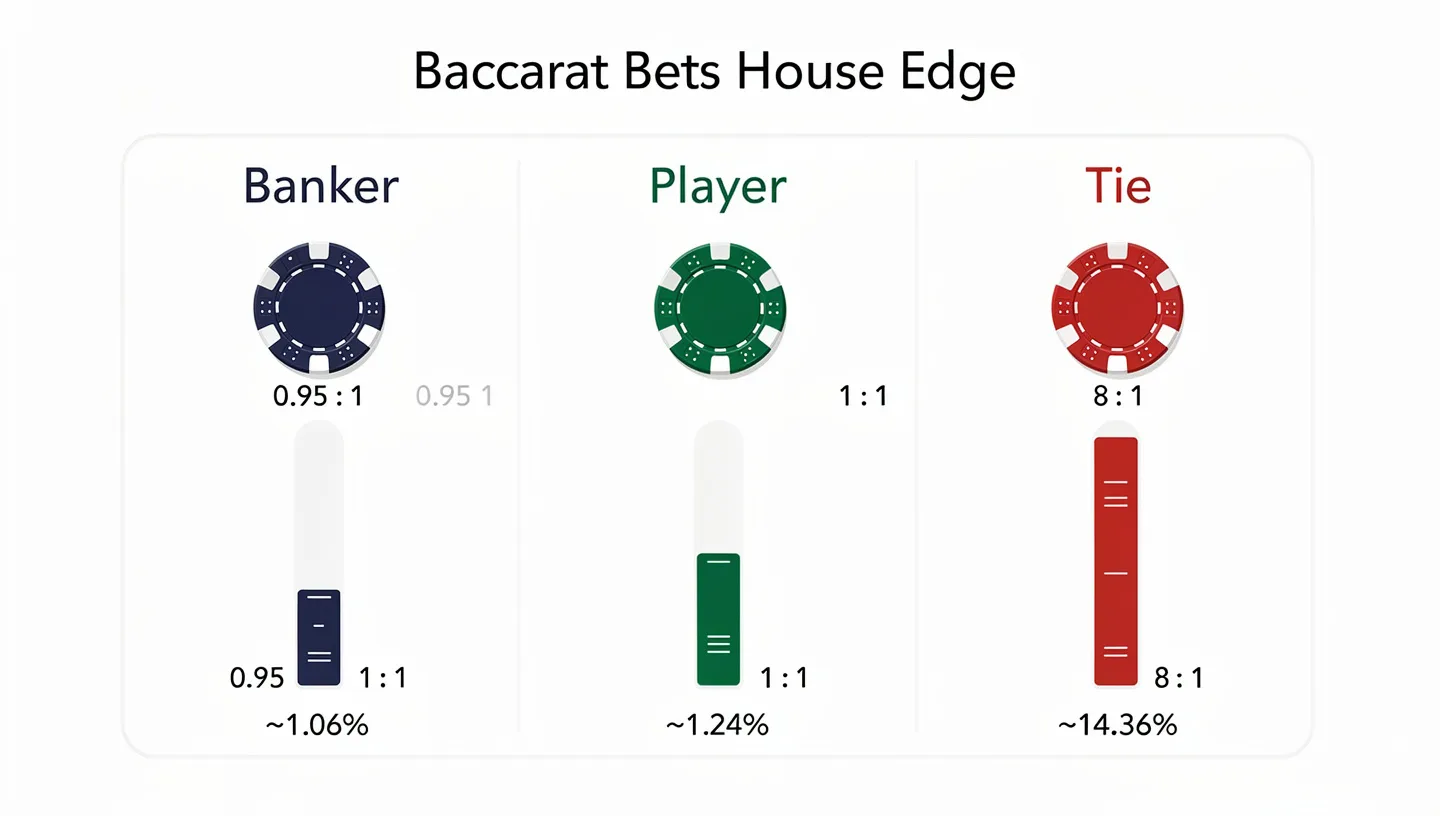
| Bet | Payout | House Edge |
|---|---|---|
| Banker | 0.95 to 1 | About 1.06% |
| Player | 1 to 1 | About 1.24% |
| Tie | 8 to 1 | About 14.36% |
Banker Bet
The Banker bet wins slightly more often than the Player bet, which is exactly why casinos charge a commission, usually five percent, on winning Banker bets. Even after that commission, this remains the single best bet on the table thanks to its low house edge, and it is the one bet most experienced players return to again and again regardless of what strategy they are otherwise following at any given session.
Player Bet
The Player bet pays even money with no commission attached, making it simpler to track than the Banker bet even though its house edge sits slightly higher. Some players prefer it purely for the simplicity of a clean 1 to 1 payout without doing commission math in their head after every win.
Tie Bet
A Tie bet pays out handsomely at 8 to 1, but it wins far less often than either main bet, and the house edge reflects that. Most experienced players treat this bet as a rare, low probability side wager rather than a serious part of any strategy, since chasing ties consistently tends to drain a bankroll faster than almost any other approach at the table.
Common Baccarat Side Bets
Player Pair and Banker Pair pay out if the first two cards dealt to that hand form a pair, typically around 11 to 1. Super Six pays out if the Banker wins with a total of exactly six, often at 12 to 1. Dragon Bonus pays based on how large a margin a natural win is scored by, with bigger margins paying considerably more, sometimes reaching 30 to 1 on the largest possible winning margin. Side bets almost always carry a much higher house edge than the three main bets, often well above 10 percent, so they are worth treating as occasional fun rather than a core part of your betting plan.
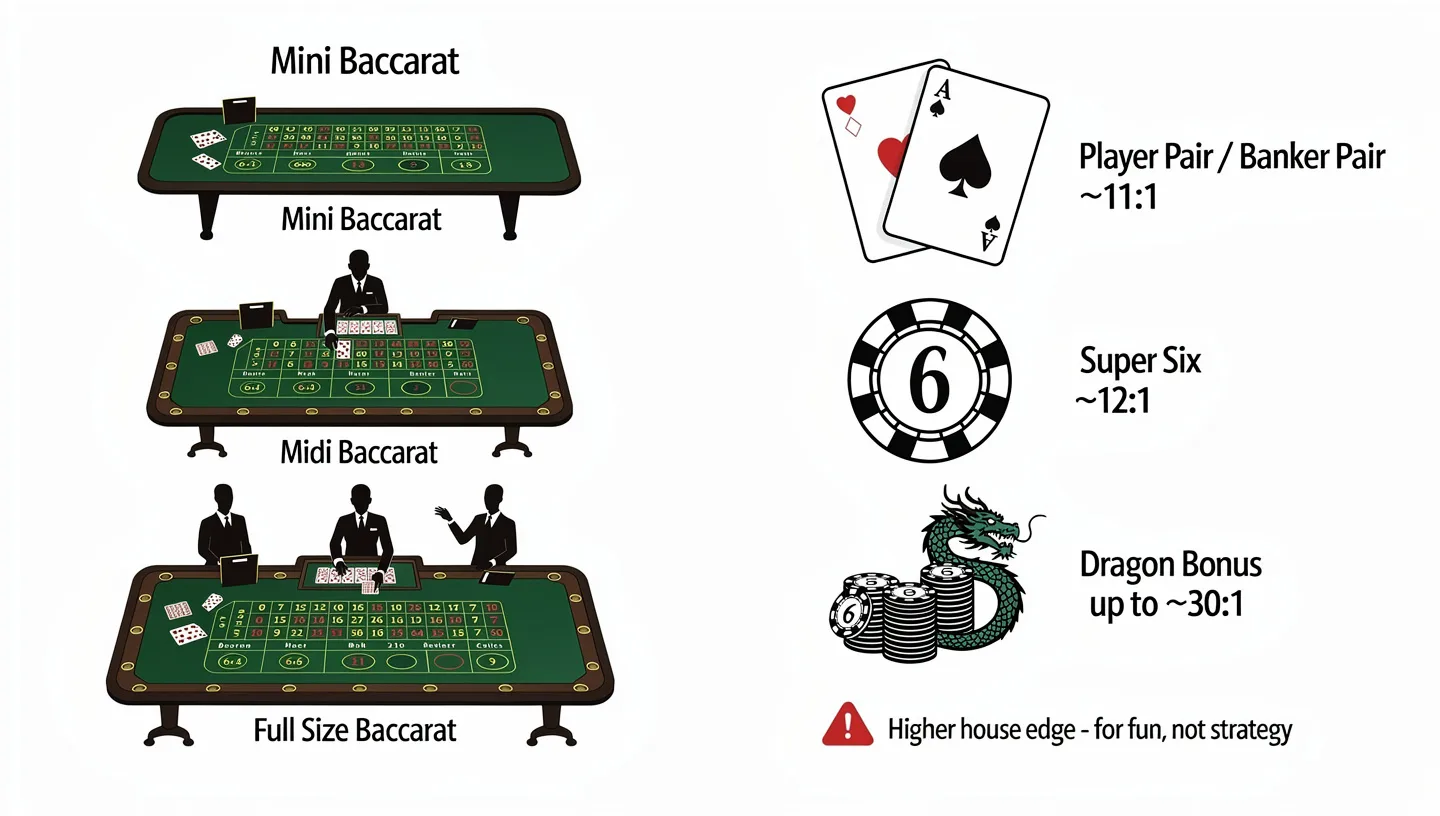
A small side bet placed for entertainment is one thing, but building a strategy around them tends to cost far more over time than most players realize until they actually track the results.
Types of Baccarat Tables
Not every baccarat table looks or plays the same, and the format you choose affects both pace and betting limits quite a bit more than most new players expect.
Mini Baccarat
Mini Baccarat seats six or seven players around a single dealer, who handles all the cards personally. Minimum bets tend to start low, often around $5, which makes this the most approachable format for newer players still getting comfortable with the pace of the game and the flow of a typical round.
Midi Baccarat
Midi Baccarat sits between mini and full size tables, seating up to nine players with higher betting limits than mini tables typically allow. Players are usually permitted to touch the cards at this format, unlike at mini tables, though bending or damaging them is never allowed under any circumstance.
Full Size Baccarat
Full size tables, sometimes called Big Baccarat, seat up to fourteen players and are reserved for higher stakes, often ranging from $50 up into six figures. These tables usually run with two dealers and a caller rather than a single dealer handling everything alone, and they tend to sit in a separate, quieter area of a physical casino away from the main floor.
Baccarat Variants Worth Knowing
EZ Baccarat removes the standard commission on Banker wins entirely, adjusting the payout structure slightly to balance the math back out, usually by turning a specific winning hand into a push rather than a win. This tends to appeal to players who find the commission math on standard Banker bets a bit tedious to track across a long session. Baccarat Banque, more common in European casinos, auctions off the Banker role to the highest bidder before each shoe begins, which changes the social dynamic of the table quite a bit compared to the standard version most players are used to, since the person holding the Banker role effectively risks their own money against everyone else seated at the table.
Online casinos also offer both a software driven version and a live dealer version of the game, and the two play quite differently despite sharing identical rules. The software version resolves each hand in seconds using a certified random number generator, while the live version streams an actual dealer shuffling and dealing real cards from a studio or casino floor. Our full comparison of online baccarat vs live baccarat breaks down exactly how each format works and which one tends to suit which type of player, including the differences in speed, minimum bets, and available side bets between the two.
Simple Baccarat Strategies for Beginners
Baccarat outcomes come down to the cards, not skill, but a handful of betting approaches can help you manage your bankroll more sensibly than betting at random.
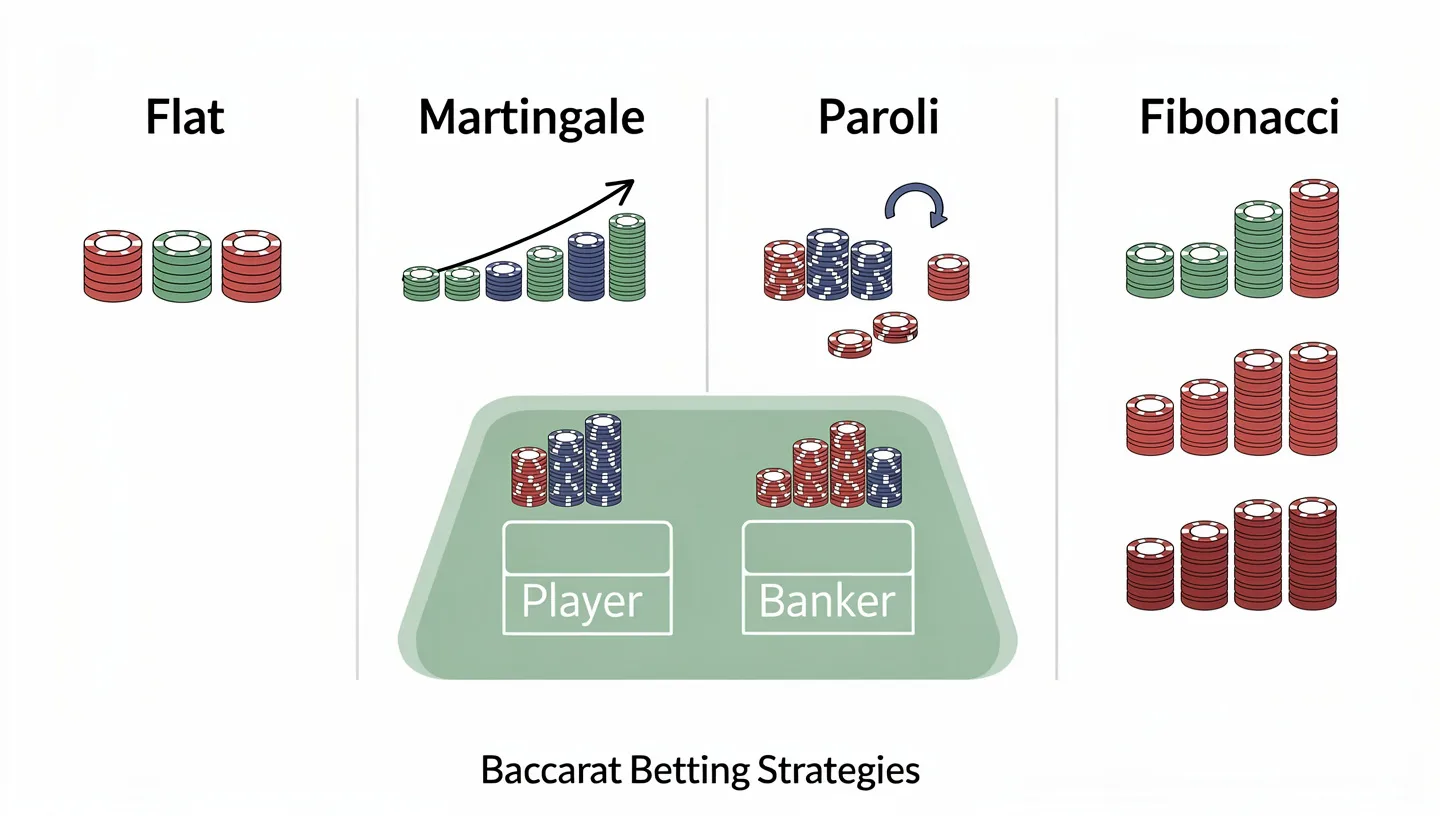
None of these systems change the underlying house edge, since that number is fixed by the math of the game itself, but they do change how your bankroll holds up over a long session.
Flat Betting
This is the simplest approach available. Bet the same amount on the same side every round rather than adjusting your stake based on wins or losses. It will not guarantee a profit, but it keeps your bankroll lasting far longer than more aggressive systems, and it is the approach most beginners should start with before trying anything more complicated or harder to track mid session.
Martingale Strategy
The Martingale approach doubles your bet after every loss, with the idea that a single win eventually recovers everything lost along the way. It can work over a short stretch, but it requires a large bankroll and a table limit high enough to absorb a long losing streak, which makes it risky for beginners who have not yet felt what a five or six loss streak actually feels like in practice. A run of even six or seven straight losses, which happens more often than most players expect, can require a bet many times larger than where you started, and plenty of tables have limits that cut this strategy off before it ever has the chance to recover.
Paroli Strategy
Paroli works in the opposite direction, doubling your bet after a win rather than a loss, then returning to your original stake after three consecutive wins. This keeps losses capped at your base bet while still letting a hot streak pay off, which makes it one of the lower risk systems worth trying as a beginner.
Fibonacci Strategy
This system uses the Fibonacci sequence, where each bet equals the sum of your previous two bets, increasing gradually after losses rather than doubling outright. It spreads risk out more slowly than Martingale while still working toward recovering losses over time. For a deeper look at these systems and a few more advanced approaches, our full guide to baccarat strategy covers the math behind each one and where they tend to fall apart under sustained bad luck.
Tips to Improve Your Baccarat Game
Stick mostly to the Banker bet, since it carries the lowest house edge of the three main options even after the commission. Treat the Tie bet as a rare novelty rather than a regular part of your betting plan, given how steep its house edge runs. Set a loss limit before you sit down and actually stick to it, since baccarat’s fast pace can burn through a bankroll quicker than slower games where each hand takes longer to resolve.
None of these tips guarantee a win, since baccarat outcomes come down entirely to the cards rather than any decision you make at the table. What they do is stretch your bankroll further and keep a session from turning into a bigger loss than you planned for going in. The rules of the game itself have stayed remarkably consistent for decades, and official casino regulations published by the New Jersey Casino Control Commission confirm the exact same drawing rules covered earlier in this guide, right down to the specific totals that trigger a third card draw for both hands.
Watching a few hands before betting real money is another simple way to get comfortable, whether that means standing near a table at a physical casino or loading a free demo version online. Seeing the third card rule play out a handful of times does more to cement it in memory than reading about it ever will, and most players find the whole process clicks into place surprisingly quickly once they have actually watched it happen a few times in a row.
If you are comparing casinos before you play, our guide on choosing a reputable online casino covers what to check before trusting any site with your money, including licensing, game testing, and how an operator actually handles payouts once you are ready to cash out. Reading through a handful of independent reviews before signing up anywhere is always worth the extra few minutes it takes, especially since a great baccarat table means little at a casino that cannot be trusted with a real money withdrawal.
Setting boundaries around your play matters just as much as picking the right bet, and it is worth doing before you sit down rather than after a rough session already has you frustrated. Our guide on setting responsible gambling limits covers practical tools for keeping a session in check before it gets away from you, whether that means a deposit cap, a time limit, or simply a firm number you will not bet past no matter how the shoe is running.
Frequently Asked Questions
What is the goal of baccarat?
The goal is to correctly predict which hand, Banker or Player, will finish closer to a total of nine, or to correctly call a tie between the two. You are betting on the outcome rather than playing a hand yourself, which is exactly what makes the game so quick to pick up compared to something like blackjack or poker, where a wrong decision can genuinely change the outcome of a hand.
Is baccarat a game of skill or luck?
Baccarat is almost entirely a game of luck. The dealer follows fixed rules for drawing a third card, so there are no decisions left for players to make once bets are placed, and no amount of study changes the odds behind any individual hand.
What is the best bet in baccarat?
The Banker bet is generally considered the best option, since it carries the lowest house edge of the three main bets even after the standard commission on winning bets. Most experienced players stick to it almost exclusively for this exact reason.
Can I play baccarat online?
Yes, most licensed online casinos offer both a standard software version and a live dealer version of baccarat. Both follow identical rules and payout structures, with the main difference coming down to speed and presentation rather than anything about the actual math of the game itself.
How many decks are used in baccarat?
Most baccarat games use six or eight standard decks shuffled together in a shoe. Some smaller or specialty tables use a single deck instead, which slightly shifts the house edge on certain bets, though the difference is small enough that most players never notice it in practice.
Is baccarat easy to learn?
Yes, baccarat is one of the easier casino games to pick up, since the dealer handles nearly every decision during a round. New players typically only need to understand the three betting options and the basic idea of getting closest to nine, and most people feel comfortable after watching or playing just a handful of hands at a real table or through a free demo online.
What happens if I run out of money mid shoe?
Nothing forces you to keep playing once you have decided you are done, and stepping away mid shoe is always an option regardless of how many hands have already been dealt. Setting a firm stopping point before you sit down makes this decision much easier to stick to once the pressure of an actual session sets in, rather than trying to talk yourself into just one more hand.