Dragon Tiger vs Baccarat is the comparison most players make once they see both games sitting next to each other in a live dealer lobby. Both use a shoe of standard cards, both ask you to back one side, and both are decided by luck alone. The similarity stops there. Dragon Tiger deals a single card to each side and the higher card wins, while Baccarat deals two or three cards to each hand and the total closest to 9 takes the round. That one change moves the house edge, the number of bets on the table, the speed of play and the amount of rules you need to know before you sit down.
This guide lines the two games up on cards, values, bets, payouts, side bets and speed, and then puts the numbers next to each other: 3.73% on the main Dragon Tiger bets against 1.06% on the Baccarat Banker. You will also find a direct answer on which game suits which type of player, a section on playing either one from the US, and a short FAQ at the end.
Dragon Tiger vs Baccarat at a Glance
The table below covers the differences players ask about first. Each row is explained further down, and the math sits in the house edge section.
| Feature | Dragon Tiger | Baccarat |
|---|---|---|
| Cards per side | One | Two, sometimes three |
| How a round is won | Higher card | Total closest to 9 |
| Card values | Ace low, King high | Ace 1, tens and face cards 0 |
| Third card rule | None | Fixed drawing table |
| Main bets | Dragon, Tiger, Tie | Player, Banker, Tie |
| House edge on the best bet | 3.73% | 1.06% Banker, 1.24% Player |
| Result of a tie | Dragon and Tiger bets lose half | Player and Banker bets are returned |
| Pace | Quick | Slower |
Dragon Tiger has fewer rules and faster rounds, which is why beginners often start there. Baccarat costs less per hand on its two main bets, and the layout carries more side bets to choose from.
What Is Dragon Tiger?
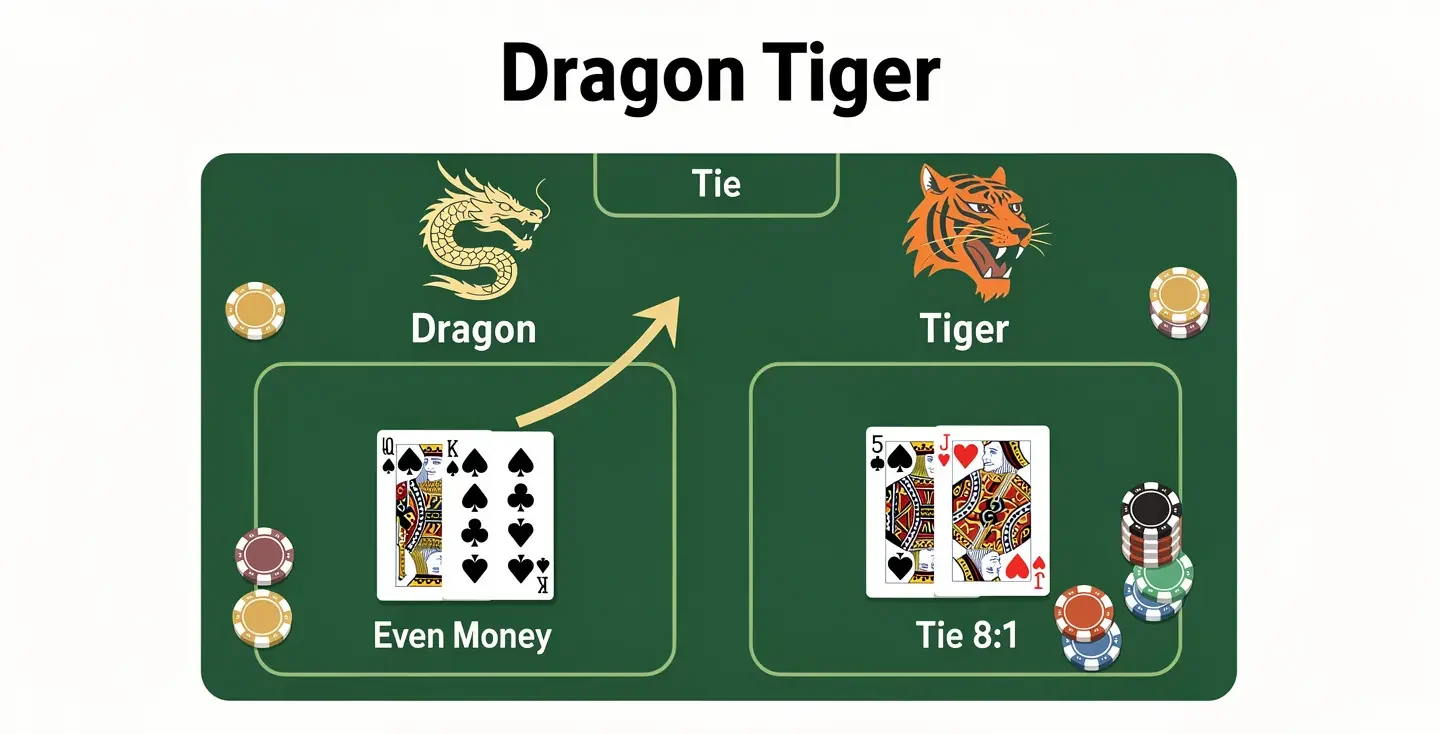
Dragon Tiger is a table game built around one comparison. The dealer turns one card for the Dragon position and one for the Tiger position, and you back the side you expect to show the higher card.
Where the Game Comes From
Dragon Tiger is usually placed in Cambodia, although Wizard of Odds calls that origin a rumor and says he has never come across the game in Macau. The name follows the Yin and Yang idea, with the Tiger standing for Yin and the Dragon for Yang. Today Dragon Tiger turns up mostly in live dealer lobbies, right next to the Baccarat tables.
How a Round of Dragon Tiger Works
The game runs on six to eight decks, and eight is the usual number at live tables. Before any card comes out you place a chip on Dragon, Tiger or Tie. The dealer then turns one card face up on each side. Ranks run from Ace low up to King high, and suits play no part in the main bets. If the Dragon card is higher, Dragon bets are paid 1:1, and Tiger works the same way. Equal ranks make a Tie, which pays 8:1 to 11:1 depending on the provider, while bets on Dragon or Tiger lose half of the stake. A hand by hand example is on our Dragon Tiger rules page.
Dragon Tiger Bets and Payouts
Dragon and Tiger pay even money. The Tie is the big payout option, and the side bets vary by software provider, with a suit bet, odd or even, Big or Small, and a Suited Tie that pays 50:1 at many tables. Most players keep their chips on Dragon or Tiger, since the two bets cost exactly the same.
What Is Baccarat?
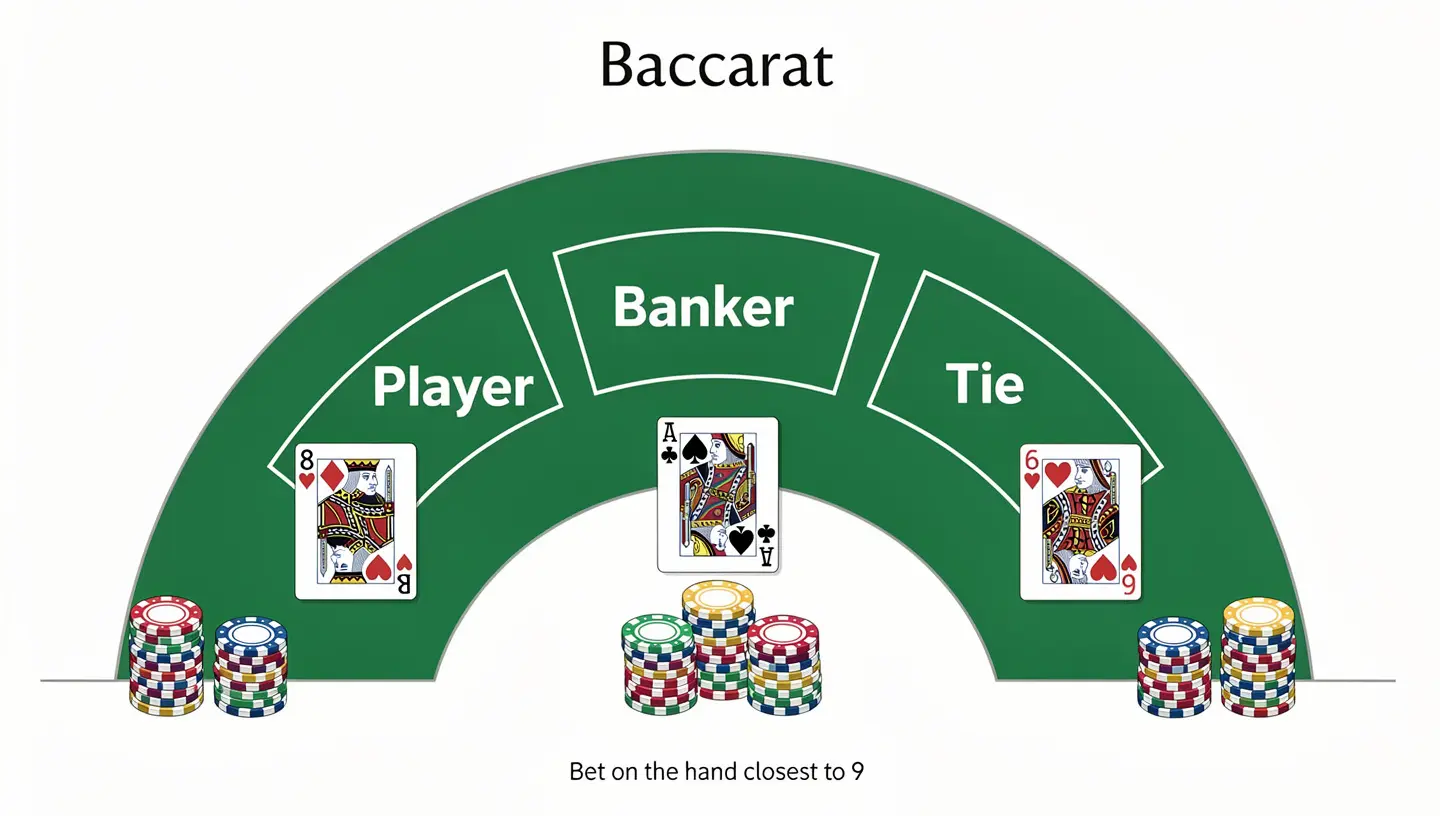
Baccarat is a card game with two hands, Player and Banker. You bet on the hand you think will finish closest to 9, or on a Tie. The game is often traced back to Italy and France, and it is now a fixture in casinos from Macau to Las Vegas. Our Baccarat guide covers the game from the first hand.
How a Baccarat Hand Is Scored
Each hand starts with two cards. Aces count 1, cards from 2 to 9 count face value, and tens and face cards count zero. When a total goes past 9, only the last digit is kept, so a 7 and an 8 make a hand worth 5. A total of 8 or 9 on the first two cards is called a natural, and it ends the round on the spot.
Baccarat Rules for Drawing a Third Card
When neither hand has a natural, a fixed table decides whether a third card is drawn. The Player hand draws on a total of 0 to 5 and stands on 6 or 7. The Banker rule depends on the Banker total and on the card the Player received. Neither the player nor the dealer makes a choice, so the table is something to read once for reference and not to memorize.
Baccarat Bets and Commission
The main bets are Player, Banker and Tie. Winning Banker bets are paid 0.95 to 1 because the casino takes a 5% commission, and the Banker bet still carries the lowest house edge on the layout even after that cut. Commission free versions pay Banker 1:1 but pay only half when the Banker wins with a total of 6.
Key Differences Between Dragon Tiger and Baccarat
Dragon Tiger and Baccarat are both dealt from a shoe and both come down to two sides. The gaps show up in how many cards are dealt, how they are valued and what you can bet on.
Cards Dealt and Hand Totals
Dragon Tiger uses exactly two cards per round, one for each side, and the round is over as soon as they are turned over. Baccarat starts with four cards, two for Player and two for Banker, and adds a third card to either hand when the table calls for it. In Dragon Tiger there are no totals to add. You compare two single cards. In Baccarat you add the values of each hand, drop the tens digit and compare the results. This is why a Baccarat round is easy to misread for a new player, while a Dragon Tiger round makes sense the moment the cards are shown.
Card Values and Scoring
Ranking works in opposite directions. In Dragon Tiger the Ace is the lowest card and the King is the highest, so the ladder climbs from 2 to 10 and then through Jack, Queen and King. Baccarat ignores rank: the Ace is 1, tens and face cards are 0, and every hand is reduced to a single digit from 0 to 9. A King beats everything in Dragon Tiger, yet the same King adds nothing to a Baccarat hand. Some guides list Dragon Tiger Aces as zero or face cards as 10, and both statements are wrong.
The Third Card Rule
Dragon Tiger has no third card. One card lands on each side and the round is finished. Baccarat is built around this rule. The Player hand draws on 0 to 5, the Banker follows a table tied to its own total and to the Player third card, and the dealer applies all of it automatically. Players do not need to learn the table, but it explains why Baccarat feels slower and why the Banker hand wins slightly more often than the Player hand, at about 45.9% against 44.6%.
Betting Options
Dragon Tiger offers Dragon, Tiger and Tie, and most players stay on Dragon or Tiger because the two cost the same. Baccarat offers Player, Banker and Tie, and here the choice matters: the Player bet costs more than the Banker bet, so there is a small mathematical answer that most guides repeat. A Baccarat layout also carries Pair bets and bonus bets, where a Dragon Tiger table usually adds only a few extras. A Dragon Tiger decision is a coin flip between two equal options, and a Baccarat decision has a cheaper side.
Payouts and Commission
Winning Dragon and Tiger bets pay 1:1 with no commission taken. Baccarat pays Player 1:1 and Banker 0.95 to 1 after the 5% commission, unless the table is a no commission version. Tie payouts differ as well: 8:1 is standard in Baccarat, while Dragon Tiger ties pay from 8:1 to 11:1 depending on the provider. Evolution, On-Air and Pragmatic tables pay 11:1, Playtech pays 10:1, and XPG and Ezugi pay 8:1.
What Happens on a Tie
A tie is where the two games separate most clearly. In Dragon Tiger, equal ranks cost anyone on Dragon or Tiger half of the wager, and that rule alone produces the 3.73% house edge on the main bets. In Baccarat a tie is a push for Player and Banker bets, and only the Tie bet wins. Ties land more often in Baccarat, at close to 1 hand in 10, than in Dragon Tiger, where the figure is just under 1 in 13. The Tie bet is a poor buy in both games, and the numbers are laid out in the house edge section below.
Side Bets
Baccarat side bets include Player Pair and Banker Pair, which pay 11:1, Perfect Pair, Either Pair, and the Dragon Bonus and Dragon 7. Dragon Tiger side bets are lighter. There is the Suited Tie, which pays 50:1 when both cards match in rank and suit, Big and Small, which win when the card is over or under 7 and lose on a 7, plus suit, color, and odd or even bets. Every side bet carries a higher house edge than the main bets, and Big and Small alone sit above 7%.
Speed of Play
Dragon Tiger rounds are short. Live rounds commonly last 30 to 60 seconds, and one live version lists 25 second rounds, so a player sees far more hands per hour than at a Baccarat table. Baccarat takes longer because two or three cards go to each hand, totals are announced and the third card rule is applied. Faster rounds mean faster losses at the same bet size, which matters more than the percentage alone suggests. Our comparison of online vs live Baccarat shows how the pace changes between RNG and live dealer tables.
Strategy, Roadmaps and Card Counting
Neither game rewards skill the way blackjack does, because you decide nothing after the bet is placed. Baccarat players like to follow scoreboards and streaks, and Pragmatic added five Baccarat style roadmaps to its Dragon Tiger table so the same habit carries over. Roadmaps do not change the odds, since every round is independent. Card counting does nothing for the Dragon and Tiger bets, because both sides draw from the same shoe.
The difference between Dragon Tiger and Baccarat is one card against two or three. Dragon Tiger vs Baccarat is a choice between speed with simple rules and a lower cost per hand with more rules to learn.
Dragon Tiger vs Baccarat House Edge and Odds
House edge is the share of each wager the casino expects to keep over a long run, and it is the biggest cost gap between the two games. The figures below are the standard ones for an eight deck shoe. For a wider look at where the better paying tables sit, see our list of the best payout casinos.
House Edge on the Main Bets
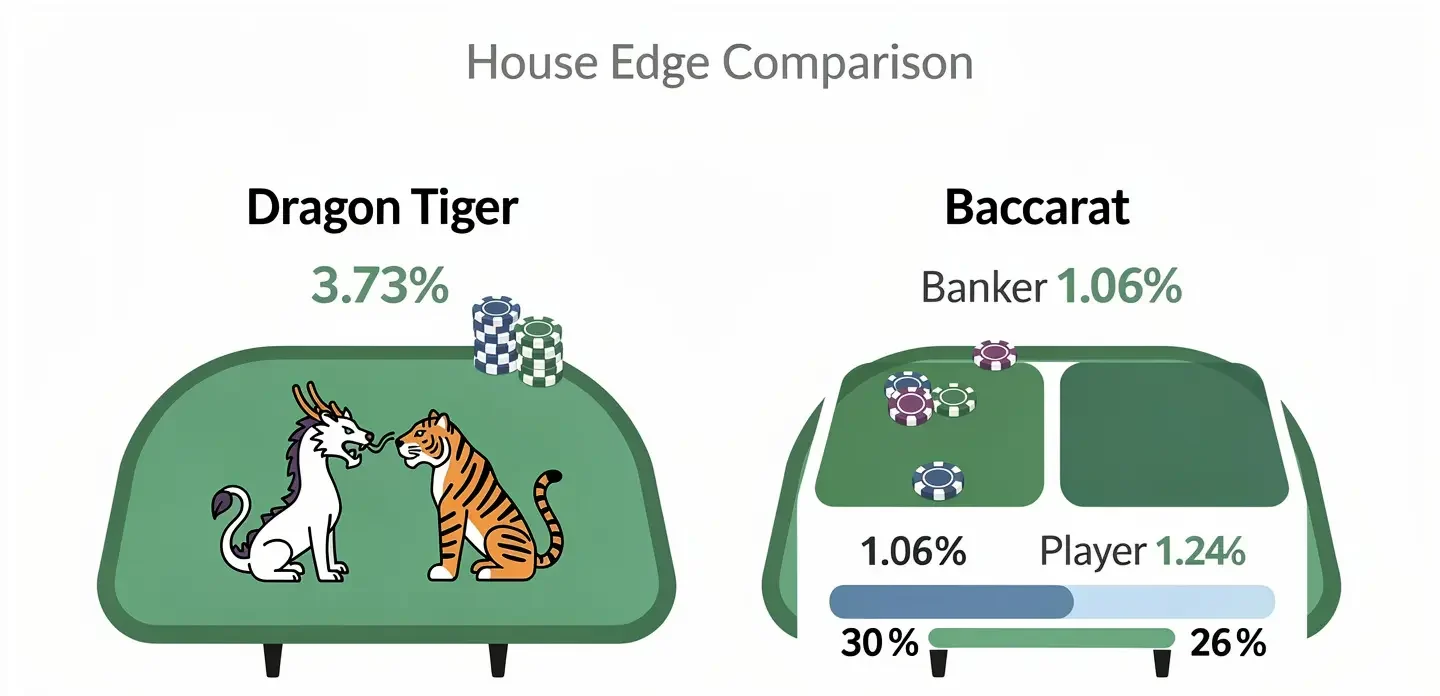
| Bet | Payout | House edge |
|---|---|---|
| Dragon Tiger: Dragon or Tiger | 1:1, tie loses half | 3.73% |
| Dragon Tiger: Tie at 8:1 | 8:1 | 32.77% |
| Dragon Tiger: Tie at 11:1 | 11:1 | 10.36% |
| Baccarat: Banker | 0.95:1 | 1.06% |
| Baccarat: Player | 1:1 | 1.24% |
| Baccarat: Tie at 8:1 | 8:1 | 14.36% |
The two Dragon Tiger main bets share one house edge of 3.73%, so picking Dragon over Tiger changes nothing. In Baccarat the Banker bet costs 1.06% and the Player bet 1.24%. Seen as a return, Dragon Tiger gives back 96.27 on every 100 wagered on Dragon or Tiger, while the Baccarat Banker gives back about 98.94. For anyone weighing the Dragon Tiger vs Baccarat house edge, Baccarat is cheaper by about 2.7 percentage points on its best bet.
Tie Bet Odds in Both Games
The Tie bet is the weakest wager in both games, and it is worse in Dragon Tiger. At 8:1 the Dragon Tiger Tie costs 32.77%, while the Baccarat Tie at the same payout costs 14.36%. A bigger Dragon Tiger payout helps only a little: 9:1 leaves 25.30%, 10:1 leaves 17.83% and 11:1 leaves 10.36%. A payout of 12:1 would be needed to bring the edge down to 2.89%, and no table offers it. In Baccarat a 9:1 Tie payout brings the edge to about 4.85%, which is a good reason to read the payout line before putting a chip on a tie in either game.
What the Numbers Cost You per 100 Hands
Percentages are easier to judge with a bet size attached. Take $10 on each of 100 hands, which is $1,000 in total wagers. The long run expected loss comes out as follows.
| Bet | Expected loss on $1,000 wagered |
|---|---|
| Baccarat Banker | $10.60 |
| Baccarat Player | $12.40 |
| Dragon Tiger: Dragon or Tiger | $37.30 |
| Dragon Tiger: Tie at 11:1 | $103.60 |
| Baccarat Tie at 8:1 | $143.60 |
| Dragon Tiger: Tie at 8:1 | $327.70 |
These figures multiply the house edge by the amount wagered. They are averages over a very large number of hands, not a forecast for one shoe, and a short run can go either way. The table does show the effect of pace: because Dragon Tiger rounds come faster, a player who stays an hour at the same $10 bet places more hands and pays the 3.73% on a larger total.
Payout Differences by Provider
In Dragon Tiger, the provider matters mostly for the Tie bet and the side bets. Evolution and Pragmatic Play tables list an RTP of 96.27% on the main bets, which is the same 3.73% edge seen from the player side. A table that pays the Tie at 8:1 instead of 11:1 is a clearly worse deal, so open the rules panel and check the payout line before placing a first chip.
Similarities Between Dragon Tiger and Baccarat
Dragon Tiger and Baccarat share more than the layout suggests. Both are dealt from a shoe of standard 52 card decks with no jokers, and both are pure luck once the chips are down: there is no decision after the bet, no bluffing and no strategy that beats the house edge. In both games you back one side to come out ahead, and in both a Tie is possible and best left alone. Both are also a regular part of live dealer lobbies, where a real dealer turns the cards on camera and a chat box sits beside the table. A player who knows Baccarat can pick up Dragon Tiger in a few minutes, and the reverse holds too.
Which Is Better, Dragon Tiger or Baccarat?
Dragon Tiger and Baccarat suit different players, and the deciding factors are cost per hand, speed and how much you want to follow while you play.
Dragon Tiger vs Baccarat for Beginners
Dragon Tiger is the easier of the two for a first table. In Dragon Tiger there is one card per side, no scoring and no third card table, so a new player can follow it from the first round. Baccarat is easy to play too, since the dealer handles all the drawing, but the scoring and the third card rule can confuse beginners for a few rounds. A beginner who wants the lower house edge can still start on Baccarat by betting Banker only and ignoring the rest of the layout.
Best Choice for a Low House Edge
Baccarat wins this category without much argument. The Banker bet at 1.06% and the Player bet at 1.24% are both cheaper than the 3.73% on Dragon or Tiger, and the gap grows once hands per hour are counted. Players who put cost first and accept the 5% commission on Banker wins get more value from Baccarat than from Dragon Tiger.
Best Choice for Fast Action
Dragon Tiger takes this category. Rounds are short, results are instant and nothing needs to be memorized, which suits a player who wants quick decisions and does not care to follow a scoreboard. The trade is a higher cost per hand, so a fixed budget and a set number of rounds matter more here than at Baccarat. Players who like fast Asian table games often try Sic Bo as well.
Best Choice for Strategy and Patterns
Baccarat gives more to follow: streaks on the scoreboard, a choice between Player and Banker, pair bets and bonus bets. None of it changes the math, but many players enjoy tracking the flow of a shoe, and Baccarat has the longer tradition of doing so. Anyone who prefers Baccarat vs Dragon Tiger for this reason should keep in mind that roadmaps predict nothing.
Playing Dragon Tiger and Baccarat in the US
Baccarat is a standard table at US casinos, both land based and online. Dragon Tiger is harder to find, so the first task is to confirm that the site you pick offers it and that it is licensed to serve your state.
Is Dragon Tiger Legal in the US?
The game itself is ordinary card play, so the legal question is really about where you play it. Real money online casino play is legal only in states that license it, and each state keeps its own list of approved operators. Whether a licensed operator in your state carries Dragon Tiger differs from site to site, and some sites that list it hold offshore licenses instead of a state license. Before depositing, confirm the license with our guide on how to verify a casino license.
Live Dealer Tables and RNG Games
Dragon Tiger and Baccarat both come in two formats. A live dealer table streams a real dealer and real cards, and an RNG version uses software to pick the cards, usually with faster rounds and lower minimum bets. The rules and the house edge stay the same, but a live table adds a shoe you can watch, a chat box and roadmaps, and the pace depends on the studio.
Age Limits, Licensing and Sweepstakes Sites
Age limits depend on the state and the site, with 21 the most common minimum at licensed US casinos, so read the terms before signing up. Sweepstakes sites use virtual coins instead of cash deposits and follow different rules. Bonuses on table games often carry heavier conditions than slot bonuses, so check the wagering requirements to see how much of a Dragon Tiger or Baccarat bet counts toward them.
Common Mistakes and Myths
Card Counting and Betting Systems
Card counting gives nothing on the Dragon and Tiger bets, because both sides draw from the same shoe. Wizard of Odds notes that side bets such as Big, Small and suit react to the makeup of the shoe in theory, and with an edge above 7% on Big and Small that theory does not help much. Betting systems such as the Martingale, where the stake doubles after every loss, change the size of the swings but leave the house edge where it was. A long losing streak can empty a bankroll fast.
Chasing the Tie Bet
A Dragon Tiger Tie bet looks attractive because of the payout, but it lands rarely, with roughly 1 in 13 Dragon Tiger hands ending in a tie, and the house edge is 32.77% at 8:1 and 10.36% at 11:1. Repeating the Tie bet after each miss only speeds up the loss.
Names That Sound Alike: Dragon Bonus and Dragon 7
Mixing up Dragon Tiger and Baccarat terms is common because of the name. Dragon Bonus and Dragon 7 are Baccarat side bets, not Dragon Tiger bets. Dragon Bonus pays when a hand wins by four points or more or with a natural, and Dragon 7 pays 40:1 when the Banker wins with a three card 7. A few Asian resorts also run a hybrid table sold as Dragon Tiger Baccarat, which is regular Baccarat with extra side bets.
Responsible Play
Both games move quickly, and a fast game makes it easy to spend more than planned. Set a budget and a time limit before the first hand, take breaks between shoes to protect your bankroll, and stop when the budget is gone instead of raising stakes to win it back. Our page on responsible gambling limits explains deposit, loss and time limits. Players in the US can call or text the National Problem Gambling Helpline at 1-800-522-4700, and the National Council on Problem Gambling lists current contact options and state resources. Gambling is for adults of legal age only.
Final Verdict: Dragon Tiger vs Baccarat
For the lowest cost, Baccarat is the better game, with Banker at 1.06% and Player at 1.24% against 3.73% on Dragon or Tiger. For the simplest rules and the fastest rounds, Dragon Tiger is the better game, since a round is one card against one card. At either table, stay on the main bets, leave the Tie alone, treat side bets as extras with a higher price, and set a budget before the first round.
Dragon Tiger vs Baccarat FAQ
Is Dragon Tiger a Version of Baccarat?
Yes. Dragon Tiger is usually described as a simplified, two card version of Baccarat, and many live dealer lobbies list it under Baccarat. It keeps the shoe, the two sides and the Tie bet, and drops the totals and the third card. The main gaps in Baccarat vs Dragon Tiger are the rules and the cost per hand.
What Is the House Edge in Dragon Tiger?
The house edge is 3.73% on the Dragon and Tiger bets. The Tie bet runs from 32.77% at 8:1 down to 10.36% at 11:1, and side bets such as Big and Small sit above 7%.
Which Has Better Odds, Dragon Tiger or Baccarat?
Baccarat. The Banker bet carries a 1.06% house edge and the Player bet 1.24%, both lower than the 3.73% on Dragon or Tiger.
Can You Count Cards in Dragon Tiger?
Not in a way that helps. The main bets are unaffected because both sides draw from the same shoe, and the side bets that react to the shoe carry too high a house edge to pay off.
Is Dragon Tiger Good for Beginners?
Yes. One card per side and no third card table make it the easier of the two games to follow. New players should stick to Dragon or Tiger, skip the Tie and set a budget first.
Can You Play Dragon Tiger for Free?
Many sites offer demo or play money versions, which let you learn the layout and the pace without risking cash. Real money play requires a licensed site in your state.