Sports betting sites are not all built the same way, even when they look almost identical on the surface. Clean design, a big welcome offer, and a long list of sports can hide a lot of differences underneath, and those differences show up the moment you try to withdraw money or the moment odds actually get compared side by side. A reputable bookmaker is licensed, transparent about its pricing, and pays out on time without excuses.
One that is cutting corners will usually look fine right up until something goes wrong. This guide walks through what actually separates a trustworthy betting site from a risky one, including a few checks most beginners skip entirely, like how much a bookmaker’s odds are quietly costing you compared to a competitor offering the same bet.
Why your choice of bookmaker matters
Picking the wrong betting site rarely feels like a mistake at first. The account opens fine, the deposit goes through, and the app looks polished enough. The problems tend to show up later, when a withdrawal takes far longer than expected, when a bonus turns out to have terms that make it nearly impossible to actually use, or when the odds on offer are consistently a little worse than what is available elsewhere.
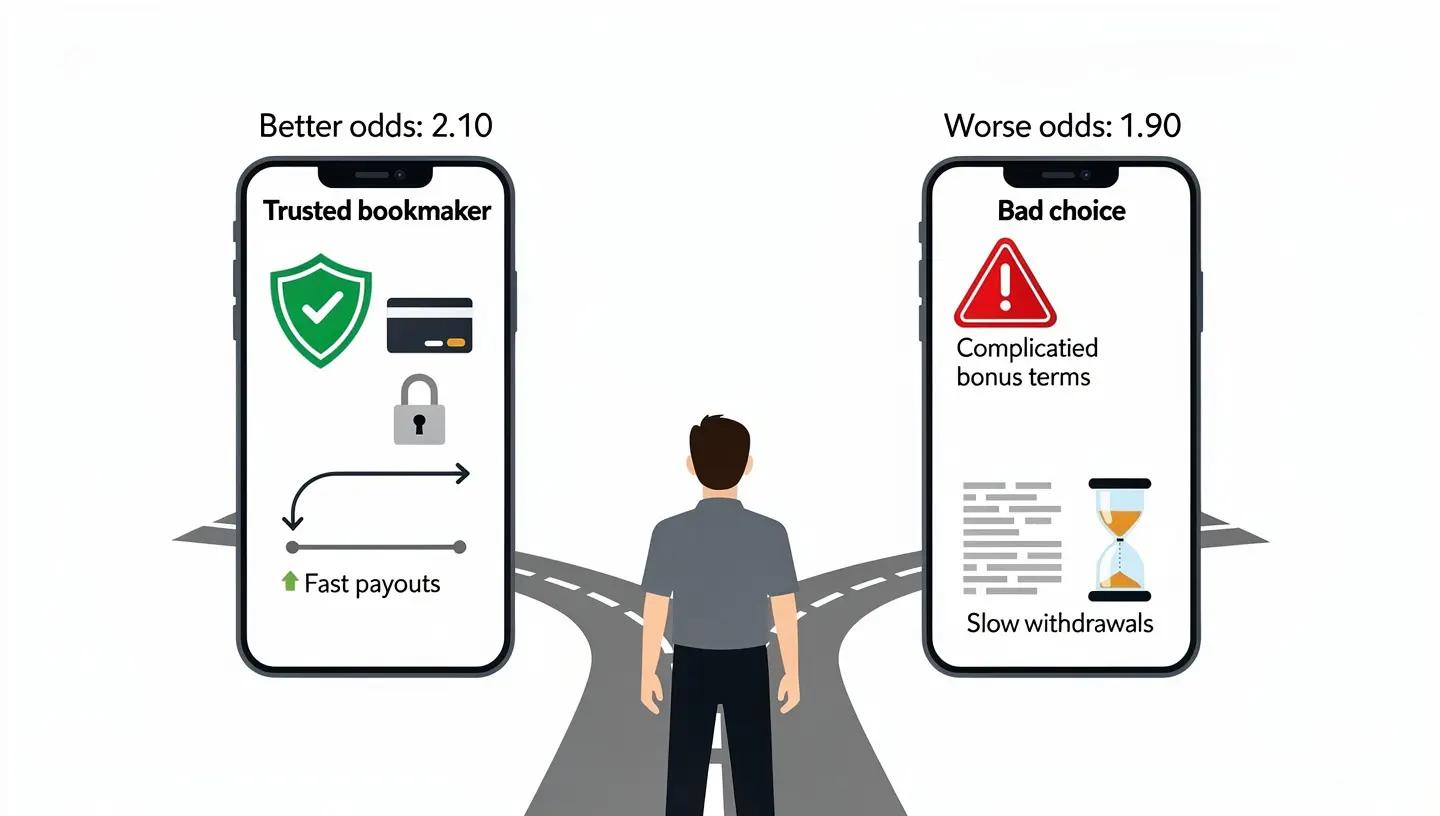
None of that is dramatic on its own, but over a season of regular betting it adds up to real money either kept safe or quietly lost. A trustworthy betting site protects you on both fronts: it treats your funds and personal data properly, and it does not price its odds in a way designed to squeeze extra margin out of every bet you place.
Check for a valid gambling license
Licensing is the starting point for evaluating any bookmaker, before odds, bonuses, or app design even enter the conversation.
What licensing means for you
A licensed bookmaker has gone through background checks on its ownership, proven it holds enough capital to cover player winnings, and agreed to follow rules around fair advertising, dispute handling, and player fund protection. This oversight is what gives you somewhere to turn if something goes wrong. An unlicensed operator can simply ignore a complaint, and there is no regulator you can appeal to if it does.
Licensing does not guarantee a perfect experience, but it does guarantee accountability, which is the one thing an unregulated site can never offer no matter how professional it looks.
How to verify a bookmaker’s license
Scroll to the footer of the site first. A legitimate bookmaker will display a license number along with the name of the regulator that issued it. Do not stop there though. Copy that number and search for it directly on the regulator’s own website, since a seal or badge on the bookmaker’s page can be copied from somewhere else entirely.
If the license number does not match any real entry, or the regulator has no record of it, that is reason enough to close the tab. The same verification process applies whether you are checking a casino or a sportsbook, and our guide on how to verify a casino license walks through the exact steps in more detail.
Recognised licensing authorities
Not every regulator applies the same level of scrutiny. The UK Gambling Commission and the Malta Gaming Authority are generally considered among the stricter bodies, with regular audits and real consequences for operators who break the rules. Offshore regulators such as Curaçao eGaming license a large share of the market under a lighter framework, which is not automatically a red flag but does mean the oversight behind the license works differently.
If you are weighing a bookmaker with an offshore license specifically, our breakdown of the Curaçao gambling license explains what that license does and does not require from an operator.
A UKGC or MGA license generally comes with stricter mandatory responsible gambling requirements and more frequent compliance checks than a typical offshore license, which is worth factoring in if that level of protection matters to you specifically. Neither tier is automatically the wrong choice, and plenty of well run bookmakers operate under lighter licenses simply to serve a broader international customer base that stricter regulators do not cover as easily.
The gap between tiers is less about honesty and more about how much ongoing oversight actually sits behind the license day to day. Our breakdown of casino license types covers how these tiers actually differ, which applies just as directly to sportsbooks as it does to casinos.
Look for strong security measures
Licensing tells you a bookmaker answers to someone. Security tells you whether your card details and personal information are actually protected once you start using the site.
SSL encryption and data protection
Check for a padlock icon next to the address bar and confirm the site uses SSL encryption, shown by a URL starting with https rather than http. This encrypts the information travelling between your device and the bookmaker’s servers, which matters every time you log in, deposit, or update personal details.
Setting this up correctly costs an operator almost nothing, so a site missing it, or one where the browser throws a security warning, is not worth trusting with a deposit regardless of how good the odds look.
Track record and player reputation
How long a bookmaker has been operating, and how it has treated players over that time, tells you more than any homepage claim. Search the operator’s name alongside the word review and look past the first page of results, since paid placements often dominate early search results. Pay closer attention to recent reviews rather than ones from years back, since ownership and payout practices can shift over time.
A handful of complaints is normal for any large operator, but the same complaint, such as delayed withdrawals or accounts closed after a big win, showing up repeatedly across unrelated reviewers is a pattern worth taking seriously.
Compare odds quality and understand the vig
This is the part beginners skip most often, and it is arguably the one that costs the most money over time.
What the vig actually costs you
Every bookmaker builds a margin into its odds, commonly called the vig or juice. On a standard point spread bet, odds of minus 110 mean you risk 110 dollars to win 100. Some bookmakers regularly price the same bet at minus 105 instead. That five dollar difference feels small on a single wager, but across hundreds of bets over a season it becomes a meaningful amount of money, all lost simply because the odds were priced worse at one site than at another for the exact same outcome.
A bookmaker that consistently prices wider than its competitors is effectively charging you a hidden tax on every bet you place, win or lose.
Why line shopping matters
Line shopping means comparing odds on the same event across more than one bookmaker before placing a bet, and it is standard practice among experienced bettors for exactly this reason. Holding accounts at two or three licensed operators, rather than committing to a single site, lets you consistently grab the better number rather than accepting whatever one bookmaker happens to offer.
Even a half point difference on a spread, or a few cents of juice on a moneyline, can turn a losing bet into a push or a push into a win over enough volume. This is not about disloyalty to any one operator. It is simply the most direct way to keep more of your own money.
Check available betting markets
A reputable bookmaker should cover the sports and bet types you actually care about, not just the major leagues with the biggest audiences. Every established site offers moneylines, spreads, and totals on football, basketball, and similar mainstream sports, so that alone does not separate one book from another. The real differences show up in prop markets, live betting depth during a game, and coverage of less mainstream sports or leagues.
If you follow a specific sport closely, check the market catalog before signing up rather than assuming coverage will match a site’s overall reputation. It is also worth checking whether futures and outright markets are available if you like to bet on outcomes ahead of a season, since not every operator prices these as competitively as its game day markets.
Understand welcome bonuses and terms
Welcome offers are the most visible way bookmakers compete for new customers, and the headline number is often the least important part of the deal.
Common bonus types
Most welcome offers fall into a few categories. Our full breakdown of casino bonus types covers the same underlying structures in more detail, since sportsbooks and casinos generally use very similar bonus mechanics.
| Bonus type | How it works |
|---|---|
| Deposit match | Adds bonus funds equal to a percentage of your first deposit, usually with conditions before withdrawal |
| First bet insurance | Refunds your opening wager as bonus credit if it loses |
| Bonus bets | Free wagers handed out on signup, only the profit pays out, not the stake |
Reading which category a welcome offer actually falls into before signing up helps set realistic expectations about how much of it you can genuinely use.
Reading wagering requirements and minimum odds
The terms attached to a bonus matter more than the size of it. A wagering requirement dictates how many times you must bet the bonus amount before any winnings can be withdrawn, and a requirement of ten times or higher on a modest bonus can mean thousands of dollars in required betting volume before you see a cent. Minimum odds restrictions are just as important, since many bonuses only count bets placed above a certain price, which stops you from clearing the requirement on heavy favorites.
Our guide on how wagering requirements actually work explains how to read these terms properly before you claim any offer, including how to calculate the real betting volume a specific offer will actually demand from you before deciding whether it is worth claiming at all in the first place.
Clearing a wagering requirement also usually means completing identity verification before any of that money can actually leave your account, since most licensed bookmakers require this step ahead of a first withdrawal regardless of how the bonus itself was structured.
This can catch new bettors off guard right when a bonus finally pays off. Our page on the casino KYC verification process explains what documents operators typically ask for and why the request is standard practice rather than a red flag.
Test the mobile app and website
Most betting today happens through a mobile app rather than a desktop browser, and a clunky app costs you more than convenience. If the interface freezes or lags during a live game, you can miss a line before it moves, which is a real financial cost, not just an annoyance. Before depositing anywhere, open the app or mobile site and check how quickly it loads, whether the bet slip is easy to use, and whether live odds update without delay.
A bookmaker that has invested properly in its app usually shows it in small details, like how few taps it takes to place a straightforward bet.
Check payment methods and withdrawal speed
The moment you try to withdraw is usually where a bookmaker’s real character becomes clear, since a polished deposit page tells you very little.
Payment options and processing times
Look for well known payment methods such as major cards, established e-wallets, and bank transfers, along with clear information on any associated fees. Processing times vary significantly by method. E-wallets are typically the fastest, often clearing within a day, while bank transfers and checks can take anywhere from three to ten business days.
A reputable bookmaker states these timeframes clearly rather than leaving you to find out the hard way. Our page on casino withdrawal times breaks down typical ranges by method, and the same general expectations apply to sportsbook withdrawals.
What to do if a withdrawal is delayed
A short delay beyond the stated timeframe is not automatically a red flag, since payment providers occasionally have their own processing hiccups. Contact support directly and ask for a specific update rather than assuming the worst right away. A pattern of repeated, unexplained delays across multiple withdrawal attempts is a very different story, and that pattern is what actually signals a problem rather than a one off inconvenience.
If you want a full walkthrough of the withdrawal process itself, our guide on how to withdraw casino winnings covers the general steps that apply across most licensed operators.
Evaluate customer support
You do not need an account to get a sense of how a bookmaker treats its customers. Open live chat, if it exists, and ask a simple question about withdrawal times or bonus terms before you register. A reputable operator should respond within a few minutes during normal hours, in plain language, and should actually answer what you asked rather than deflecting with a scripted reply. If there is no live chat, try email and note both the response time and whether the answer is useful.
Slow or vague responses before you have even deposited are a strong hint at how support will behave once you have a genuine dispute to resolve. It is also worth checking how many contact channels exist in total, since a site relying solely on a contact form with no stated response window is giving itself plenty of room to go quiet once a real problem comes up.
Check for responsible gambling tools
A bookmaker that takes player wellbeing seriously offers practical tools rather than a single disclaimer buried in the terms page. Deposit limits, loss limits, and betting limits let you set boundaries before a session starts rather than relying on willpower once you are already several bets deep. Self-exclusion, which lets you lock yourself out of an account for a set period or permanently, is a legal requirement at most licensed operators and should be simple to find and activate through account settings.
A site that makes these tools hard to locate, or that requires contacting support just to set a basic limit, is not prioritising player protection the way it should. For practical ways to use these tools, our guide on setting responsible gambling limits walks through how to set boundaries that actually stick.
Red flags of an untrustworthy bookmaker
Some warning signs are worth listing together, since spotting even one is often enough reason to look elsewhere before you deposit.
- No license information anywhere on the site, or a license number that does not match any real regulator
- Odds consistently priced wider than competitors on the same events
- Bonus terms that are vague, buried in dense legal text, or change without notice
- Wagering requirements well above the industry norm, sometimes fifteen times the bonus amount or higher
- Repeated player complaints about delayed, reduced, or denied withdrawals
- No visible SSL padlock, or browser warnings about an unsafe connection
- Customer support that is slow, unresponsive, or gives contradictory answers to the same question
None of these alone always means a bookmaker is dishonest, but two or more appearing together is a strong reason to keep looking elsewhere. Trust your instincts here too. If the terms page feels deliberately hard to follow, or support keeps giving you a different answer to the same question, that is rarely an accident.
Quick checklist: reputable bookmaker in under 5 minutes
If you only have a few minutes before deciding whether a site is worth exploring further, run through this shortlist first.
- Confirm the license number directly on the regulator’s own site, not just the bookmaker’s seal
- Check for the SSL padlock and a working https connection
- Compare odds on one or two events against a competing bookmaker
- Search recent reviews for repeated complaints about withdrawals or support
- Check that deposit limits and self-exclusion tools are easy to find
- Read the wagering requirements before you claim any welcome bonus
Comparing a shortlist of two or three licensed operators before committing your main bankroll is generally worth the extra half hour it takes, especially once you factor in how much odds differences alone can affect your results over a full season of betting. Knowing the licensing tier behind each option means you are choosing with full information rather than by accident.
The process typically involves uploading a photo ID and sometimes a recent utility bill or bank statement to confirm your address. It usually only needs to be completed once per account, after which future withdrawals go through without repeating the same checks.
Once you are confident a bookmaker checks these boxes, you are in a much better position to focus on actually finding value rather than worrying about whether your money and your winnings are safe. Comparing a shortlist of two or three licensed operators before committing your main bankroll is generally worth the extra half hour it takes, especially once you factor in how much odds differences alone can affect your results over a full season of betting.
Many bettors who start out with sportsbooks eventually branch into casino games as well, often once they are already comfortable with how a licensed operator handles deposits and verification. If that sounds like you, learning how to play blackjack is one of the more approachable places to start, since the rules are simple enough to pick up in one sitting while still leaving room to develop real strategy over time.
Frequently asked questions
How do I know if a bookmaker is legit?
Check for a valid license displayed in the footer and confirm the number directly on the regulator’s website, look for SSL encryption, and search recent player reviews for recurring complaints about withdrawals or support before you sign up.
What is the vig and why does it matter?
The vig, also called the juice, is the built in margin a bookmaker charges on every bet. Standard pricing is minus 110 on each side of a spread bet, but some bookmakers price wider, which quietly costs bettors more money over a large number of wagers even when the actual outcome of each bet is unaffected.
How long do bookmaker withdrawals normally take?
E-wallet withdrawals are typically processed within 24 to 48 hours at reputable bookmakers, while bank transfers and checks usually take between three and ten business days depending on the payment provider and the site’s own verification process.
Should I have accounts at more than one bookmaker?
Many experienced bettors do, specifically to compare odds on the same event and take the better price, a practice known as line shopping. There is no restriction on how many licensed operators you can hold accounts with at the same time.
What are the biggest red flags of an untrustworthy bookmaker?
Missing or unverifiable licensing, odds that are consistently priced worse than competitors, wagering requirements far above the industry norm, and repeated complaints about denied or delayed withdrawals are among the clearest signs a bookmaker is not worth the risk.