No, online casino play is not legal in Singapore. The Gambling Control Act 2022 bans unlicensed remote gambling, and the Gambling Regulatory Authority (GRA) has licensed only one remote operator, Singapore Pools, which offers lottery and sports betting but no casino games. Anyone who plays at an online casino in Singapore can be fined up to S$10,000, jailed for up to six months, or both.
The rules do not stop with players. Operators, advertisers and people who hand over their bank accounts face heavier penalties, and since January 2025 the Singapore Police Force blocks sites, adverts and payments linked to online gambling in Singapore.
This guide explains what the law says, what is still allowed, how offshore sites fit in, and how to check a site before you sign up. Fines, levies and ages below follow the rules in force in October 2026.
Is Online Casino Gambling Legal in Singapore in 2026?
Is Online Gambling Legal in Singapore?
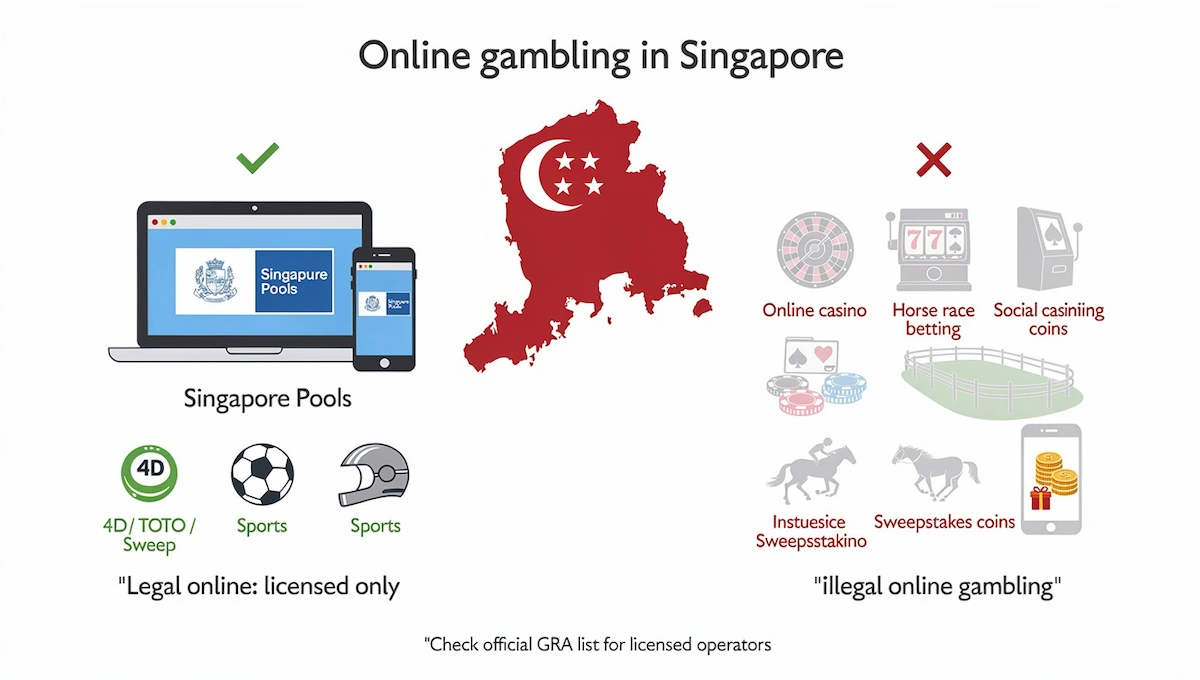
Online gambling is legal in Singapore only through a licensed operator, and there is just one. Singapore Pools sells 4D, TOTO, Singapore Sweep and sports bets online. It does not offer slots, roulette, blackjack or baccarat. Any online casino in Singapore that offers these games runs without permission, whatever licence it shows from another country.
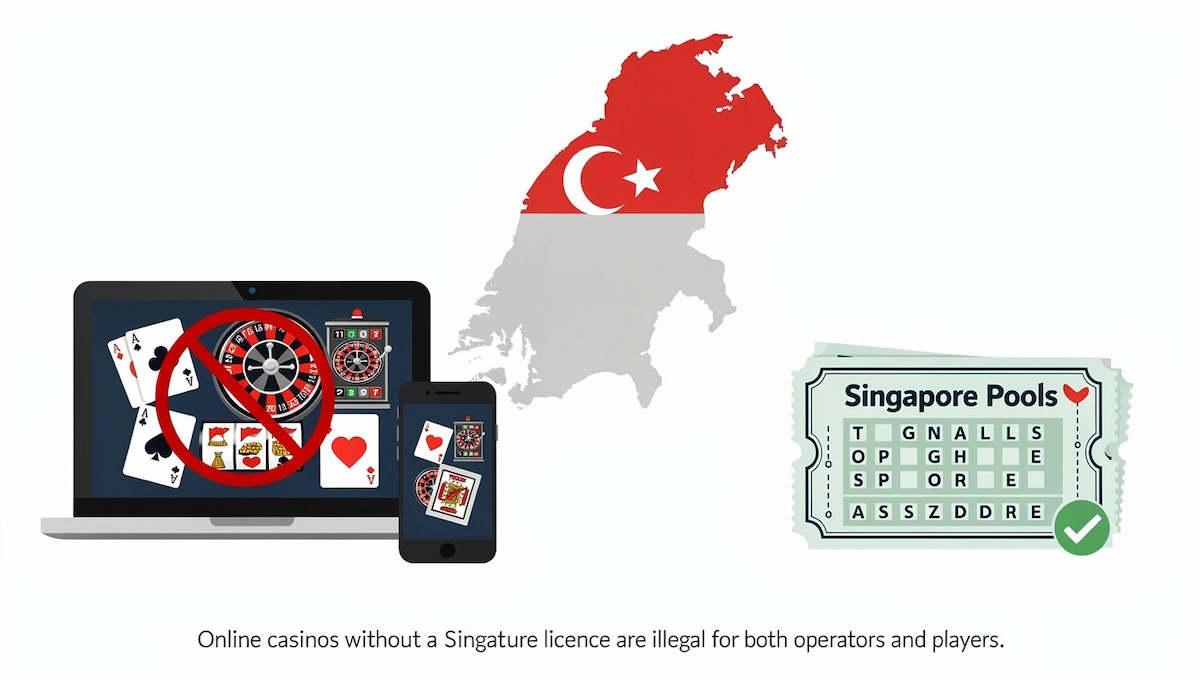
The law makes no difference between a site based in Singapore and a site based abroad. If the operator offers games to people located in Singapore without a licence, it breaks the Gambling Control Act. The player breaks it too, because the offence covers any person in Singapore who takes part.
Some sites call the position a grey area. For casino games it is not. That claim usually comes from affiliate pages that want you to register.
People who type online casino Singapore or online gambling Singapore into a search engine see pages that rank the best online casinos in Singapore, with bonus codes and star ratings. These pages are adverts, not legal advice. The online casinos in Singapore that they list hold licences from other countries, not from the GRA, so none of them can offer games to players in Singapore within the law.
Quick Facts at a Glance
- Main law: Gambling Control Act 2022, in force since 1 August 2022
- Regulator: Gambling Regulatory Authority (GRA)
- Licensed remote operator: Singapore Pools only
- Player penalty: fine up to S$10,000, jail up to six months, or both
- Operator penalty: fine up to S$500,000 and up to seven years in jail
- Legal gambling age for casinos and remote gambling: 21
- Gambling winnings: not taxed
Singapore Online Gambling Laws in 2026
The Gambling Control Act 2022 and the GRA
The Gambling Control Act 2022 (GCA) came into force on 1 August 2022 and replaced several older laws, including the Remote Gambling Act 2014. Under the GCA, all gambling is unlawful unless a licence or an exemption covers it.
The GRA licenses operators and enforces the rules. Its page on unlawful remote gambling names Singapore Pools as the only operator licensed for remote gambling. The two casinos on the island, Marina Bay Sands and Resorts World Sentosa, fall under the Casino Control Act, which covers land-based play only.
What Happened to the Remote Gambling Act 2014
The Remote Gambling Act 2014 was the first law aimed at online gambling in Singapore. It banned remote gambling unless the operator held exempt operator status, and only Singapore Pools and Singapore Turf Club received it. The GCA took over these rules in 2022. Many articles still quote the old act and the old S$5,000 fine, so check the date of any source. The current maximum fine for a player is S$10,000.
What Is Remote Gambling?
Remote gambling means gambling through the internet, a phone, television, radio or any other electronic channel, where the player and the operator are in different places. Online casinos, live dealer tables, poker rooms, online sportsbooks and betting groups on messaging apps all count as remote gambling.
Why Singapore Prohibits Gambling by Default
Singapore takes the view that gambling causes social harm, so the starting point is a ban and licences are the exception. The GCA puts the duty on operators to hold a licence, and it puts the duty on players to stay away from operators that do not hold one.
What Is Legal Online in Singapore?
A small list of products is allowed online. Everything outside this list counts as unlawful gambling for people in Singapore.
Singapore Pools
Singapore Pools is owned by the Tote Board and holds the only remote gambling licence granted by the GRA. The licence was renewed for five years from 25 October 2025. Customers can place 4D, TOTO and Singapore Sweep bets, and bet on football and motor racing, through the website, the app and outlets. The company runs no online casino, so a Singapore Pools account will not give you access to slots or table games.
Singapore Turf Club
Singapore Turf Club once held exempt operator status for horse racing bets. Racing at Kranji ended in October 2024, and the GRA page lists only Singapore Pools as a licensed remote operator today. Treat any claim that the Turf Club offers online betting with care and compare it with the GRA list.
Free-to-Play Games and Social Casinos
Games that cost nothing and pay no cash prize sit outside the gambling definition. Trouble starts when you buy coins or credits that can be turned into money or prizes. Sweepstakes casinos use that coin model under United States rules, and nothing in the GCA gives them cover for players in Singapore. Read the terms of any social casino before you pay real money.
Can Singapore Players Use Offshore Online Casinos?
Offshore sites cause most of the confusion. Many accept SGD, show a licence logo from Curacao or Malta, and advertise in English and Chinese. None of this changes the legal position for a player in Singapore. A player who asks whether online casinos in Singapore with an overseas licence are safe to use gets a legal answer first, and the answer is no. Safety, fair games and quick payouts are separate questions that only matter after the legal one is settled.
Why an Overseas Licence Does Not Make a Casino Legal
A licence from Curacao, Malta, Anjouan or any other country only has force in the country that issued it. Singapore law asks a single question: does the operator hold a GRA licence? If it does not, the site is unlawful for people in Singapore. You can read how the Curacao gambling licence works to see what it does cover and why it carries no weight here.
Why Offshore Sites Still Open From Singapore
Blocking is not perfect. Offshore operators change domains, copy their pages to mirror sites, and spread links through social media and affiliate pages. Payments also move through cards, e-wallets and crypto. A site that still loads is not a site that is allowed.
Many operators also hire agents who contact people through messaging apps and groups, offer small free credits, and then push players towards bigger deposits. Meeting an agent through a friend does not make the site any more legal. It is one more reason to treat every unlicensed offer with caution.
Are Brands Such as BK8 or 12Play Legal in Singapore?
Lists of the best online casinos in Singapore often name brands such as BK8, 12Play or Maxim88, with scores for local payments and bonuses. The GRA names Singapore Pools as the only licensed remote operator, so none of these brands holds a Singapore licence. The same test works for any name you meet: look for it on the GRA page.
Common Myths About Online Casino Sites in Singapore
- The server is abroad, so Singapore law does not apply. The participation offence covers any person in Singapore, wherever the server sits.
- Only operators get punished. Players can be charged and fined under the same act.
- Crypto casinos sit outside the law. The payment method does not change the status of the site, and a guide to crypto and Bitcoin casinos will tell you the same about licensing.
- A VPN hides me. A VPN changes the address your device shows, not the place where you sit. Banks and payment firms still hold records of your deposits.
- SGD support and big bonuses prove a site is legal. They only prove that the site wants customers from Singapore.
Penalties for Online Gambling in Singapore
The penalties come from the Gambling Control Act, which you can read on Singapore Statutes Online. The table gives the maximum for each group.
| Who | Offence | Maximum penalty |
|---|---|---|
| Player | Taking part in unlicensed remote gambling | S$10,000, six months in jail, or both |
| Operator | Providing unlicensed remote gambling | S$500,000 and seven years in jail |
| Agent | Acting as agent of an unlawful betting operation | S$200,000 and seven years in jail |
| Repeat operator | Second or later offence | S$700,000 and ten years in jail |
| Advertiser | Promoting unlawful gambling | S$20,000 |
Penalties for Players
A person in Singapore who plays on an unlicensed site can face a fine of up to S$10,000, up to six months in jail, or both. The court sets the sentence, and the law applies to a single bet in the same way as to regular play.
Penalties for Operators and Facilitators
Operators carry the heaviest penalties, up to S$500,000 and seven years in jail. A repeat offender can face S$700,000 and ten years. People who help run a site can be charged as well. An agent of an unlawful betting operation faces up to S$200,000 and seven years in jail, and people who move the money can face money laundering charges with up to ten years in jail.
Penalties for Advertising and Affiliates
Advertising unlawful gambling can lead to a fine of up to S$20,000. This covers websites, influencers, social media accounts and affiliates that send traffic to an unlicensed casino. Residents can report adverts to the police through the I-Witness portal.
Lending Your Bank Account or Singpass
Gambling syndicates look for people who will let them use a bank account, a card or a Singpass login. Even if you never place a bet, handing these over may lead to separate charges, for example for helping move illegal money. If you are unsure about your position, speak to a lawyer.
What Happens If You Get Caught Online Gambling in Singapore?
The police investigate, and a court decides the outcome. The law allows a fine, jail or both, and the sentence depends on the facts: how much money was involved, how often the person played, and whether anyone else was recruited. Payment records and phone data are normal evidence in these cases.
A Recent Case From October 2025
On 5 October 2025 the Singapore Police Force raided seven men aged 28 to 53 in simultaneous operations across the island, using information from the FBI and Meta. Reports had arrived since March 2023 from people who were lured into opening accounts on an online betting site and told to send money to anonymous bank accounts in exchange for gambling credits. Early winnings were paid out, but players who tried to withdraw larger amounts were told to win more or buy more credits.
Several victims lost more than S$175,000, and the police seized cash, 15 bank accounts, phones, SIM cards and a luxury watch worth over S$500,000 in total. The charges cited in the release cover running an unlawful betting operation, acting as an agent, gambling with an unlawful service provider, using a SIM card registered under another name, and moving criminal proceeds. The case shows how the same pattern repeats: a friendly agent, a personal bank account and a withdrawal that never arrives.
How Singapore Blocks Online Casinos
Website and Payment Blocking
The GRA used to handle blocking, and the Singapore Police Force took over from 1 January 2025. The police now handle website blocking, the blocking of adverts, and payment blocking for unlawful remote gambling services. According to the news site GGRAsia, the GRA had already blocked more than 1,600 illegal gambling sites by mid-2023. By 31 December 2024 the Ministry of Home Affairs reported more than 3,800 blocked sites, which it linked to more than 145,000 illegal gambling transactions worth about S$37 million. The ministry also said the approach is not foolproof, because illegal operators can create new websites easily.
The result is that many online casinos in Singapore that once targeted local players now load slowly, change address often, or fail at the payment step. Blocks are not permanent, since a new domain can appear within days, which is why the law targets the player and the payment as well as the site.
Is Using a VPN Legal?
The GRA page on unlawful remote gambling does not mention VPNs, and a VPN is not illegal in itself. The offence, however, is taking part in unlicensed remote gambling while in Singapore. A VPN does not change where you are, so it gives you no legal cover, and your bank records still show where the money went.
Can You Use PayNow, Cards or Bank Transfers?
PayNow, debit cards and bank transfers are normal payment tools, but using them to fund an unlicensed casino does not make the payment lawful. The police can act on payments linked to unlawful remote gambling, and a deposit sent to the personal account of a named individual is exactly the pattern found in recent syndicate cases. A site that only accepts transfers to private accounts, or that changes the account number from one deposit to the next, should be treated as a warning.
Are Casino Apps Legal in Singapore?
Apps count as remote gambling in the same way as websites. A listing in an app store, or a download link from a chat group, tells you nothing about a licence. The only licensed remote gambling app is the one from Singapore Pools. Illegal websites, apps and adverts can be reported to the police.
Is Online Casino Gambling Legal for Tourists in Singapore?
No. The participation offence applies to any person in Singapore, and the GRA page makes no exception for visitors. A tourist who plays on a phone in a hotel room is in the same position as a resident.
Visitors who want a casino game have a legal option. Foreign passport holders can enter Marina Bay Sands or Resorts World Sentosa with valid ID, pay no entry levy, and play at the tables once they are 21. The two resorts are the only legal route for tourists who want casino games, since no online casino in Singapore holds a licence. Visitors who use a foreign card or a foreign phone plan to bet online from Singapore are still inside the offence.
Legal Ways to Gamble in Singapore
Marina Bay Sands and Resorts World Sentosa
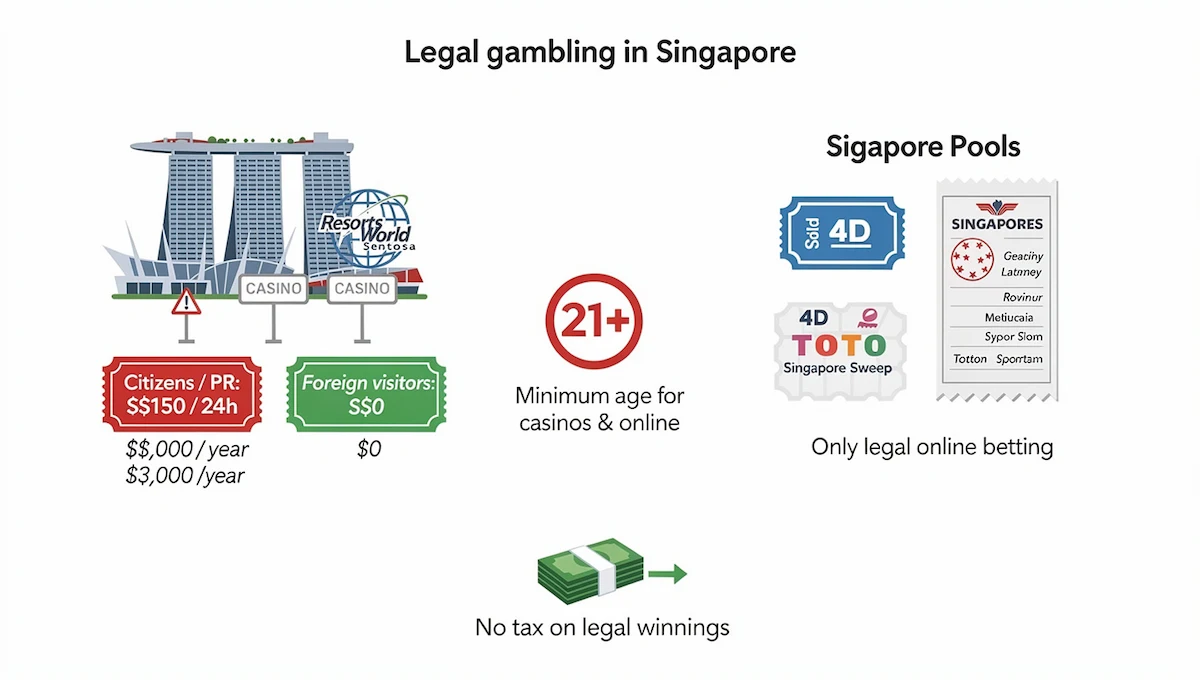
Two licensed casinos operate in Singapore, Marina Bay Sands and Resorts World Sentosa. Both offer slots and table games such as baccarat, blackjack, roulette and sic bo, and both check ID at the door.
The Casino Control Act and the GRA set the rules for them. Each resort has gaming floors, private rooms for high stakes and a mix of electronic and live dealer tables, so players who like the speed of an online casino can still find fast electronic games on site.
Casino Entry Levy
Citizens and permanent residents pay a casino entry levy of S$150 for each 24 hours, or S$3,000 for a year of entry. Foreign visitors pay nothing. Older articles still quote S$100 and S$2,000, which are out of date.
4D, TOTO and Sports Betting With Singapore Pools
Singapore Pools runs 4D, TOTO and Singapore Sweep draws, plus football and motor racing bets. You can buy at outlets or online with an account. These are the only products you can legally gamble on over the internet in Singapore.
Legal Gambling Age
The legal gambling age is 21 for casinos and for remote gambling. Some articles say 18 because certain venue-based bets, such as horse betting, used a lower limit. For online play, use 21.
Are Gambling Winnings Taxable?
No. The IRAS treats gambling winnings as a windfall, not as income, so there is no tax on them. This only applies to legal play, and it is no reason to use an unlicensed site.
Online Casino Singapore vs Land-Based Casinos
| Feature | Unlicensed online casino | Marina Bay Sands and Resorts World Sentosa |
|---|---|---|
| Legal status for players in Singapore | Unlawful | Legal and licensed |
| Games | Slots, live dealer, table games | Slots and table games |
| Entry cost | None | S$150 per day or S$3,000 per year for citizens and PRs |
| Player risk | Fine up to S$10,000, jail up to six months | Follows casino rules |
| Dispute route | None in Singapore | GRA oversight |
A Singapore online casino that wants to be legal needs a GRA licence, and no casino site has one. For games such as sic bo, the only legal tables are in the two resorts, and sic bo rules are worth learning before a visit.
How to Check If an Online Casino Is Legal in Singapore
The check takes a few minutes and costs nothing. Any Singapore online casino that says it is approved should be able to name a GRA licence and a company that holds it.
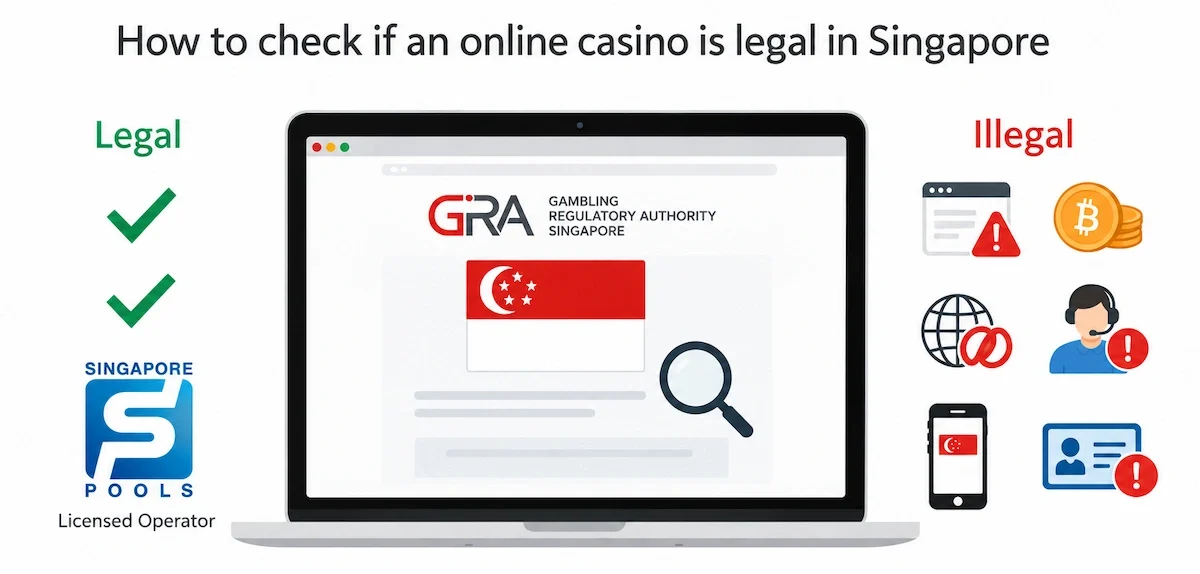
If the site cannot do that, stop there. Everything else on the page, from the design to the payment logos, tells you nothing about legal status.
Check the Operator Against the GRA
Open the GRA page on unlawful remote gambling and look at the list of licensed operators. At the time of writing, it names only Singapore Pools. If the casino you are looking at is not Singapore Pools, it is not licensed for remote gambling in Singapore. The general method for checking a licence number is explained in a guide on how to verify a casino licence, but a foreign licence still will not make a site legal here.
Red Flags of an Unlicensed Site
- No GRA licence and no named company with a physical address
- A foreign licence number that does not match the regulator register
- Huge welcome bonuses with wagering terms that are hard to find
- Support only through chat apps
- A domain that keeps changing, or links shared in social media groups
- Pressure from an agent or a friend to join quickly
Payment Warning Signs
- A request to deposit into the personal bank account of a named individual
- Crypto as the only deposit option
- A fee, tax or deposit demanded before a withdrawal
- A request to send ID documents through a chat app instead of a secure upload. Compare this with how casino KYC verification normally works.
Bonuses and Free Credit Offers
A welcome bonus, free credit or free spins offer is a sales tool and says nothing about legal status. No Singapore regulator stands behind a bonus from an unlicensed site, so the operator can change the terms or refuse a payout with little consequence. Free credit often needs a deposit first, a promo code from an agent, or a turnover target that is met only after many bets, and the fine print can change after you have paid. Players who join through a friend or a chat group are often offered an extra reward for bringing others, which is a recruiting method rather than a gift. Large offers usually come with a high rollover, and reading how wagering requirements work shows why a bigger bonus is often a worse deal.
Risks of Playing at Unlicensed Online Casinos
The first risk is legal. A fine or jail term is possible for any player in Singapore. The second is financial. An unlicensed operator has no duty to pay you, and many refuse withdrawals, freeze accounts or invent extra fees. The third is personal data. Identity documents, card numbers and phone details go to a company you cannot trace. Players at any online casino in Singapore also have no ombudsman, no GRA complaint route and no court that can easily force payment.
What to Do If You Lose Money to an Unlicensed Site
Stop sending money, even when the site promises that the next payment will release your balance. Save screenshots, account numbers, chat messages and transaction receipts, and tell your bank at once. Report the site, app or advert to the police, and call the ScamShield helpline on 1799 if you think you were scammed. The GRA page on unlawful remote gambling is the place to check whether a complaint belongs to the regulator or to the police.
Responsible Gambling and Help in Singapore
Gambling harm is real for players who stay within the law as well. The National Problem Gambling Helpline run by the NCPG is open on 1800-6-668-668. Singapore offers self-exclusion, visit limits and a family exclusion order, which lets a relative ask for a person to be barred from casinos. From 21 September 2026 a single self-exclusion covers casinos, gaming machine rooms and remote gambling. A guide to responsible gambling limits shows how to set deposit and time limits.
Singapore Online Gambling Law Timeline
This list shows how online gambling in Singapore changed, and why online gambling Singapore rules look different today from what older articles describe.
- 2014: Remote Gambling Act passed, with Singapore Pools and Singapore Turf Club found suitable as exempt operators
- 2015: Blocking of overseas gambling sites begins
- 1 August 2022: Gambling Control Act replaces the older laws, and the GRA becomes the regulator
- October 2024: Horse racing ends at Kranji
- 31 December 2024: More than 3,800 illicit gambling sites blocked in total
- 1 January 2025: Singapore Police Force takes over blocking of sites, adverts and payments
- 5 October 2025: Police raid seven men in a transnational unlawful remote betting case
- 25 October 2025: Singapore Pools licence renewed for five years
- 21 September 2026: Single self-exclusion covers casinos, gaming machine rooms and remote gambling
Bottom Line
Is online casino legal in Singapore? No. Singapore Pools is the only licensed remote operator, and it has no casino games. Any SG online casino that accepts players in Singapore does so without a licence, and the player can be fined up to S$10,000 or jailed for up to six months. The legal choices are the two casinos at Marina Bay Sands and Resorts World Sentosa, and the lottery and sports bets from Singapore Pools. Check the GRA page before you deposit anywhere.
Is Online Casino Legal in Singapore? FAQ
Is online gambling legal in Singapore?
Only with a licensed operator, and the GRA lists Singapore Pools as the single one. It offers 4D, TOTO, Singapore Sweep and sports betting. Online casino games are not licensed.
Can you get caught gambling at an online casino in Singapore?
Yes. Deposits and withdrawals pass through banks, cards or e-wallets, which keep records, and the Singapore Police Force now handles payment blocking. The police can investigate any person in Singapore who plays on an unlicensed site.
Is it legal to play at offshore casinos from Singapore?
No. The offence covers any person in Singapore who takes part in unlicensed remote gambling, and it does not matter where the casino is based.
Does a Curacao or Malta licence make an online casino legal in Singapore?
No. A foreign licence only has force in the country that issued it. In Singapore, only a GRA licence counts, and only Singapore Pools holds one for remote gambling.
Is a VPN legal for online gambling in Singapore?
A VPN is not illegal in itself, but it gives no protection. The offence depends on you being in Singapore when you gamble, and a VPN does not change that.
Are online casino winnings taxable in Singapore?
No. The IRAS treats gambling winnings as windfalls, so they are not taxed. That does not make play on an unlicensed site legal.
What is the legal gambling age in Singapore?
It is 21 for casinos and for remote gambling. Some older articles say 18 for certain venue-based bets, but that does not apply online.
Can Singapore Pools offer online casino games?
Not at present. Its licence covers lottery products and sports betting, and it runs no online casino. A site that claims to be a Singapore Pools casino is not the real operator.
Are bonuses and SGD accounts a sign that a site is legal?
No. Bonuses and SGD accounts are marketing tools. The only sign that matters is a GRA licence, and no online casino holds one.
Can affiliates and influencers promote online casinos in Singapore?
No. Advertising unlawful gambling can lead to a fine of up to S$20,000, and the police handle the blocking of adverts. Anyone who earns commission by sending Singapore traffic to an unlicensed casino carries the same risk.
Can a foreign operator get an online casino licence in Singapore?
The GRA page names Singapore Pools as the only licensed remote operator and lists no foreign casino. Treat any claim of an approved foreign casino as false until you see its name on the GRA page.
Is it safe to play at online casinos in Singapore?
Not legally, and often not financially. An unlicensed site gives you no protection under Singapore law, no complaint route and no guarantee of payment, and your identity and card details go to a company you cannot trace.
Can you use PayNow at an online casino in Singapore?
PayNow works technically at some sites, but it does not make the casino legal, and the police can act on payments linked to unlawful remote gambling. Be careful with any site that asks you to pay a private person.
Are casino apps legal in Singapore?
Only the Singapore Pools app holds a remote gambling licence. Any casino app that offers slots or table games for money is unlicensed, whatever the store listing says.
What should I do if an online casino asks for extra money before a withdrawal?
Stop paying. Fees, taxes or deposits demanded before a payout are a common scam pattern, and paying more rarely releases the money. Keep screenshots and payment records, report the case to the police, and read this guide on how to withdraw winnings to see what a normal payout looks like.