Yes, a PAGCOR license is legit. It is issued by the Philippine Amusement and Gaming Corporation, a government-owned regulator, and a casino that holds one has been registered and checked inside the Philippines. The catch is the scope. A PAGCOR licensed casino is built for players located in the Philippines, and plenty of sites wave the PAGCOR logo around without any valid license behind it.
So the useful question is not only whether the license is real, but whether the casino in front of you actually holds it. This article covers what a PAGCOR license includes, what it proves and what it leaves open, how to verify it step by step, which fake claims PAGCOR itself has warned about and how it compares with Curacao, MGA and UKGC licenses. Rules in this area change often, so confirm the current status on pagcor.ph before you deposit anywhere.
What Is a PAGCOR License and Who Issues It?
PAGCOR in Brief
PAGCOR stands for the Philippine Amusement and Gaming Corporation. It is a government-owned and controlled corporation under the Office of the President, and its powers were consolidated by Presidential Decree No. 1869, known as the PAGCOR Charter. The agency traces its origin to an earlier decree, PD 1067-A.
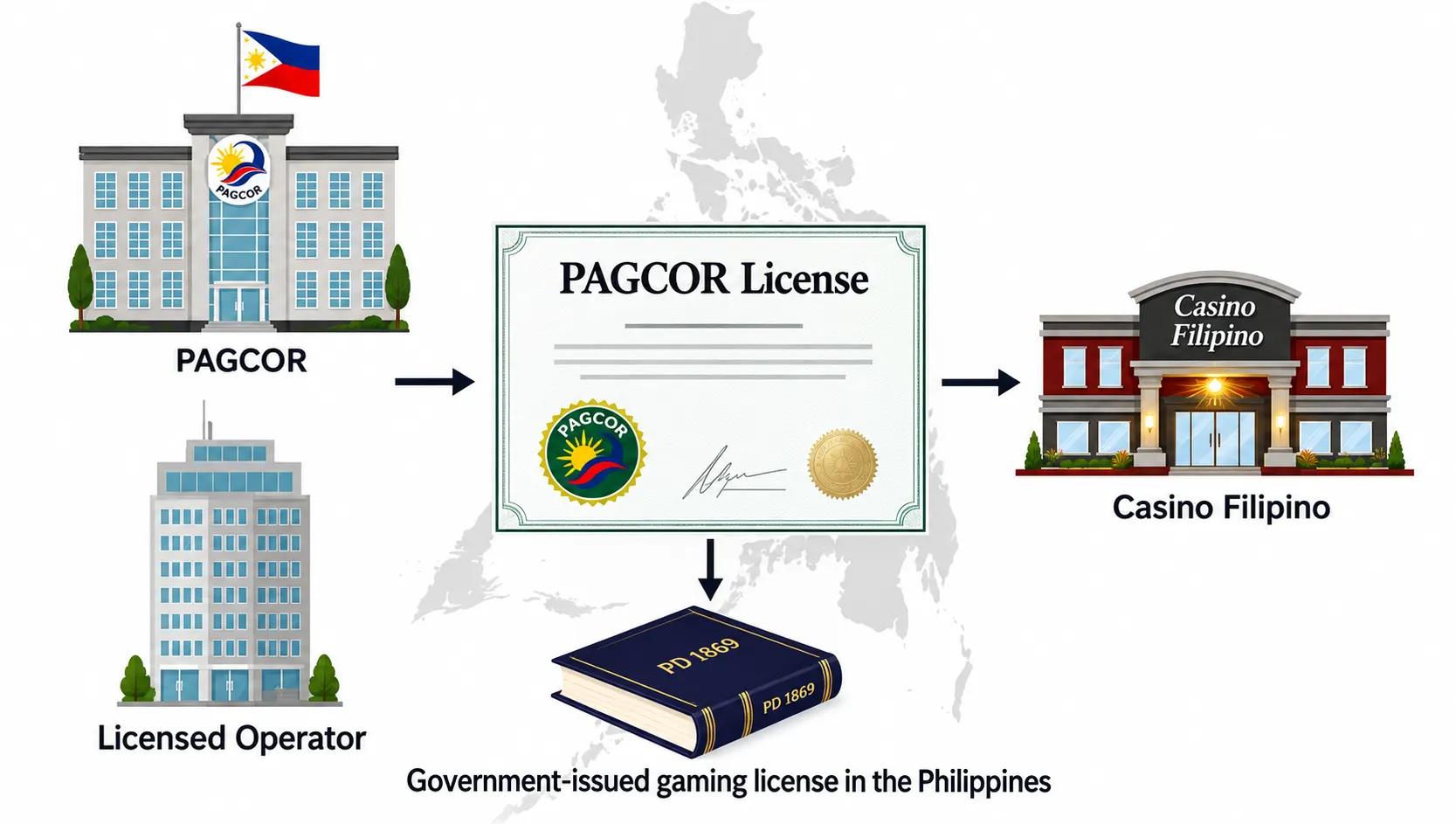
PAGCOR does two jobs at once. It licenses and supervises gambling in the country, and it also runs its own casinos under the Casino Filipino brand. Few regulators work this way, and it is the most common objection to the system, which is covered in the criticism section below.
A PAGCOR license is a formal approval for a specific operator, brand, platform or activity, and each category has its own rules. If you want a wider picture of how gambling licenses are grouped around the world, our guide to casino license types explains the main categories.
Legal Basis of the PAGCOR License
PAGCOR works under Presidential Decree No. 1869, promulgated on 11 July 1983, which merged the earlier decrees on its franchise and powers (PD 1067-A, 1067-B, 1067-C, 1399 and 1632) into one charter. Republic Act No. 9487, enacted in June 2007, extended the franchise to 10 July 2033, with another 25-year renewal possible. Philippine Supreme Court rulings treat PD 1869 as the source of PAGCOR’s power to regulate games of chance and to license casinos.
For a player this means the license rests on a statute, not on a company policy. Newer rules sit on top of that charter, including the PIGO rules from 2020 and the anti-money laundering law that covers casinos. An operator that claims PAGCOR authority should be able to point to this framework.
What Gaming Does a PAGCOR License Cover?
Depending on the category, a PAGCOR license can cover slots, table games such as blackjack, baccarat and roulette, live dealer games, virtual games, bingo, lottery-style games, sports betting and online poker. PAGCOR also keeps lists of approved platforms and accredited service providers, so the studios and software suppliers behind a casino can be checked as well. Reviewers report that some international studios are missing from the approved lists, which explains why certain well-known slots do not appear at licensed Philippine sites.
PIGO vs POGO: Two Types of PAGCOR Licenses
Two abbreviations come up in almost every article about this topic, and mixing them up is how a lot of bad advice starts.
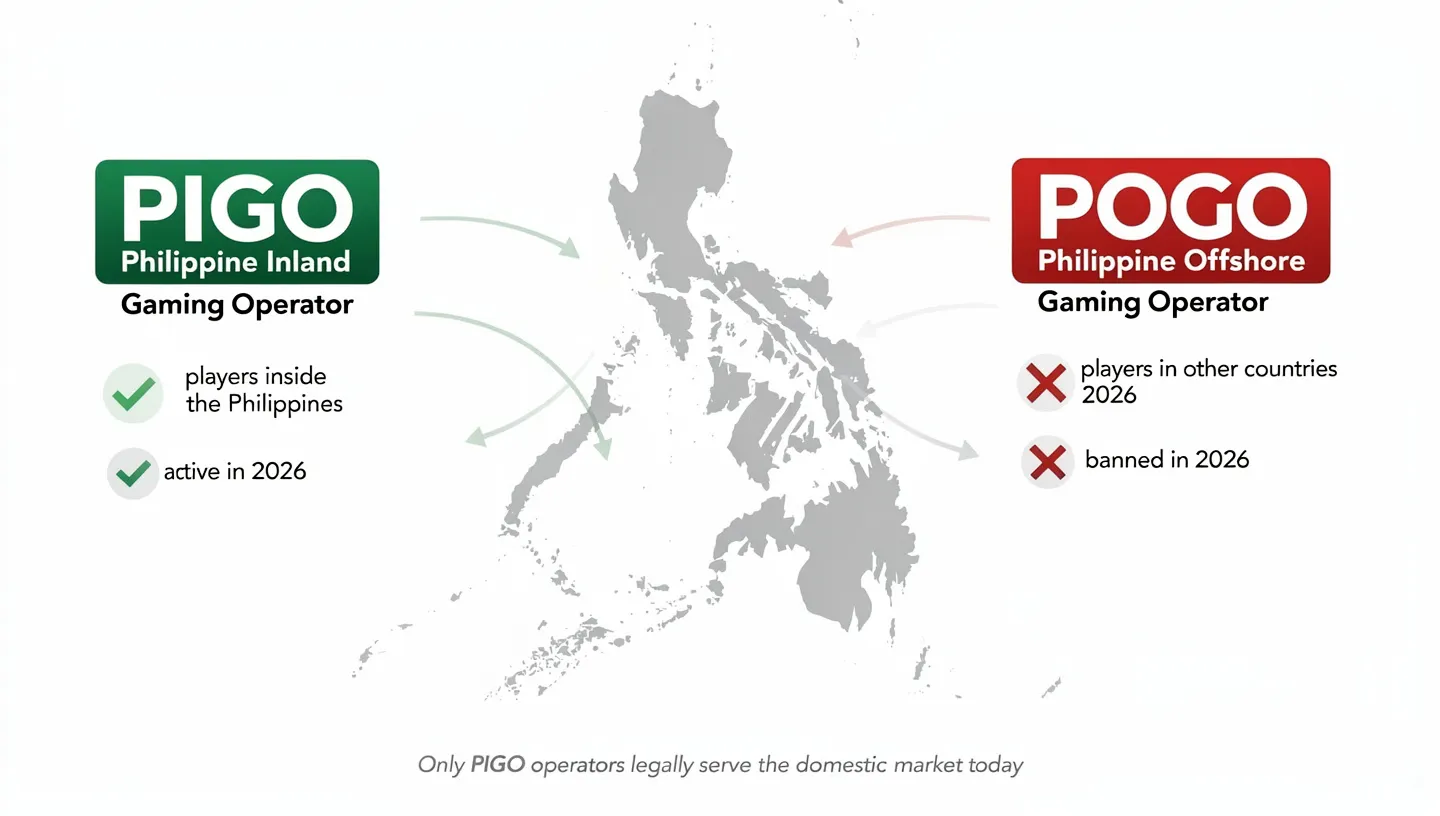
| Type | Full name | Meant for | Status in 2026 |
|---|---|---|---|
| PIGO | Philippine Inland Gaming Operator | Players located inside the Philippines | Active framework, in place since 2020 |
| POGO | Philippine Offshore Gaming Operator | Players in other countries | Banned, no valid POGO license exists |
Only PIGO operators legally serve the domestic market today. If a casino says it holds a PAGCOR offshore license, treat that as a false claim until PAGCOR confirms otherwise.
What Executive Order 74 Changed
Executive Order No. 74, signed in late 2024, banned POGO, IGL and other offshore gaming operations in the Philippines, and the ban took effect on 31 December 2024. Older articles that still describe a PAGCOR offshore license as an active option are out of date. This matters for anyone outside the Philippines, because the old offshore route was the main reason international players ever saw a PAGCOR license on a casino site.
Is a PAGCOR License Legit? What It Proves and What It Does Not
Why the PAGCOR License Is Legit
The PAGCOR license is legit because the body behind it is a state-owned corporation with a legal charter, not a private company selling certificates. PAGCOR keeps public lists of accredited brands, registered domains and service providers, audits its licensees and can suspend, revoke or fine operators that break the rules. A casino with a valid PAGCOR license works under Philippine law, has a registered business behind it and answers to a regulator that players can contact.
That is a real difference from a site with no license or with a license nobody can check. When a dispute comes up at a PAGCOR licensed operator, there is at least one institution above the casino that can look at the case.
Are PAGCOR Casinos Legit for Every Player?
Not for every player. The license is built for the domestic market, so a PAGCOR licensed casino is legit for people who are physically in the Philippines and aged 21 or older, which is the minimum gambling age there. That standard does not carry over by itself to a player in Europe, the United States or the Balkans. Your own country decides whether a gambling site is lawful for you, and a Philippine license does not change that.
Since the offshore ban, any site that promotes a PAGCOR license to players outside the Philippines deserves a hard look. The section on fake claims covers this in detail.
What a PAGCOR License Does Not Guarantee
A license shows regulatory status. It does not promise the following:
- Fast payouts. First withdrawals are slower at almost every casino because of identity checks.
- A win in a complaint. PAGCOR can review a case, but the result depends on the facts.
- Legal status in your country. Local law still applies.
- Protection from losing money. Gambling stays a high-risk activity under any license.
- That the site you are on is the licensed one. Fake sites copy real brands, so the exact domain has to match PAGCOR records.
How PAGCOR Vets Operators Before Granting a License
PAGCOR does not hand out a license to anyone with a nice website. Descriptions of the process from legal and industry sources follow the same pattern: the applicant has to be a corporation registered in the Philippines, show enough capital to run the business and pass a background review of the company, its investors and its key people. Ownership has to be transparent, and unexplained holding layers make the review longer.
The technical side comes next. Gaming software goes through testing, including RNG certification from accredited labs such as GLI, iTech Labs or BMM, and the platform has to meet data protection rules under the Philippine Data Privacy Act. The operator also has to run AML controls and customer identity checks, offer responsible gambling tools and pay the fees and taxes the law requires.
A PAGCOR license is not a one-time approval. Licensees face audits and compliance checks, and renewal depends on a clean record and on tax payments being up to date. Exact capital amounts and fee schedules differ between sources and change over time, so no numbers are quoted here. The official PAGCOR pages are the place to read them.
How an Online Casino Gets a PAGCOR License
This part is for operators and for readers who want to know how hard the license is to obtain. The steps follow how legal sources describe the process, and PAGCOR can change documents and fees at any time.
- Contact PAGCOR with a first inquiry and the basic company documents.
- File the full package: business plan, corporate papers, technical specifications and proof of financial capacity.
- Pass due diligence on the company, its investors, its key staff and the ownership chain.
- Pass testing of the gaming system, including RNG, security and data protection.
- Pay the application and license fees and, where required, post a bond.
- Receive a provisional or full license, followed by audits and yearly renewal.
The domestic license goes only to Philippine companies with confirmed income and financial guarantees, and it carries a high entry cost plus regular fees and gaming taxes. Older guides also describe a third category, the offshore POGO license, which no longer exists. A real PAGCOR license leaves a long paper trail that PAGCOR can confirm, and a fake one does not.
How to Verify a PAGCOR License in 5 Steps
A badge or a sentence in the footer is a claim, not proof. The same logic applies to any regulator, and our guide on how to verify a casino license walks through it in general terms. For PAGCOR, run these five checks in order.
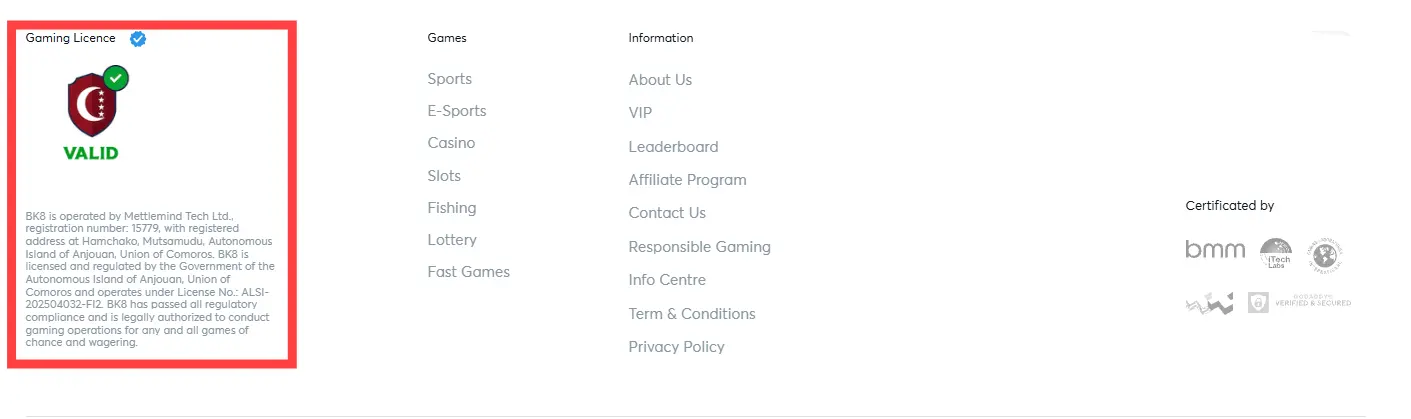
Step 1: Check the Footer for a License Number
A real holder of a PAGCOR license shows a specific license or accreditation number, the registered company name and a link to PAGCOR or a visible seal. A line like “licensed and regulated” with no number behind it tells you almost nothing. Write the number and the company name down before moving to step two.
Step 2: Match the Domain With PAGCOR’s Official List
PAGCOR publishes a document of service providers and registered domains on its own site, and you can open it in the official PAGCOR list of registered domains. Search for the casino name and, more importantly, the exact web address. One missing letter or a different ending means a different site. Casinos often run several domains, and only the registered ones count.
Step 3: Read PAGCOR’s Public Warnings
PAGCOR has posted warnings about a fake PAGCOR license, fake certificates, fake licensing websites and sites that use its logo without permission. Check whether the casino or its operator name appears in any of them. The PAGCOR Guarantee page is another place to confirm that a platform is on record.
Step 4: Confirm the License Status, Not Just That It Exists
A license can be active, suspended, revoked or surrendered. A casino that still shows a PAGCOR logo after losing its PAGCOR license is a serious red flag. Status matters even more now that the market is changing, so a list of PAGCOR licensed casinos copied from an affiliate site last year is not good enough.
Step 5: Contact PAGCOR Directly
If the lists do not settle it, write to PAGCOR through pagcor.ph with the casino name, domain and the license number it displays. PAGCOR states that official questions about its licenses should go through its website or its listed phone lines, not through a chat message from the casino or an unknown agent.
Fake PAGCOR License Claims: Red Flags and Real Cases
Vague Wording That Means Nothing
Careful operators say exactly who licensed them and under which number. Weak claims use softer words such as “PAGCOR registered”, “PAGCOR compliant”, “PAGCOR recognized”, “PAGCOR verified” or “regulated under Philippine law” with no license reference. Any of these can be written by anyone, and none of them can be matched to a record.
Offshore Casinos Advertising PAGCOR to Players Outside the Philippines
This is the biggest trap for international readers. Since 31 December 2024 there is no valid POGO license, and the active PIGO license only covers players inside the Philippines. A casino that promotes a PAGCOR license to players in Europe or North America is either using an outdated claim or inventing one.
Some review sites also mix casinos with Curacao or Anjouan licenses into lists titled “PAGCOR casinos”. A list with that title is not proof of anything. For a wider checklist of trust signals beyond licensing, read our guide on how to spot a reputable online casino.
Cases PAGCOR Has Warned About
In 2025 PAGCOR warned about agreements circulating in the name of Lucky 7 Bingo Corporation. The company was a legitimate licensee for E-Games venue operations as of 30 April 2025, but it held no valid offshore license. The agreements asked for an upfront cash deposit of Php3,000, and PAGCOR called the license shown in them fake and any deal based on it fraudulent. You can read the details in the ASGAM report on the warning.
PAGCOR also told a Philippine news outlet that PhilWin is neither a licensed nor an accredited online gaming platform, even though the brand had millions of users by its own claims. Earlier in 2025 the agency flagged fake websites and Viber messages that pretended to come from its officials. Popularity is not a license.
Official Domains, Apps and Fake Copies
Real casinos often run several domains and mobile apps, and scammers copy the design of each one. Only domains on the PAGCOR registered list count as the licensed site. Android users sometimes install an APK file instead of using an app store, and in that case the file should come only from the casino’s own registered domain, never from a download portal or a link sent in a chat. A site that looks identical to a known brand but sits on a different web address is a copy.
Is It a Scam? Signs That a Site Is Faking Its License
- No license number, or a number that is not in PAGCOR records
- A domain that is missing from the registered domain list
- No Philippine business address despite a claim of Philippine licensing
- License text copied between sites with different company names
- A PAGCOR logo that does not link anywhere
- Requests to send money to a personal number or account
- A PAGCOR claim aimed at players outside the Philippines
PAGCOR License vs Curacao, MGA and UKGC
Players often ask whether a PAGCOR license beats the licenses that dominate international casino sites.
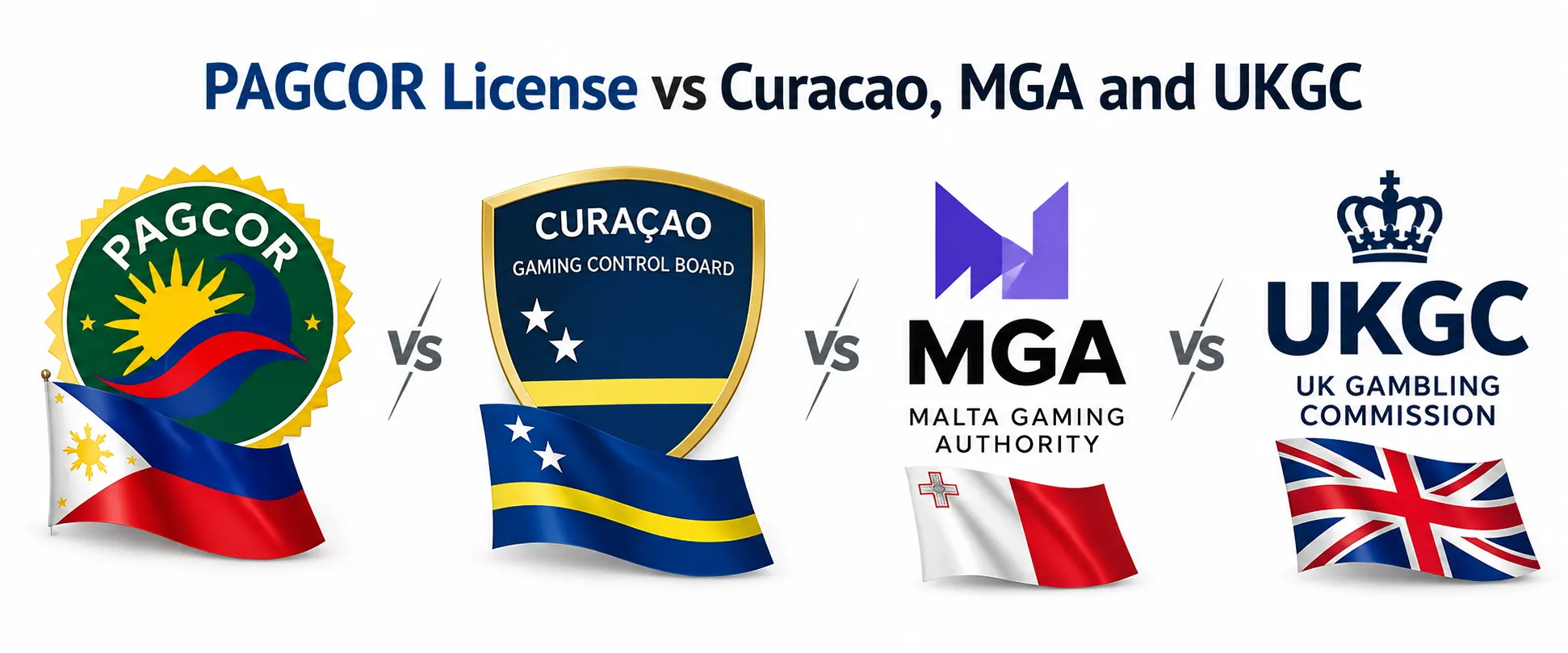
The honest answer is that they serve different markets, and the comparison below shows where they differ.
Comparison With International Licenses
| Parameter | PAGCOR | Curacao | MGA | UKGC |
|---|---|---|---|---|
| Regulator type | State-owned, also an operator | Offshore licensing body | Independent regulator in Malta | Independent regulator in the UK |
| Main market | Players inside the Philippines | International, wide reach | Mainly Europe | United Kingdom |
| Strictness | High, with audits and identity checks | Lighter, easier and cheaper to obtain | High, balanced for operators | Very high, strict rules |
| Complaint route | Complaint to PAGCOR for licensed operators | Limited, depends on the casino | Formal complaint route | Formal complaint route |
| Fits you if | You live in the Philippines | You accept lighter oversight | You live in the EU | You live in the UK |
Reviewers describe the Curacao license as quick and cheap for operators, which is why it appears on so many international sites, and as lighter on player protection. Our guide to the Curacao gambling license covers what that means in practice. Within the Philippines, many Curacao casinos accept Filipino players anyway, although Philippine law formally allows only PAGCOR licensed operators to serve local players. For a Filipino player, the main gain from a PAGCOR licensed site is the complaint route to a local regulator.
MGA and UKGC licenses cover markets that PAGCOR does not touch. If you live in the EU or the UK, those are the licenses that matter for you, and a PAGCOR logo adds no protection at all.
PAGCOR vs CEZA and Other Philippine Regulators
PAGCOR is not the only gambling authority in the Philippines. The Cagayan Economic Zone Authority, known as CEZA, issues its own gaming licenses from a special economic zone and has mostly aimed them at international customers. Sources disagree on whether CEZA licensed sites may take players who live in the Philippines, and the protection they offer is described as lighter than PAGCOR oversight. A CEZA license is a different document and gives no access to the PAGCOR complaint route.
Other bodies cover other products. The Philippine Charity Sweepstakes Office runs lotto and similar games, and the Games and Amusements Board oversees professional sports and the betting around them. A site that mixes these names up with a PAGCOR license is not giving you a straight answer.
PAGCOR Licensed vs Unlicensed Casinos
An unlicensed casino has no regulator to answer to. Players get no complaint route, weaker data protection and nobody who can freeze or recover funds if the site stops paying. For operators, Philippine legal sources list cease-and-desist orders, criminal charges, asset seizure, domain and IP blocking and fines. PAGCOR told the public in 2022 not to play at unlicensed online casinos and described it as a criminal act. The risk runs in both directions, so a PAGCOR licensed site is the only version of this market with a body above it.
Player Protections at PAGCOR Licensed Casinos
KYC, AML and the 21+ Rule
Every PAGCOR licensed operator must confirm who the player is. That means a government ID, proof of address and proof that the payment account belongs to you, and in some cases a video check. Some sources report that identity checks now happen before the first deposit, but timing differs by operator, so read the terms of the site you use. Our guide to casino KYC verification explains what documents to prepare and why the first withdrawal takes longer.
Players must be 21 or older. Government officials, military staff and police are among the groups barred from playing, and accounts can be frozen during an AML review until the source of funds is confirmed.
Responsible Gambling Tools and the NDRP Registry
Casinos with a PAGCOR license must offer self-exclusion, deposit and loss limits and time controls. PAGCOR also maintains the National Database of Restricted Persons, known as NDRP. It lists people who asked to be excluded, people reported by family members and people barred by their job or by a legal restriction, and casinos must check new players against it. Self-exclusion at one operator may not apply to others, so a player who needs a full break should use every operator’s tool.
Game Fairness and RNG Testing
Games at a PAGCOR licensed casino need independent RNG testing before approval, and slots usually show their return to player in the game info panel. This is a technical check on the software, so it does not tell you whether a specific session will win or lose.
Payments and Bonus Terms at PAGCOR Licensed Casinos
Payment Methods
Licensed Philippine casinos have usually offered e-wallets, bank transfers, cards and, at some operators, crypto. The e-wallet part changed in 2025. The central bank, Bangko Sentral ng Pilipinas, ordered e-wallets to remove in-app links to online gambling sites by 16 August 2025, and both GCash and Maya complied by disabling their gaming features. The step was announced as temporary, pending a stricter BSP circular, so the situation may have moved since then.
In practice this means a casino’s payment page can differ from what older articles describe, and each operator lists its own methods. Be careful with any site that asks you to send money to a personal wallet number, because a real operator does not collect deposits that way. Speed also depends on the method and on whether your account is verified, and our page on casino withdrawal times shows typical ranges for each payment type.
Bonus Terms
A PAGCOR license does not make a bonus fair. Welcome offers at licensed casinos still come with expiry dates, maximum bets, excluded games and withdrawal caps, and each operator sets its own numbers. Slots usually count fully toward the playthrough, while table games often count for a small share or nothing at all, so a bonus that looks generous on the banner can be hard to clear. Read the terms before you accept anything, and compare the real cost of the playthrough, not the headline amount. Our guide to wagering requirements shows how to do the math.
Identity verification also interacts with bonuses. Many operators block a withdrawal until the account passes KYC, and breaking a bonus rule such as the maximum bet can void the winnings. If a casino cancels a payout and quotes a term you cannot find in its rules, keep the screenshots, because that is the kind of case a regulator can look at when the operator holds a valid license.
How to File a Complaint Against a PAGCOR Licensed Casino
Start with the casino. Contact support through live chat or email, state the problem, attach screenshots and transaction IDs and ask for a written reply. Keep every message. Most payment issues get solved at this stage, and a stuck payout is the usual reason people escalate. Our page on how to withdraw winnings lists the common causes of delays before you file anything.
If the casino does not answer or rejects the case, write to PAGCOR with your name, the casino name and domain, the license number, a timeline of events and your evidence. PAGCOR can act only on operators that hold a PAGCOR license. A dispute with an unlicensed site is outside its authority, and the only options left are local police or cybercrime units, which rarely recover money. That is the practical reason to verify a license before the first deposit and not after a problem.
Can You Use a PAGCOR Licensed Casino Outside the Philippines?
Who Can Legally Play
Under the PIGO framework, a PAGCOR licensed casino serves players located in the Philippines, and the PAGCOR license does not open the door for anyone else. Several reviewers state that a Filipino player abroad cannot log in either, and a player from another country cannot use these sites at all. An operator that wants international customers needs additional licenses from other regulators. Any site that says otherwise is not following the PAGCOR rules it advertises.
Tax on Casino Winnings
Philippine rules can apply tax to larger casino winnings, and licensed operators handle some of it at payout. The rates and thresholds have changed over the years, so check the current figures with the Bureau of Internal Revenue or a tax advisor. If you live outside the Philippines, your own country’s tax rules apply, and a gambling license does not replace them.
Advantages of a PAGCOR License for Players
Players in the Philippines get several concrete benefits from a PAGCOR licensed casino, and most of them come from having a regulator that can be contacted.
- Government oversight. A state-owned regulator audits licensees and can suspend or revoke a license.
- A complaint route. PAGCOR can review disputes with licensed operators.
- Tested games. Software goes through RNG testing by accredited labs before approval.
- Identity and age checks. KYC rules cut down underage play and account fraud.
- Responsible gambling tools. Limits, self-exclusion and the NDRP check are required.
- A local business behind the site. A registered Philippine company has to follow tax and data privacy law.
None of these points promise a win or a quick payout, but together they explain why a verified PAGCOR license is worth checking before a deposit.
Drawbacks and Criticism of the PAGCOR License
- Dual role. PAGCOR regulates the market and also runs its own casinos. Critics call this a conflict of interest, and the planned privatization of its casino business is meant to address it.
- Limited reach. The PAGCOR license serves only the Philippines, so it says little to a player elsewhere.
- Slower start for new players. Strict identity and AML checks delay the first withdrawal.
- Narrower game choice. Reviewers report that some well-known providers are missing from approved lists, although the exact list changes.
- Misleading marketing. Affiliate lists often present every casino with a PAGCOR logo as equally safe, which is not true.
What Changed for PAGCOR Licenses in 2026
The offshore ban is fully in force, and the domestic PIGO framework is the only active online route. Industry sites also report a new minimum fee for e-casino operators from April 2026 and a wave of consolidation, with weaker operators expected to surrender licenses. Identity checks have reportedly become stricter as well. Treat these points as reported developments and confirm them on pagcor.ph, because a PAGCOR license that was active last year may not be active today.
Responsible Gambling Resources
A license reduces some risks, but it does not make gambling safe. Set deposit and time limits before you start, never play with money meant for bills and stop if you notice you are chasing losses. Our guide to responsible gambling limits shows how to set them. Organizations such as Gamblers Anonymous and national helplines offer free support, and PAGCOR runs its own responsible gaming program in the Philippines.
Key Takeaways on PAGCOR License Checks
- A PAGCOR license is real and comes from a state regulator.
- It covers players located in the Philippines, not players in other countries.
- The offshore POGO license is banned, so a PAGCOR claim aimed at international players is a red flag.
- Match the license number, the company name and the exact domain with PAGCOR records.
- Check the status, because licenses can be suspended, revoked or surrendered.
- A license gives you a complaint route, not a guarantee of payouts.
Verdict: Is a PAGCOR License Legit for Online Casinos?
A PAGCOR license is legit when it is real, active and tied to the exact domain you are using. It comes from a state regulator, requires audits and identity checks and gives players in the Philippines a complaint route. It is not a universal seal. It does not cover players outside the Philippines, it does not guarantee payouts and it is easy to fake on sites that never held it.
Check the PAGCOR license number, match the domain with the official list and confirm the status before you pay anything. If the casino fails any of those checks, move on. For a shortlist of operators that pass broader trust checks, see our list of reputable online casinos.
PAGCOR License FAQ
Is a PAGCOR license legit?
Yes, a PAGCOR license is legit. It is issued by a government-owned regulator and backed by public lists, audits and enforcement powers. It is legit only when the casino really holds it, so match the license number and the exact domain with PAGCOR records.
Are PAGCOR casinos safe?
A PAGCOR licensed casino is safer than an unlicensed site because they face audits, identity checks and a complaint route. No license makes gambling risk-free, and a licensed casino can still be slow to pay or strict with bonus terms.
Is an online casino with a PAGCOR license legit for players outside the Philippines?
No. The active PIGO license covers players located in the Philippines, so a PAGCOR license is not a legit sign for an international player. The offshore POGO license was banned at the end of 2024, so a PAGCOR claim aimed at international players is a red flag.
How can I check if a casino has a PAGCOR license?
Find the license number in the footer, search the casino name and exact domain in the PAGCOR list of registered domains, read PAGCOR’s public warnings and confirm the status. If something does not match, write to PAGCOR through pagcor.ph.
Is a PAGCOR license better than a Curacao license?
For a Philippine player it usually is better, because oversight is stricter and the complaint route is local. Curacao is lighter and cheaper for operators and fits international sites. Neither replaces the license of your own market, such as MGA in the EU or UKGC in the UK.
Does a PAGCOR license make a casino legal everywhere?
No. It shows regulatory status in the Philippines only. Your own country’s law decides whether a site is lawful for you.
What does a fake PAGCOR license look like?
A fake PAGCOR license usually shows a missing license number, a number that is not in PAGCOR records, a domain that is not on the registered list, copied license text and vague phrases such as “PAGCOR verified”. A logo without a link is another warning.
Does a casino license guarantee my money is safe?
No. A license gives you a regulator to complain to, but it cannot promise payouts or stop losses. Read the terms, use limits and withdraw winnings you do not plan to play.
What happens if a PAGCOR casino loses its license?
PAGCOR can suspend or revoke a license, and the casino must stop operating as a PAGCOR licensed site. Players should withdraw their balance early if the casino shows signs of trouble, such as delays, missing support or a changed domain, and report unpaid funds to PAGCOR.
Is PAGCOR a government agency?
PAGCOR is a government-owned and controlled corporation under the Office of the President of the Philippines. It regulates gambling and also operates its own casinos.
Can I play at more than one PAGCOR licensed casino?
Yes. Philippine players can register at several licensed operators, and each one runs its own identity checks. Self-exclusion at one operator may not apply to the others, so use the tool at every site if you want a full break.
What games are available at a PAGCOR licensed casino?
Typical categories are slots, table games, live dealer games, bingo, lottery-style games, sports betting and poker. Which of them you see depends on the operator’s approved category and on which software studios are on the PAGCOR lists.
Does a PAGCOR license cover sports betting?
Yes, PAGCOR publishes rules for sports betting as one of its categories. A betting site still has to hold the right category and appear on the official lists, so check it the same way as a casino.
Are PAGCOR licensed casinos safe on mobile?
Licensed operators run mobile sites and some offer apps, and the same license checks apply. Use only the registered domain, and download any app file from that domain, not from a link in a message.
Is a PAGCOR license required for casinos that serve Filipino players?
Formally, yes. Review sites and legal sources state that only PAGCOR licensed operators may serve players in the Philippines, even though many offshore casinos accept them anyway. Playing at those sites leaves you without the PAGCOR complaint route.
What is the minimum age at a PAGCOR licensed casino?
The minimum age for Filipino players is 21, which is higher than the 18+ limit at many international casinos. Some groups, such as government officials, military staff and police, are barred from playing.