Yes, online gambling is legal in the Netherlands, but only if the operator holds a license from the Kansspelautoriteit, the Dutch gambling regulator known as the KSA. The licensed online market opened on 1 October 2021 under the Remote Gambling Act, known in Dutch as the Wet Kansspelen op Afstand or KOA. Before that date, online casino games, poker and online sports betting had no legal route for private operators, and Dutch players relied on offshore sites that carried no local oversight at all.
The short version is simple: a Dutch resident can play at any operator that appears on the KSA’s public license register, and that operator is responsible for age checks, deposit limits and the gambling tax on its own revenue. Anything outside that register sits in a legal grey zone for the operator, even though the player is not fined for using it. The rest of this guide works through the law behind that answer, how the rules actually apply at the table, and what changes are already on the way.
Quick Answer: Legal, If the Operator Is KSA-Licensed
Online gambling in the Netherlands is regulated, not banned and not unrestricted either. A licensed operator can offer online casino games, sports betting and poker to Dutch residents, provided it meets the KSA’s requirements on player protection, anti-money laundering and tax. An operator without a Dutch license is not permitted to target Dutch players at all, regardless of where that operator itself is based or licensed.
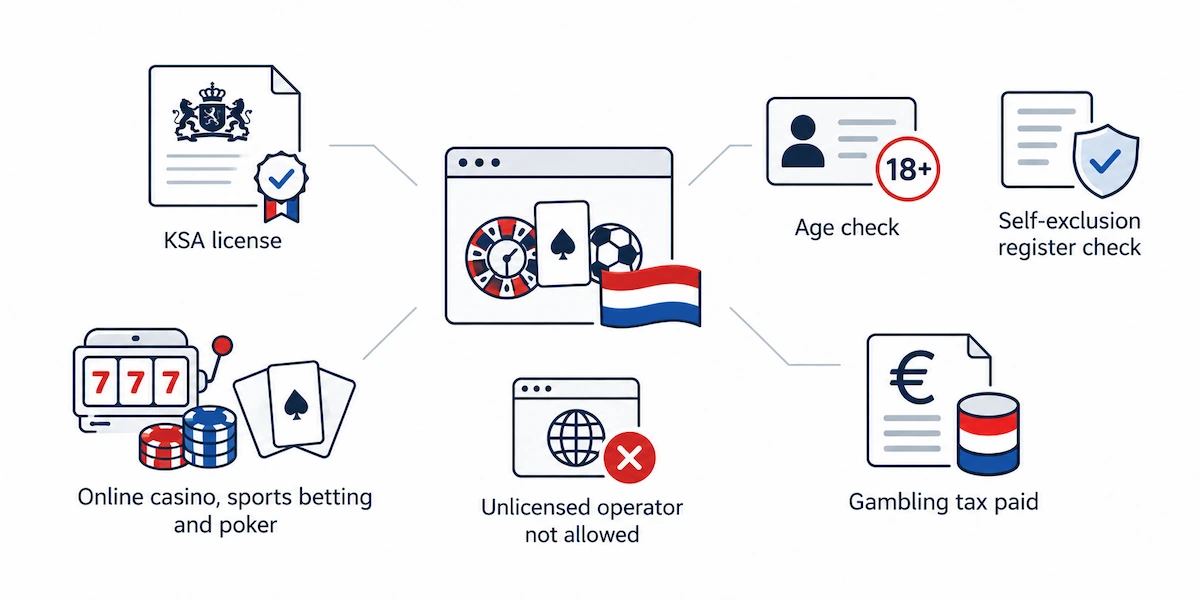
Three things decide whether a given site is legal to use from the Netherlands: whether it holds a current KSA license, whether it checks age and the national self-exclusion register, and whether it pays gambling tax on money won by Dutch players. If all three are true, the site is operating inside Dutch law. If none are true, the player faces no criminal penalty, but loses every protection the law was built to provide.
What Counts as a Game of Chance Under Dutch Law
Dutch law defines a game of chance as a game in which prizes can be won and the outcome is decided mainly by chance rather than player skill. This definition sits in Article 1 of the Wet op de Kansspelen and is written broadly on purpose, so that it covers lotteries, betting, casino games and online games of chance without needing a separate rule for each new format. A game is still treated as a game of chance even when some skill is involved, as long as skill does not give a player a dominant influence over the result. Poker sits in this category for exactly that reason, even though skilled players win more often over time than beginners do.
The Short History of Dutch Gambling Law
Dutch gambling regulation did not start in 2021. It goes back more than sixty years, and the older framework still governs land-based venues today.
The 1964 Betting and Gaming Act
Until 1964, most forms of gambling were prohibited in the Netherlands outside of state lotteries. The Betting and Gaming Act, known as the Wet op de Kansspelen or Wok, created a state-backed framework that year. Under that framework, TOTO became the official sports betting provider and Holland Casino received exclusive rights to run physical casinos. Land-based gambling in the Netherlands still operates under the same 1964 Act, even after the later reforms aimed at the online market.
The Grey Market Years
From the late 1990s onward, Dutch players increasingly used international betting and casino sites that held no Dutch license at all. The government did not prosecute individual players for this, but it also offered no supervision over those sites, no tax collection and no player protection. That grey market lasted more than two decades, and a large share of the betting activity available to Dutch residents moved offshore during that period.
The Remote Gambling Act (KOA) and the 2021 Reform
The Remote Gambling Act entered into force on 1 April 2021 and the licensed online market opened six months later, on 1 October 2021. For the first time, private operators could apply for a Dutch online license covering casino games, sports betting and poker, rather than relying on the state monopoly that had defined land-based gambling since 1964. The Act set out the licensing conditions, the duty of care toward players, the advertising limits and the gambling tax that now shape the online market.
Who Regulates Online Gambling in the Netherlands?
Two different regulatory bodies oversee different parts of the Dutch gambling landscape, and mixing them up is a common source of confusion online.
The Kansspelautoriteit (KSA)
The Kansspelautoriteit is the Dutch gambling authority, established in 2012 as an independent regulator. It grants and renews online and land-based licenses, supervises compliance with the Wok and the Remote Gambling Act, and enforces against operators that offer or advertise gambling without a license. As the main gambling authority in the country, the KSA can issue administrative fines, binding instructions, public warnings and, in serious cases, suspend or revoke a license. At the end of 2025 there were 31 licensed and regulated operators on the KSA’s register, and the first group of follow-up licenses, running through to 2031, was granted in September 2026.
The ACM: Skill Games and Social Casinos
Not every money-adjacent game falls under the KSA. Skill games that pay out cash prizes, where the result depends mainly on player ability rather than chance, are overseen by the Authority for Consumers and Markets, known as the ACM, rather than the gambling regulator. The ACM also supervises and regulates social casinos, the apps where players spend virtual credits with no real cash payout. This regulatory distinction rarely appears in general guides to Dutch gambling law, but it matters if a product sits close to the line between a game of skill and a game of chance.
How Operators Get a Dutch Gambling License
Understanding what an operator had to do to get listed on the KSA register helps explain why a Dutch license is treated as a meaningful signal rather than a formality.
Who Actually Needs a License
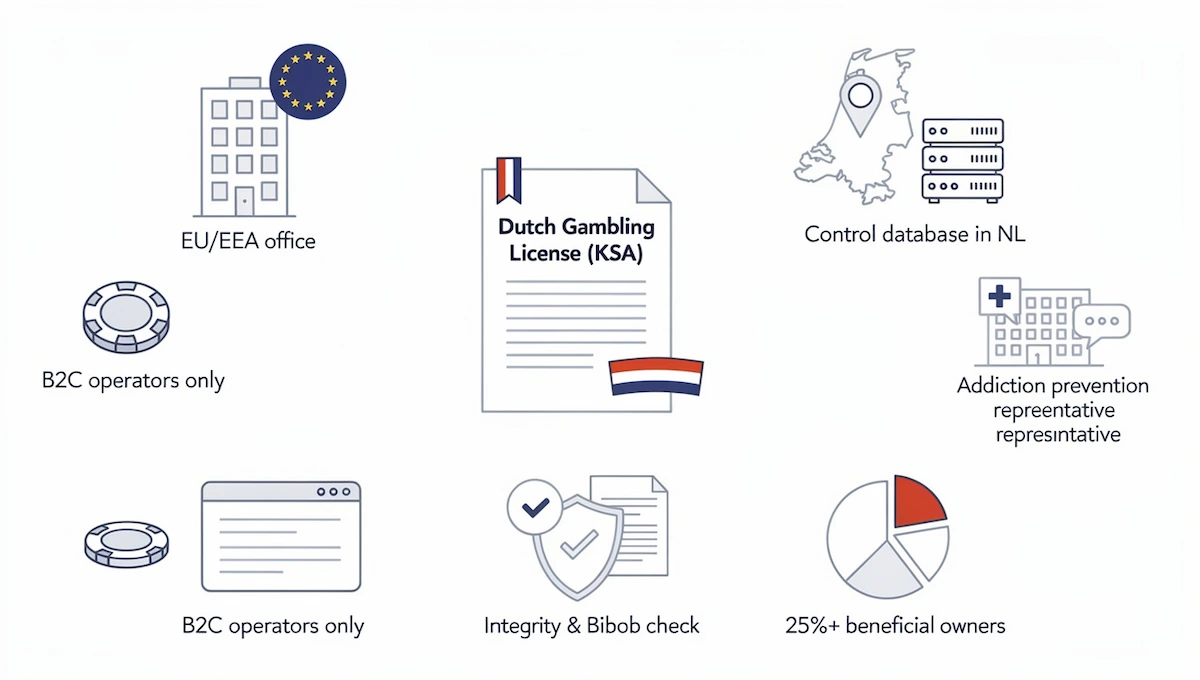
Only B2C operators, meaning companies that offer games of chance directly to Dutch consumers, need a license. Software suppliers and other B2B parties are not licensed separately, but the licensed B2C operator remains fully responsible for making sure its suppliers meet the KSA’s technical standards.
Requirements and Costs
An applicant needs a registered seat in the EU or EEA, a Dutch-based representative responsible for addiction prevention, and a control database hosted inside the Netherlands. The application fee is tens of thousands of euros, and the review focuses heavily on an integrity assessment of the people behind the company, which is usually the slowest part of a process that can take six to nine months from start to finish.
Ownership and Shareholder Transparency
Licensed operators must disclose beneficial owners holding 25 percent or more of the company, so the KSA always knows who ultimately controls a licensed brand. This sits alongside the Bibob integrity check applied to individuals in key positions, and together the two rules are meant to keep organized crime and opaque ownership structures out of the regulated market.
What’s Legal to Play Online in the Netherlands
A Dutch license does not cover every product at once. Operators apply for specific categories, and not every licensed site offers everything.
Online Casino Games
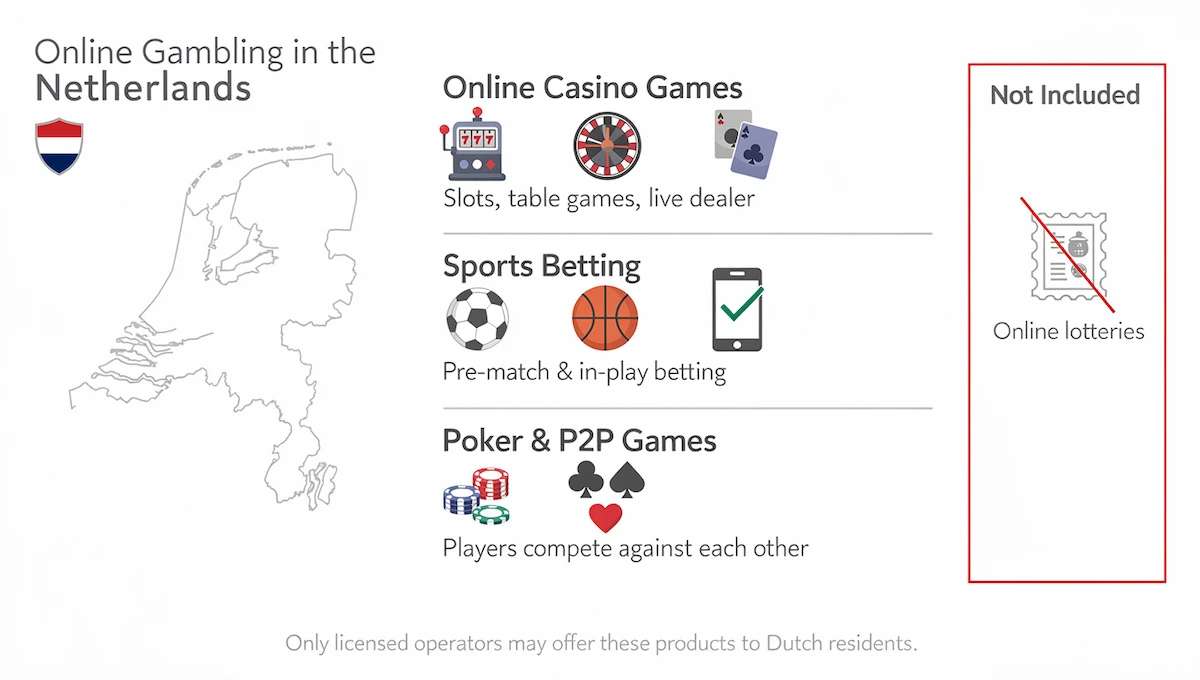
Slots, table games and live dealer formats such as live roulette and live blackjack are available through licensed operators, and roughly 30 of the 31 licensees hold the live dealer category. Live games must run under camera surveillance with trained staff, and every operator checks the national exclusion register at login, regardless of which game is being played. Autoplay is not permitted under a Dutch license, so each round starts only after the player acts, and the next round only after the previous result is final. The law sets no maximum stake and no required payout percentage, though an operator must disclose its payout percentage where this is technically possible.
Sports Betting
Online sports betting is covered by the same Remote Gambling Act, and about 24 of the 31 licensed operators hold the sports betting category alongside their casino license. Pre-match and in-play betting are both allowed, and fantasy sports with cash prizes fall under the same category. Betting advertising aimed at television viewers during a live match is restricted, though an operator’s own site or app is treated differently from broadcast advertising.
Poker and Peer-to-Peer Games
Poker is legal online in the Netherlands, but only around 8 of the 31 licensed operators hold the specific permission for peer-to-peer casino games, where players compete against each other rather than the house. It is worth checking that a given site actually carries that category before assuming every licensed casino offers a poker room.
What’s Still Prohibited Online
Online lotteries remain excluded from the standard online license altogether, even though the land-based state lottery is legal and long-running. Offering or advertising any of these products to Dutch residents without a KSA license is prohibited, whatever jurisdiction the operator itself is licensed in elsewhere. Operators that hold a Dutch license still fall into different license categories depending on which products they are permitted to offer, which is why two licensed sites can look quite different from each other.
How to Check If an Online Casino Is Licensed in the Netherlands
The KSA publishes a public register of every current license holder, and checking it takes a minute. Some unlicensed sites copy the look of a legitimate operator or use a similar domain name, so the register is the only reliable way to confirm a site’s status rather than trusting its own claims.
- Search the operator’s name directly on the KSA’s official license register before creating an account
- Confirm the license covers the specific product you want, such as casino games or sports betting, since categories are not automatic
- Follow the same steps used to verify a casino license at any regulated operator, since the KSA register works the same way as other regulators’ registers
- Check that the site asks you to set deposit, time and loss limits during registration, since a licensed operator is required to do this
- Avoid a site that accepts Dutch players without ever mentioning the KSA, CRUKS or a Dutch-language duty of care policy
Age Requirements and Player Protection
Dutch law sets player protection rules that go further than a simple minimum age, and several of the finer points are easy to get wrong.
The 18+ Minimum Age
You must be 18 or older to gamble online in the Netherlands, for casino games, sports betting and online poker alike. Licensed operators verify age during account registration using identity documents, and this check applies regardless of the product being offered.
The Confusing “24” Advertising Rule
A figure of 24 circulates widely in discussions of Dutch gambling law, and it is frequently misreported as a second legal gambling age. It is not. Untargeted online advertising for gambling is permitted only where at least 95 percent of the audience actually reached is aged 24 or over. That rule binds the advertiser and is measured by audience reach, not by who is allowed to register and play. The minimum age to gamble stays at 18 regardless of this advertising threshold.
CRUKS: The National Self-Exclusion Register
CRUKS is the national self-exclusion register, checked by every licensed operator at every login, both online and at relevant land-based venues. A player can register voluntarily, or be placed on the register involuntarily following a risk assessment, and exclusion lasts a minimum of six months once it takes effect. While registered, a player cannot open an account or place a bet with any licensed Dutch operator.
Deposit Limits and Affordability Checks
Players set their own deposit, time and balance limits when they register, and those defaults are deliberately cautious. A new player aged 18 to 24 can deposit up to roughly 150 euros a month, while a player aged 25 and over can go up to roughly 350 euros a month, before the limit requires a direct conversation with the operator’s trained staff. Since October 2024, stricter rules require an affordability check once net deposits pass a set monthly threshold, and an account can be restricted if that affordability cannot be established. These figures sit well below the general responsible gambling limits that many operators outside the Netherlands offer only as an optional setting rather than a mandatory one.
Payments: How You Deposit and Withdraw
Dutch rules reach into payments as well, not just licensing and advertising. Only payment instruments issued by an EU-licensed bank, payment institution or e-money institution are permitted, and every payment method used must be traceable back to the player’s own identity. iDEAL is the most common deposit method among Dutch players, alongside Visa, Mastercard and several e-wallets, and a licensed operator generally does not charge its own deposit or withdrawal fees, although a payment provider sometimes does.

Licensed operators cannot extend credit to players, so every deposit has to be the player’s own money up front. During account verification, operators typically ask for identification, proof of address and a BSN, the Dutch citizen service number, alongside the standard checks covered by typical withdrawal times at a regulated site, and most licensed operators process a verified withdrawal within a day or two once the account has cleared its checks.
Gambling Tax in the Netherlands
Taxation sits at the center of how the licensed market is funded, and the rate has climbed every year since the market reopened.
Do You Pay Tax on Winnings at a Licensed Site?
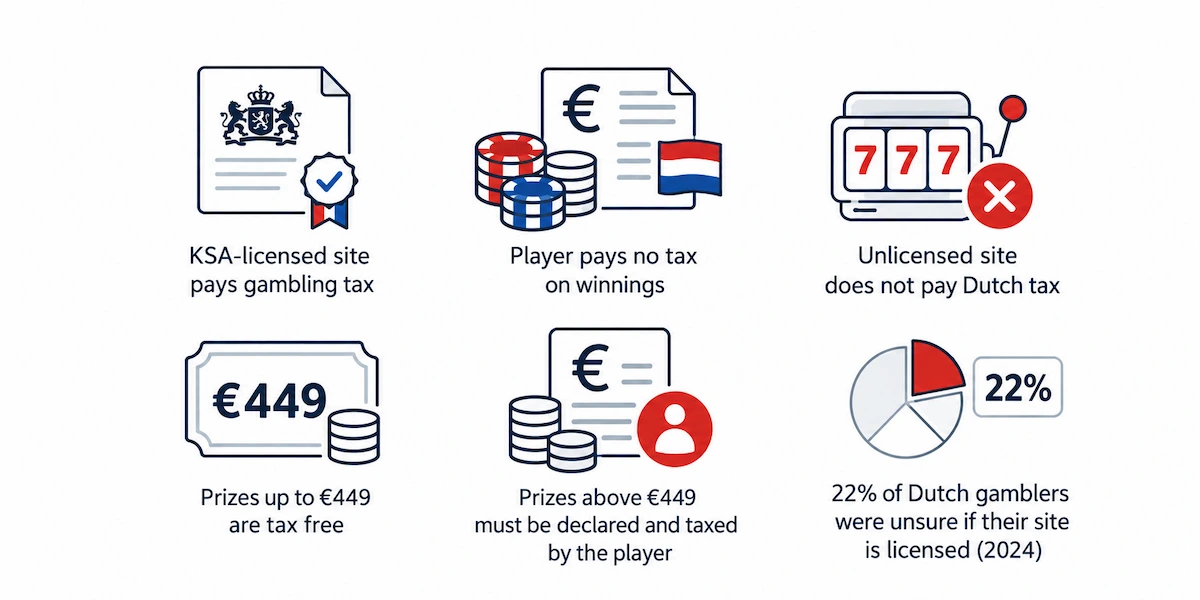
No. At a licensed Dutch operator, the operator itself pays gambling tax on its gross gaming revenue, and the player owes nothing further on individual winnings. This is one of the clearest practical advantages of staying with a KSA-licensed site rather than an offshore alternative, and it is also why the process to withdraw winnings from a licensed Dutch operator does not involve any separate tax step on the player’s side.
What Happens If You Play on an Unlicensed Site
Dutch tax law sets a general exemption threshold of 449 euros for an individual prize from a game of chance. Below that figure, a prize is not taxed at all. Above it, if the winnings come from an operator that does not already pay Dutch gambling tax, meaning an unlicensed or offshore site, the player becomes personally responsible for declaring and paying the tax on that amount. A 2024 survey found that roughly 22 percent of Dutch gamblers were unsure whether the site they actually used was properly licensed, which shows how easily this distinction gets missed.
Gambling Tax Rate History
| Year | Gambling Tax Rate (Gross Gaming Revenue) |
|---|---|
| 2023 | 29.5% |
| 2024 | 30.5% |
| 2025 | 34.2% |
| 2026 | 37.8% |
Licensees also pay a separate levy of 1.95 percent toward the KSA’s own supervisory costs, and bets placed on Dutch horse races carry an additional 10 percent contribution. The rate is set each year in the national Tax Plan, so it is worth checking the current figure on the Dutch Tax Administration’s own site directly rather than assuming last year’s number still applies.
Advertising and Sponsorship Rules
Dutch advertising rules for gambling tightened sharply after the online market opened, moving from a fairly open approach to one of the stricter regimes in Europe.
The Untargeted Advertising Ban
Since 1 July 2023, untargeted advertising for online gambling has been banned outright. This rules out gambling ads on television, radio, in print and in public spaces. Online advertising remains allowed, but only where it is targeted and specifically excludes minors, young adults under the audience threshold and players already on CRUKS.
The End of Sports Sponsorship
Sponsorship by gambling operators outside sport ended on 1 July 2024, and sports sponsorship itself ended a year later, on 1 July 2025. Using athletes, influencers or other role models in gambling advertising is prohibited, and cashback-style bonus promotions face separate restrictions on top of that. Several common bonus types that are advertised freely in other markets are simply not allowed to be promoted the same way to a Dutch audience.
What Happens If You Gamble on an Unlicensed Site
The legal position for players is more forgiving than it might sound, though it is far from risk-free.
Is It Illegal for Players?
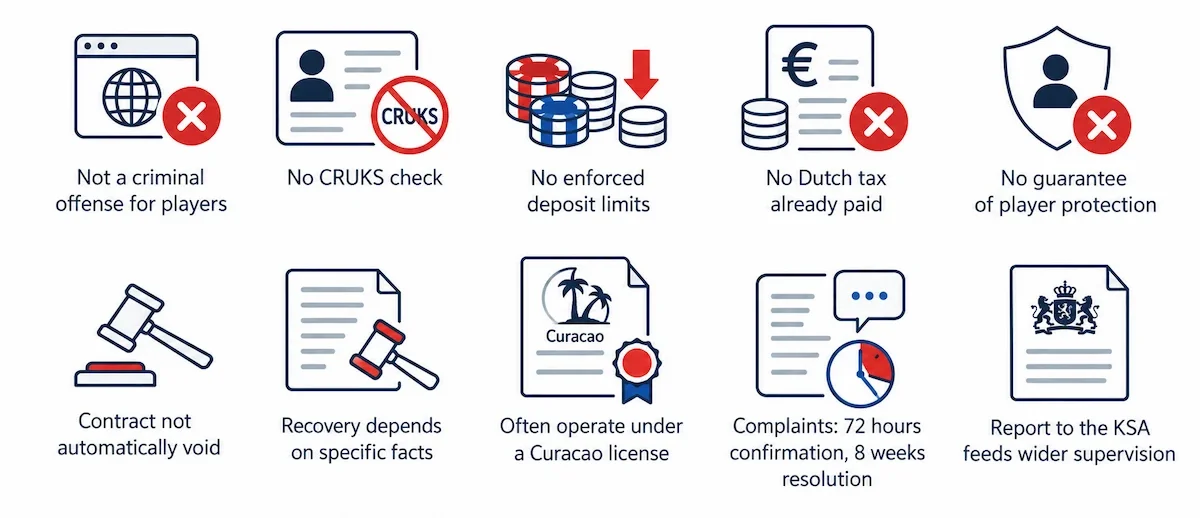
Playing on an unlicensed site is not a criminal offense for the player, and the Netherlands does not fine individuals for using an offshore operator. The risk sits elsewhere: no CRUKS check, no enforced deposit limits, no Dutch tax already paid on winnings, and no guarantee that the operator follows any duty of care at all.
Can You Get Your Losses Back?
Recovering losses from an unlicensed operator is difficult. The Dutch Supreme Court has held that a contract with an unlicensed operator is not automatically void, so a player cannot simply claim a contract was invalid and demand a refund on that basis alone. Case law in this area is still developing, and a successful claim tends to depend on the specific facts, including whether the operator ignored clearly rising deposits or otherwise failed its duty of care. Many of the offshore sites that still accept Dutch players operate under a Curacao gambling license rather than a KSA one, which is legal where that license was issued but gives a Dutch player none of the protections described above. At a licensed Dutch operator, the picture is different: a complaint must be handled through a free procedure, receipt has to be confirmed within 72 hours, and the operator must resolve the complaint within eight weeks. A report to the KSA itself feeds the regulator’s wider supervision of that operator, but it does not settle an individual dispute on its own.
Licensed vs Unlicensed Operators
| Factor | Licensed (KSA) Operator | Unlicensed Operator |
|---|---|---|
| Legal to use from the Netherlands | Yes | Not prosecuted, but outside Dutch oversight |
| CRUKS self-exclusion check | Required at every login | Not applied |
| Deposit and time limits | Set by player, enforced by operator | Not guaranteed |
| Tax on player winnings | Paid by the operator | Player’s own responsibility above 449 euros |
| Dispute process | Free complaint procedure, KSA oversight | No regulator to appeal to |
Enforcement and Fines
The gambling authority’s enforcement record shows this is not a rule that exists only on paper. Fines for operating without a license, or for breaching advertising rules, can reach the sixth fine category or 10 percent of annual turnover, whichever figure is higher. In March 2026, an unlicensed operator was fined 24.8 million euros, among the larger penalties issued since the regulated market opened. Individuals applying for key positions at a licensed operator also go through a Bibob integrity assessment, which examines the origin of funds and the reliability of those involved before a license is granted or renewed.
How Big Is the Dutch Online Gambling Market
Online gross gaming result in the Netherlands came to roughly 1.2 billion euros in 2025, down about 18.5 percent from the year before, which the KSA links to the tighter deposit and advertising rules that took effect over that period. The regulator estimates channelisation, meaning the share of play that happens through licensed rather than unlicensed sites, at around 53 percent by gross gaming result, with a noticeably higher figure by player count. Roughly 1.38 million active player accounts were recorded across licensed operators, a scale that still makes the Netherlands one of the larger regulated online gambling markets in the European Union despite its stricter rules.
Recent and Upcoming Changes
The framework set in 2021 has kept shifting, and two developments from 2026 matter for anyone trying to understand where Dutch gambling law is heading next.
The September 2026 Council of State Ruling
In September 2026, the Council of State upheld the Netherlands’ single-license system for certain lottery and sports betting products, finding that it does not breach European Union free-movement rules. The same month, the KSA granted the first group of follow-up online licenses, replacing a portion of the original 2021-era licenses that were due to expire.
What’s Coming in 2027
A draft bill expected in 2027 would tighten online advertising rules further, including restrictions on bonus advertising, and introduce an overarching deposit limit that would apply across every operator a player uses rather than per site. A separate study is also examining whether the Netherlands should cap the total number of online licenses it issues.
Land-Based Gambling in the Netherlands
Land-based gambling sits under the original 1964 Act rather than the newer Remote Gambling Act, and it still carries its own monopoly structure. Holland Casino holds exclusive rights to operate physical casinos in the country, alongside licensed slot arcades and retail sports betting locations, plus the long-running state lottery and approved charity lotteries. The minimum age of 18 applies at land-based venues just as it does online, and the same CRUKS register covers relevant physical locations as well.
How to Start Gambling Online Legally in the Netherlands
- Confirm the operator holds a current KSA license and that the license covers the product you want to use
- Register with valid identification, since licensed operators require age and identity verification before you can deposit
- Set your own deposit, time and loss limits during sign-up, since this step is mandatory rather than optional
- Complete the operator’s identity verification process early, since it is required before most withdrawals are released
- Read the terms on any welcome offer carefully, since Dutch rules already restrict how aggressively bonuses can be advertised to begin with
A KSA license is the floor, not the whole picture, and two licensed operators can still differ sharply in how they treat customers day to day, from how quickly support actually answers a ticket to how clearly their terms are written in plain Dutch or English. Players who are comparing operators rather than committing to the first licensed site they find can also look at what separates a reputable online casino from one that simply meets the legal minimum, since a license confirms that a site is allowed to operate, not that it is the best one available.
Netherlands Online Gambling FAQ
Is online gambling legal in the Netherlands?
Yes. Online gambling has been legal in the Netherlands since 1 October 2021, provided the operator holds a license from the Kansspelautoriteit under the Remote Gambling Act. Offering or advertising online gambling to Dutch residents without that license remains prohibited.
Do I have to be Dutch to use a KSA-licensed site?
No. KSA licensing is about where the operator is permitted to offer its service, not the player’s nationality. Anyone physically in the Netherlands and meeting the 18-plus age requirement can use a licensed operator, regardless of citizenship.
What is the minimum gambling age in the Netherlands?
The minimum age is 18 for online casino games, sports betting and online poker. The commonly cited figure of 24 is an advertising audience rule, not a separate gambling age, and does not change who may register or play.
Do I pay tax on money I win online?
Not at a licensed Dutch site, since the operator already pays gambling tax on its revenue. At an unlicensed or offshore site, winnings above 449 euros may need to be declared and taxed by the player directly.
What is CRUKS?
CRUKS is the national self-exclusion register for games of chance in the Netherlands. Every licensed operator checks it at login, and a player on the register is excluded from all licensed online and relevant land-based providers for at least six months.
Is it illegal for me to play on an unlicensed offshore site?
Playing itself is not a criminal offense for the player, but none of the usual protections apply. There is no enforced CRUKS check, no guaranteed deposit limits and no regulator you can complain to if something goes wrong.
Can I get my money back if an unlicensed operator treats me unfairly?
It is possible but difficult. The Dutch Supreme Court has ruled that a contract with an unlicensed operator is not automatically void, so a refund is not guaranteed simply because the site lacked a license. Case law here is still developing.
Why do some sites say online gambling is still illegal in the Netherlands?
Some older pages have not been updated since before the Remote Gambling Act took effect in 2021, or still describe the earlier Draft Bill as pending rather than already in force. Always check the KSA’s own license register rather than relying on an article’s publication date alone.
What’s changing in Dutch gambling law next?
A draft bill expected in 2027 would tighten advertising rules further and introduce a deposit limit that applies across every operator a player uses, not just per site. The gambling tax rate also rose to 37.8 percent from 1 January 2026, the fourth consecutive annual increase.