A no KYC casino lets you sign up, deposit and play without sending a passport, a utility bill or a selfie on day one. Most of them ask for an email address or nothing at all, accept crypto and pay out in minutes instead of days. That is the promise, and it is why searches for no KYC casinos keep growing.
The reality is more mixed. Some sites really never ask for documents. Many only postpone the check until you win big or withdraw a large amount. A few use the label to cover a license that nobody can verify. This guide explains what no KYC means in practice, how the sites work, which cryptocurrencies are used, what the licenses on the footer actually cover and which warning signs to check before you send a single coin.
What is a no KYC casino
KYC stands for know your customer. It is the identity check that regulated casinos run before they let you withdraw: you upload a photo ID, proof of address and sometimes proof of how you paid. A no KYC casino skips that step at registration and, on some sites, for the whole life of the account.
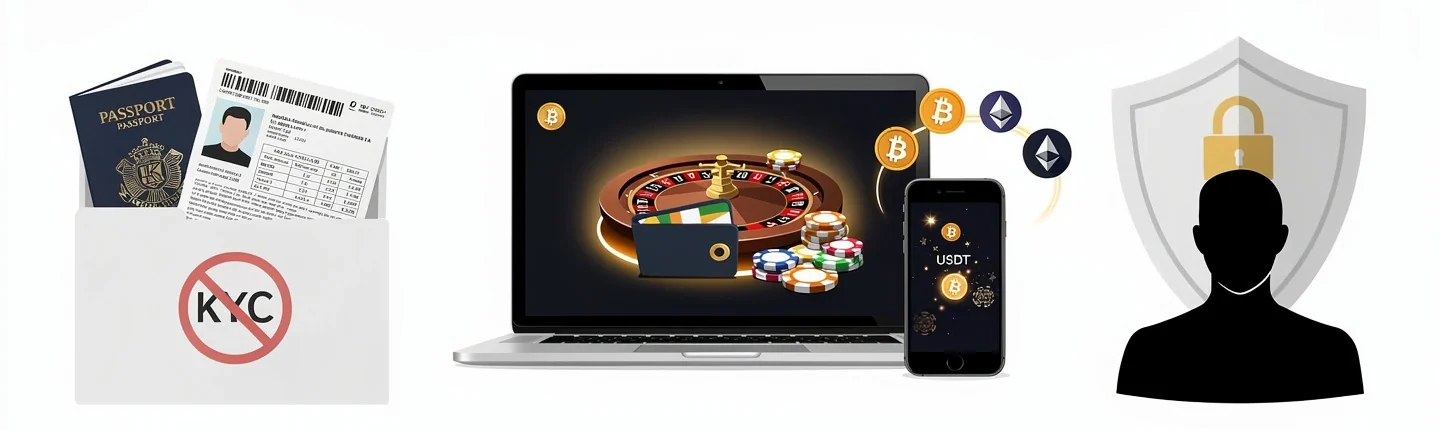
The term is used loosely. When a site says “no verification”, it can mean one of three things. It may never ask for documents under normal use. It may ask only when certain triggers appear, such as a large withdrawal. Or it may simply have a weak process that is not enforced yet. Reading the terms and conditions is the only way to know which one you are dealing with.
The usual features of a no KYC casino are:
- Fast registration: an email, a username or a wallet connection is enough to start.
- Crypto payments: Bitcoin, Ethereum, USDT, Litecoin and other coins are the main way to pay.
- Quick withdrawals: payouts are often sent within minutes once the wallet is confirmed.
- Offshore license or none: most operate under a Curaçao, Anjouan or similar license, and some under no license at all.
- Higher privacy: you share less personal data, so there is less to leak if the operator is breached.
How no KYC casinos actually work
The business model rests on crypto. When you deposit Bitcoin or USDT, the casino does not need a bank or a card network to move the money, and that removes the part of the process that normally forces identity checks. The casino sees a wallet address, a deposit amount and a transaction ID. It can pay winnings back to the same address.
Account creation is also lighter. Instead of a full form with name, date of birth and address, you often get a one-click sign up. Some sites let you play as a guest with a wallet connection. The casino assigns you an internal balance and tracks your play by account ID or wallet.
What the technology does and does not hide
Crypto is not the same as anonymous. Bitcoin and Ethereum transactions sit on a public blockchain, and anyone can follow them from your wallet to the casino and back. If your wallet was ever linked to an exchange where you passed verification, the trail leads to your name. Blockchain analysis firms do this work for a living, and casinos, exchanges and authorities can use the same tools.
So a no KYC casino hides your documents from the casino, not your transactions from the world. If privacy is your main goal, that difference matters, and it is covered in the section on privacy coins below.
The three levels of anonymity
Not every site that says no KYC works the same way. In practice there are three levels, and the table below shows how they differ.
| Level | What you give | When documents are asked | Typical sites |
|---|---|---|---|
| Full KYC | ID, address proof and payment proof before play or before first withdrawal | Always | UK, Swedish, German and other regulated casinos |
| Soft KYC | Email and basic details at sign up | Only when a limit or a trigger is reached | Most crypto casinos |
| No KYC | Email, username or wallet only | Rarely, usually only if a legal order or fraud flag appears | A smaller group of crypto and Web3 sites |
Full KYC is the standard in regulated markets. Soft KYC is where most so-called no KYC casinos really sit: you can play and withdraw within set limits, and the casino asks for more once you go beyond them. True no KYC is rare, and it comes with more risk because the operator answers to nobody in particular.
What soft KYC checks mean
The phrase soft KYC is used in two ways, and it is worth knowing both. On some sites it means light checks, such as confirming an email, a phone number or a wallet. On others it means a document check that is only requested later, after you hit a withdrawal limit or a bonus is claimed. Always read which of the two a casino means before you deposit.
Best no KYC casinos right now
The names below come up again and again in player discussions and in reviews of crypto casinos. They are listed as examples of what is currently available, not as a guarantee. Terms, limits and available countries change often, so check each site’s current rules before you register.
- BC.Game: a large crypto casino with a wide game library, its own originals and many supported coins. Verification is requested only in certain cases.
- Vave: casino and sportsbook under one account, with fast crypto payments and a lighter sign up.
- Wild.io: slots, live tables and originals, with crypto-first banking.
- CoinCasino: a crypto casino with a broad slot selection and live dealer games.
- BetPanda: a crypto casino focused on quick payouts and simple registration.
- Cryptorino: a crypto-only site with slots, table games and sports betting.
- TG.Casino: a Telegram-based casino where you can play inside the messaging app.
Short notes on the first three
BC.Game is one of the best known names in the group. It offers thousands of slots, live tables, sports betting and house games such as crash and dice that can be checked with provably fair tools. It supports a long list of coins. The account is easy to open, but like most big crypto sites it can ask for documents if a withdrawal or an account activity looks unusual.
Vave puts a sportsbook next to the casino, which suits players who bet on both. Registration is light and crypto deposits are credited quickly. Because it targets many countries, check whether your location is allowed before you deposit, since restricted regions are one of the most common reasons for a blocked withdrawal.
Wild.io is built around crypto banking and includes slots, live games and its own originals. As with the others, read the bonus terms closely, because wagering rules and maximum bet limits decide whether an offer is worth taking.
How to start at a no KYC casino step by step
The process is short, but the order matters. Doing the checks first costs a few minutes and can save you a frozen balance later.
- Check the license and the company name. Find them in the footer and confirm them in the regulator’s register.
- Read the terms on verification and withdrawals. Look for the section that says when the casino can ask for documents and what the withdrawal limits are.
- Confirm your country is allowed. Most casinos list restricted countries in the terms.
- Create the account. Use a strong, unique password and turn on two-factor authentication if it is offered.
- Make a small test deposit. Send a small amount in the coin you plan to use, on the network the casino shows.
- Test a small withdrawal. Cash out a small amount first to see how fast and how smooth the payout is.
- Only then raise your stakes. If the test went well, deposit what you planned, and keep within the budget you set.
When a no KYC casino still asks for ID
This is the part that surprises players most. A casino can advertise no KYC and still ask for documents later. It is usually not a trick. Most of these sites reserve the right in their terms to check identity whenever they see a reason to, and they treat it as a legal safeguard.
Common triggers
- Large withdrawals: a payout above the site’s threshold often starts a review.
- Mismatched wallet: withdrawing to a wallet that differs from the one used for deposits can raise a flag.
- Unusual activity: sudden jumps in stake size, odd bonus use or patterns that look like fraud.
- Multiple accounts: signs that one person is using more than one account.
- Restricted location: a player from a country the casino does not accept.
- Legal or payment partner request: a regulator, bank or payment processor asks for it.
Documents that may be requested
If the casino does ask, the usual set is a government photo ID such as a passport or driving license, proof of address dated within the last three months, and sometimes proof of the payment method or wallet ownership. Some sites also ask for a selfie holding the ID. Provide only what is requested, and send it through the secure upload in your account rather than by email.
Tiered KYC
Many crypto casinos use tiers. At the lowest tier you can deposit and withdraw small amounts with no documents. A higher tier raises the limits after you submit ID. The highest tier, if there is one, may require proof of funds. Reading the limit table before you deposit tells you where you stand, and it avoids the unpleasant surprise of a frozen withdrawal after a big win.
Why casinos require KYC
It helps to understand why the rule exists, because it explains why even a no KYC casino cannot ignore it forever. Regulated operators have to follow anti-money laundering rules. They must confirm that players are adults, that the money is not linked to crime and that people are not hiding behind fake names. Our guide to casino KYC verification goes through the full process step by step, including what is checked and how long it takes.
Casinos also use KYC to protect players. Age checks keep minors out, and identity checks block someone else from withdrawing your winnings if your account is hacked. When a casino skips this step, you gain speed and privacy, and you lose some of that protection.
Licensing and what the license in the footer means
Almost every no KYC casino shows a license number at the bottom of the page. That number is only worth something if you can find it in the regulator’s own register. The most common licenses in this group are Curaçao, Anjouan, Costa Rica and, less often, Kahnawake or Malta. A Curaçao license is by far the most common, and the rules around it have changed in recent years, which is explained in our article on the Curaçao gambling license.

Be careful with one point. An offshore license lets a site operate under that jurisdiction’s law. It does not give the casino permission to accept players from every country. In markets such as the United Kingdom, Germany, Sweden, Ontario and most US states, gambling operators need a local license, and a Curaçao license does not replace it. Playing at a site without the right license can leave you with no legal route to recover your money in a dispute.
How to check a license register
Open the regulator’s official site, search for the license number or the operator name and compare the company name, the domain and the status with what the casino shows. If the number does not exist, if it belongs to another company or if the status is suspended, treat the site as unlicensed. A badge image in the footer proves nothing on its own.
Licensed alternatives with fast verification
If your main complaint with KYC is the waiting time, there are options that do not require a no KYC casino. Pay N Play sites use bank ID to confirm who you are during the deposit, so the check is done in seconds. Some licensed casinos also let you verify before your first withdrawal and process documents within a few minutes. Different license types cover different rules, and our overview of casino license types shows how they compare.
Which cryptocurrencies work
Most no KYC casinos accept a long list of coins, but a few are used far more than the rest. The table below shows what players commonly see. Exact minimums vary by site, so treat the figures as a rough guide.
| Coin | Typical confirmation time | Typical minimum deposit | Notes |
|---|---|---|---|
| Bitcoin (BTC) | 10 to 60 minutes | About 10 to 20 USD equivalent | Most widely accepted, higher network fees at busy times |
| Ethereum (ETH) | 1 to 5 minutes | About 10 to 20 USD equivalent | Fees can rise when the network is busy |
| Tether (USDT) | 1 to 5 minutes, depending on network | About 10 to 20 USD equivalent | Stable value, so no price swings during play |
| Litecoin (LTC) | 2 to 10 minutes | About 5 to 10 USD equivalent | Low fees, popular for small deposits |
| Solana (SOL) | Under 1 minute | About 5 to 10 USD equivalent | Very fast, low fees |
Stablecoins like USDT are popular because the balance does not move with the market. If you deposit Bitcoin and the price drops before you cash out, your winnings in dollar terms shrink. If the price rises, they grow. Some players find that swing exciting and others do not want it, so choose the coin with that in mind. For a wider look at coins and sites, see our list of the best crypto and Bitcoin casinos.
Lightning Network
Some casinos support Bitcoin over the Lightning Network, which settles in seconds and charges very small fees. It is useful for small deposits and fast withdrawals. Make sure the casino lists Lightning clearly and that your wallet supports it, because sending a normal Bitcoin payment to a Lightning invoice will not work.
Privacy coins
Monero and Zcash are designed to hide sender, receiver and amount. A few casinos accept them, and that is the closest match to real anonymity. They are also restricted on many exchanges, so buying and selling them can be harder. If you use a privacy coin to hide your trail and then cash out through a verified exchange, the benefit shrinks.
Deposits, withdrawals and fees
Depositing is simple. You pick a coin, copy the casino’s address or scan the QR code, send the amount and wait for the required confirmations. Always check the network before you send. Sending USDT on the wrong network, for example, can lose the funds for good.
Withdrawals are where most of the speed advantage shows. Many no KYC casinos process a payout in a few minutes once the request is approved, and the transaction arrives after the network confirms it. Delays happen when a withdrawal passes a threshold, when the account is flagged or when the casino runs a manual review. For a clearer picture of what to expect, read our guide on casino withdrawal times.
Fees come from two places: the network and, on some sites, the casino. Network fees depend on the coin and how busy the chain is. Casinos usually do not charge for deposits, but some set a minimum withdrawal or take a small fee. If you are unsure how to cash out step by step, the withdrawal section of your account shows each step and the limits that apply.
Account and wallet security
Because there is little identity data, your account is protected mainly by your own habits. If someone gets into it, there is usually no document check that would stop a withdrawal. A few rules help:
- Use two-factor authentication on the casino account and on the exchange or wallet you use.
- Use a unique password that you do not use anywhere else, ideally stored in a password manager.
- Withdraw to a wallet you control. Sending winnings to your own wallet is safer than leaving a large balance at the casino.
- Do not leave big balances on the site. Treat the casino like a table, not a bank.
- Double check addresses. Copy and paste carefully and compare the first and last characters, because malware can swap clipboard addresses.
- Never share your seed phrase or private key with anyone, including support agents.
Provably fair games
Many crypto casinos offer provably fair games such as dice, crash, plinko and mines. These let you check that a result was not changed after you placed the bet. The system uses cryptography, and it works in four parts:
- Server seed: a secret value created by the casino. A hash of it is shown to you before you play.
- Client seed: a value you can set or change yourself.
- Nonce: a counter that increases with each bet.
- Hash: usually SHA-256, which turns the seeds into a result that cannot be guessed ahead of time.
After you finish, the casino reveals the server seed. You can run the numbers yourself or use a public verifier to confirm that the hash matches. This proves that the outcome was fixed before your bet. It does not tell you anything about the house edge, the payout rules or whether the casino will pay you, so provably fair is a useful feature and not a safety guarantee.
No KYC casino bonuses and wagering terms
Bonuses are common at crypto casinos: deposit matches, free spins, rakeback and cashback. The offer matters less than the terms attached to it. The most important number is the wagering requirement, which tells you how much you must bet before you can withdraw bonus winnings.
For example, a 50 EUR bonus with 10x wagering means you have to place bets worth 500 EUR before the bonus funds count as withdrawable. If the requirement is 40x, the same bonus needs 2,000 EUR in bets. Our guide to wagering requirements shows how to calculate this and which games count toward it.
| Term | What to look for | Why it matters |
|---|---|---|
| Wagering | Lower multiplier, applied to bonus only or bonus plus deposit | Decides how hard it is to cash out |
| Maximum bet | The highest stake allowed while the bonus is active | Breaking it can void your winnings |
| Game weighting | Share of each bet that counts, often lower for table games | Slots usually count 100 percent, others less |
| Maximum cashout | A cap on winnings from the bonus | Limits how much you can withdraw |
| Expiry | Days to complete wagering | Unused bonus is removed after the deadline |
| Verification clause | Whether the bonus can trigger a KYC check | Bonuses are a common reason for document requests |
Take note of the last row. Many no KYC casinos tie bonus withdrawals to a document check, even when normal play does not need one. If you want to stay at the lowest level of verification, a plain deposit without a bonus is often the simplest route. To compare the kinds of offers you may meet, see our overview of casino bonus types.
Games at no KYC casinos
The game selection is similar to any large online casino. Slots make up the bulk of it, with thousands of titles from the big studios. Live dealer tables cover blackjack, roulette, baccarat and game shows. Many sites add their own originals, such as crash, dice, mines and plinko, which are fast and use provably fair checks. Most also include a sportsbook and some include esports betting.
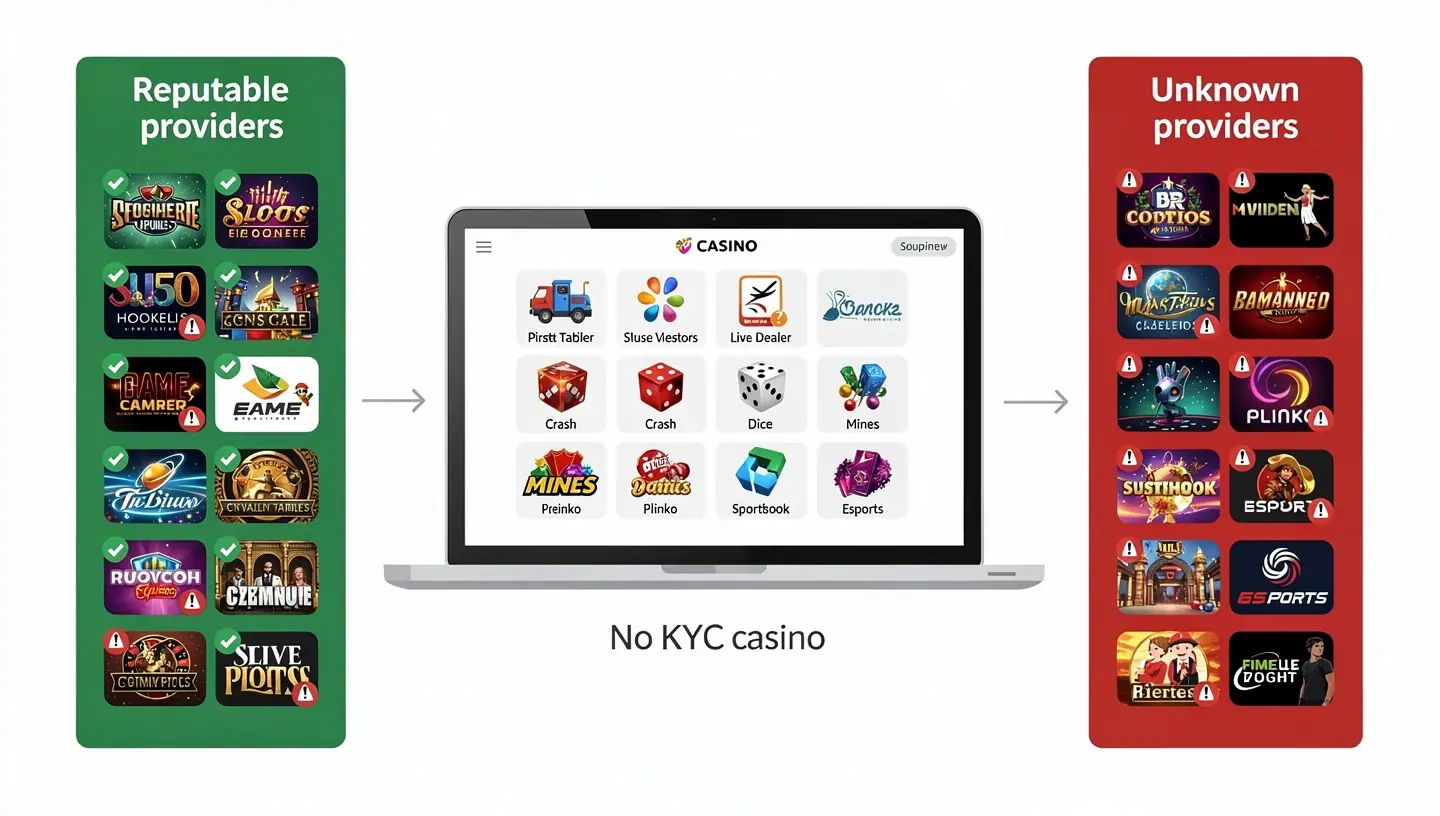
One thing to watch is the provider list. Reputable studios publish their games through licensed partners, and a casino that carries them is a better sign than one with only unknown names. If a site lists major providers but the games look odd or load from unfamiliar domains, that is worth questioning.
Sports betting, esports and poker
Many no KYC casinos also run a sportsbook with football, basketball, tennis and esports markets, often with live betting and crypto-only odds. The same rules about triggers and limits apply there. Poker is rarer, because it needs a player pool, and the sites that offer it usually run through a separate network. If you plan to bet on sports, check the maximum payout per bet and per day, since caps are common.
Mobile and Telegram play
Most no KYC casinos work in a mobile browser without an app, and some offer an app for Android. A growing group runs inside Telegram, where you play through a bot or a mini app and fund the balance with crypto. This is convenient, but it also means your account is tied to your Telegram profile, so secure that account with two-factor authentication as well.
Pros and cons of no KYC casinos
| Pros | Cons |
|---|---|
| Sign up in a minute with little personal data | Documents can still be requested later |
| Fast crypto deposits and withdrawals | Weaker consumer protection if something goes wrong |
| Fewer personal details stored, so less to leak | Offshore license that may not cover your country |
| Wide choice of coins and games | Crypto transactions cannot be reversed |
| Often high limits for deposits and bets | Fewer responsible gambling tools on some sites |
No KYC casinos vs traditional casinos
| Feature | No KYC casino | Traditional licensed casino |
|---|---|---|
| Sign up | Email or wallet, a few minutes | Full form, then ID upload |
| Payment methods | Mostly crypto | Cards, bank transfer, e-wallets, sometimes crypto |
| Withdrawal speed | Minutes to a few hours | Hours to several days |
| License | Offshore, sometimes none | Local regulator such as UKGC, MGA or others |
| Dispute help | Limited, depends on the operator | Regulator or approved dispute service |
| Reversibility | Crypto payments cannot be reversed | Card chargebacks and bank disputes may be possible |
| Player tools | Varies widely | Mandatory limits, self exclusion and checks |
If you are curious about a different model that does not take real money bets at all, see how sweepstakes casinos work. They are another way to play without a full deposit-and-withdraw cycle, although the rules are quite different.
Are no KYC casinos legal and safe
The answer depends on where you live and which site you pick. In many countries, the player is not breaking the law by using an offshore site, but the operator may be, if it accepts customers without the right local license. In others, online gambling with unlicensed operators is restricted or banned. Check your own rules before you play, and do not assume that because a site accepts you, it is legal for you.
Safety is a separate question. Some no KYC casinos have operated for years and pay winners on time. Others disappear with deposits. The fact that a site skips KYC says nothing about its honesty, so you need to judge it by other signs: a verifiable license, a clear company name, readable terms, a record of paying out and real support.
Web3 casinos vs licensed offshore casinos
Decentralized Web3 casinos run on smart contracts, and you play with your own wallet without creating an account. Outcomes and payouts are handled by code. That removes the operator from the payout step, but it adds a different risk: a bug or an exploit in the contract can lose funds, and there is nobody to complain to. Licensed offshore casinos, by comparison, are ordinary companies with a license, a support team and terms, and a withdrawal may still ask for documents. Neither type is risk free.
Where no KYC casinos accept players
Availability depends on the operator’s license and its own list of restricted countries. In practice, the situation looks like this:
| Region | Typical situation |
|---|---|
| United States | Online casino gambling is limited to licensed states, and offshore sites often block US players or operate in a legal gray zone |
| United Kingdom | Operators serving UK players must hold a UK Gambling Commission license, which requires full verification |
| Canada | Ontario has its own regulated market, and other provinces are treated differently |
| European Union | Rules vary by country, and some, like Germany and Sweden, have strict local licensing |
| Rest of the world | Many offshore sites accept players, subject to each casino’s own restricted list |
Using a VPN to get around a country block is a bad idea. It breaks the terms of almost every casino, and a site that finds it can confiscate your balance and refuse to pay out.
Taxes on winnings
No KYC does not mean no tax. In most countries gambling winnings are reportable or taxable, and crypto adds a second layer, since a coin that rises in value between deposit and withdrawal can create a taxable gain. In the United States, the IRS treats gambling income as taxable, and the details are in IRS Topic 419. Rules differ by country, so check your own tax authority or ask an accountant.
Red flags to avoid
These are the signs that should make you stop before you deposit:
- License you cannot verify: the number is missing from the regulator’s register or belongs to another company.
- Rules that change after a win: new limits, new wagering or sudden document demands that were not in the original terms.
- Seed phrase requests: no real casino ever asks for your wallet seed phrase or private key.
- Cloned domains: a website with a name that is nearly identical to a known brand.
- Pressure to deposit: countdown timers, “last chance” messages or support agents pushing you to add more.
- No company details: no operator name, no address and no way to contact anyone but a chat box.
Before you register, run a short check: find the license, search for the operator’s name next to words like scam or withdrawal problems, read the terms on bonuses and withdrawals and try a small deposit and a small withdrawal first. Our step-by-step guide on how to verify a casino license shows exactly where to look.
Who no KYC casinos suit
| Player type | Is a no KYC casino a good fit | Why |
|---|---|---|
| Privacy-minded player | Possibly | Less personal data shared, but the blockchain trail remains |
| Crypto holder who wants fast cashouts | Often | Payouts in minutes with the right coin |
| Beginner with a small budget | Caution | Fewer protections and limited help if something goes wrong |
| Player in a regulated market | No | Local rules and licenses usually apply |
| Player who wants consumer protection | No | A licensed local casino offers a regulator and a dispute route |
Responsible gambling at no KYC casinos
Fast deposits and no document checks make it easy to play more than you planned. Regulated casinos have to offer deposit limits, time reminders and self exclusion. At many no KYC casinos these tools are limited or missing, which means you need to set your own rules. Our guide to responsible gambling limits explains how to set a budget and stick to it.
Decide how much you can lose before you start, never chase losses and keep gambling money separate from living costs. Remember that crypto deposits cannot be pulled back once you send them. If gambling stops being fun or starts to cause problems, free confidential help is available from the National Council on Problem Gambling.
FAQ
Are no KYC casinos really anonymous?
Not completely. The casino may not know your name, but crypto transactions are recorded on a public blockchain, and a wallet that was ever linked to a verified exchange can be traced. Privacy coins offer more protection, but few sites accept them.
Will a no KYC casino ever ask for ID?
Yes, it can. Most sites reserve the right to request documents when you make a large withdrawal, use a different wallet, claim a bonus, show unusual activity or play from a restricted country. Read the terms to see what triggers a check.
Are no KYC casinos legal?
It depends on your country. Many players use offshore sites where the law does not punish the player, but the operator may not be allowed to accept customers from your country. Check local rules before you play.
What is the difference between no KYC and no account casinos?
A no KYC casino still creates an account for you, usually with an email or a username, and it only skips identity documents. A no account casino lets you play by connecting a wallet directly, without any sign up, and is common in the Web3 space.
Which crypto is best for a no KYC casino?
It depends on what you want. USDT keeps your balance stable, Litecoin and Solana have low fees and fast confirmations, Bitcoin is the most widely accepted and Monero gives the most privacy where it is supported. Always check the network before you send.
Are no KYC casinos safe?
Some are and some are not. The lack of KYC does not tell you whether a site is honest. Look for a license that you can verify, clear terms, a record of paying out and working support, and test with a small deposit first.
Do I have to pay tax on winnings from a no KYC casino?
In most countries, yes. Gambling winnings are often taxable, and crypto price changes can add a taxable gain. Rules differ by country, so check your tax authority or ask a professional.
How can I get verified quickly at a licensed casino?
Upload clear photos of your ID and a recent proof of address as soon as you register, make sure the name matches your payment method and use the same details everywhere. Some licensed casinos also support bank ID, which confirms your identity in seconds.
Is there a no KYC casino with a no deposit bonus?
Some sites offer small free spins or a free bet for new players, but they come with wagering and withdrawal caps, and a bonus withdrawal is one of the most common triggers for a document request. Read the terms before you claim one.
Do no KYC casinos have withdrawal limits?
Yes. Most set daily, weekly or monthly limits, and the lower tiers apply while you are unverified. Going above them usually needs documents, so check the limit table in the terms before you deposit.
Can I use a VPN at a no KYC casino?
It is a risk. Using a VPN to hide your country breaks the terms at most casinos and can lead to a frozen account and lost winnings. Play only from a country the casino accepts.